Will Mariners See Return of Big Thunder? Four 2026 Luke Raley Scenarios

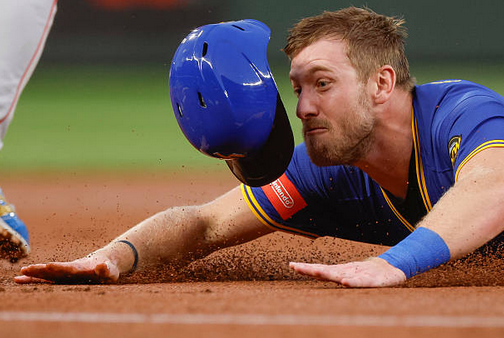
Luke Raley was a serious force in 2024, with a .243/.320/.463 slash line (batting average/on-base percentage/slugging percentage) in 455 plate appearances, a 119 OPS+ where 100 is league average, 22 home runs, 19 doubles, two triples, 58 RBIs, and even 11 stolen bases. He had 3.2 Baseball-Reference wins above replacement (bWAR or rWAR) and 2.3 FanGraphs wins above replacement (fWAR), both really strong for someone who was quite platoon-limited.
Indeed, southpaws were an Achilles’ heel for the left-handed Raley, even in a good season. Although he slashed .255/.333/.497 against right-handers, his .189/.259/.311 line against lefties meant that he only saw 82 plate appearances in lefty-on-lefty situations. Still, as long as he was mashing righties, any club would be perfectly happy to keep him in a platoon.
But 2025 didn’t see the production he and the Mariners were looking for. He never found his power stroke early on, with a .206/.345/.324 line through April 27, and then a strain in his right oblique sent him to the injured list until late June. He began to put things together a little bit in the following pair of weeks, but he was again struggling after the All-Star Break, went out again with back spasms, and became all but a non-factor from then until the season’s heartbreaking Toronto finale. His .202/.319/.311 slash line and 85 OPS+ at the end of the year turned him from a vital role player into a forgotten bench-warmer.
Swing mechanics offer insight into what went on with Raley. During his 2024 season - which, remember, was in the upper echelons of platoon hitters - he was keeping his back straight at the onset of his swing. Not hyperextended, but in a solid, natural position that allowed him to effectively transfer force to the ball. This stance was also comfortable and instinctual, with his hands naturally drifting off his body and his back slightly rounding as he loaded his swing. This is what his swing looked like with no discomfort in his back.
During Raley’s April slump in 2025, however, his initial stance was holding a bit more upper back rounding. Then, as he would go into the load of his swing, he seemed to consciously try to straighten himself by retracting his upper back, which can be seen by how he kept his hands tighter to his chest. This uncomfortable, forced position was probably a big driver of his early struggles.
Raley returned to his natural, comfortable swing position once he came off the injured list - but not for long. By late July, he was again struggling to settle his back, and his second (very much back-related) absence came not long after. Despite seeming to fix his swing mechanics by the playoffs, he had never gotten into a groove, and he went 0-5 with a hit by pitch in six October plate appearances.
On defense, there wasn’t much change from year-to-year. Raley is still a solid outfielder overall, with somewhat slow jumps made up for by his good speed and aggressiveness with both glove and arm. He’s better in the field than Dominic Canzone in right or Randy Arozarena in left, so if he can bring his hitting back to where it was in 2024, he’ll find his way into a fair amount of playing time. But will he?
Believe it or not, there was one positive indication from his 2025: his walk rate. Between 2023 and 2024, it had averaged 6.4%, but in 2025, he walked 8.7% of the time. You might be thinking that his discomfort and lack of groove led to less overall swings in 2025, but no, Raley actually swung slightly more often in 2025 than he did in 2024. The improvement in walks wasn’t nearly enough to make up for the rest of his struggles in 2025, but it offers a potential increase in his ceiling going into 2026.
Age, however, is working the other way. 2026 will be Raley’s age-31 season, and although he isn’t quite yet at the truly nasty part of the aging curve, it does mean that injury recovery will be harder. His bat speed, which was in the above-plus range in 2023 and 2024, dropped 1.2 miles per hour on average, leading to slight drops in hit quality.
These weren’t catastrophic drops on their own, but Raley also began chopping weak grounders to his pull side as a full third of all his batted balls - the highest rate of anyone in baseball with more than 200 plate appearances. His 27.1% ground ball pull rate in 2024 was already 16th highest in baseball, but he reached a level in 2025 only matched in the StatCast era by 2023 Rodolfo Castro [1].
And where 16.8% of Raley’s batted balls were pulled in the air in 2024 - slightly below league average - that figure dropped to 13.8% in 2025. Raley’s at his best when he produces lots of extra bases, and that’s not going to happen unless his pulled hits go into the air.
With all that in mind, I’ve produced four rough scenarios for how Raley’s 2026 season might shake out, and each one would have quite different implications for how the Mariners use him. They say never to tell someone the odds, but I’ve flouted that sage advice [2] and given my own guesstimates as to how likely each of these paths forward might be.
Scenario 1: Raley all but remains in the pit, with 2026 looking a lot like the end of 2025.
Guesstimated likelihood: 15%.
Scenario slash line: somewhere around .185/.260/.300.
The worst-case scenario for Raley is that nothing ends up fully operational in 2026. This is his absolute floor, and there’s not really much to be said about it. Raley wouldn’t be in T-Mobile Park for very long if his line looks like this after a couple of months, especially if he doesn’t show improvements in process during spring training.
I wouldn’t expect something along these lines without some sort of nagging injuries a la 2025, which make up around two-thirds of my projected likelihood. Put another way: such a fall-off by itself has about a 5% likelihood, while an injury-incited decline has about a 10% chance of happening.
Scenario 2: Raley bounces back somewhat, but not enough to become much more than a bench bat.
Guesstimated likelihood: 45%.
Scenario slash line: somewhere around .220/.320/.380.
A Luke Raley with an OPS of around .700 against right-handers wouldn’t retake a starting role, but he would be very much available off the bench as a real option in crunch time. He would have to adjust to the lack of regular playing time (though he would get the occasional start here and there), but there would be situations - such as those Seattle had in the postseason - where the M’s need someone to pinch-hit against a righty reliever and try [3] to produce something.
The reason I rate this as likely as I do is that, barring injuries in the outfield, Raley might only have one real month of chance in April to prove himself as one half of a platoon with Víctor Robles in right. If he slumps in that time, the Mariners might not give him much more benefit of the doubt.
Scenario 3: Raley roughly returns to the player he was in 2024 and makes a place for himself on the starting roster when there’s a righty on the mound.
Guesstimated likelihood: 35%.
Scenario slash line: somewhere around .235/.335/.455.
When Seattle opted to tender a contract to Raley during the offseason, the team signalled that they believe a bounceback is possible. While such a return to form obviously cannot be guaranteed, the injury-originated essence of his issues in 2025 give good reason to believe in him for 2026. There are clear limits to his profile - especially against lefties - but the M’s have found a niche for him before, and that niche still exists to be taken.
There are keys to look for that will probably come in spring training or April, but a May breakout could also happen under favorable circumstances. If Raley’s stance looks comfortable in spring and he begins getting into a groove day-in and day-out, he will buy himself more time to produce in the regular season and will have something of a running start to use for a potential early bounceback.
Scenario 4: Raley has the best season of his career.
Guesstimated likelihood: 5%.
Scenario slash line: somewhere around .250/.360/.510.
Generally speaking, an MLB ballplayer doesn’t radically outperform everything he’s ever done when he’s 31 - but it does happen. Take newfound Mariner Rob Refsnyder, who became a vaunted lefty-masher in his age-31 season with the 2022 Red Sox, or Yandy Díaz’ five-win season with the 2023 Rays at 31 years old.
Cementing himself on the starting roster would be a prerequisite. If he’s the third or fourth man in right field depth by June, don’t expect a four- or five-win season to give a “hello there!” at the All-Star Break. Early signs of a career year, however, might be a walk rate that continues its upward path alongside a pull air rate in the 20-25% range. Unless he finds a way to sustain improvement when there’s a southpaw on the mound, there’s still that hard platoon cap on his production, but an OPS exceeding .850 for around 400 plate appearances would still be utterly invaluable for Seattle and turn a potential positional weakness in right into a breakout strength in SoDo.
[1] 2018 Alex Avila and 2024 Jason Heyward came within a percentage point, but only Castro’s 2023 (35.7%) exceeded the one-third milestone.
[2] Harrison Ford is no longer on the Mariners.
[3] Yoda was never on the Mariners.