Mariners’ King from Kingston: What Made Matt Brash So Special in 2025?

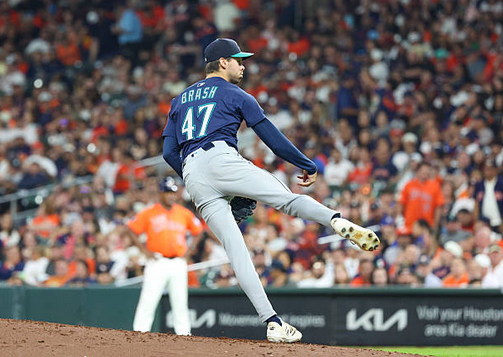
60% of the time, it works … every time. Matt Brash might as well have said that with the way he pitched in 2025, throwing one of the farthest-breaking sliders in baseball as often as he did (if you must know, the exact figure is that Brash threw his slider 60.6% of the time).
Some things in baseball speak for themselves; examples include the 2.47 ERA and .652 opposing OPS that Matt Brash had over his 42 ⅓ innings in 2025. He missed the entirety of 2024 after needing Tommy John surgery, but like many in the modern era, the man from Kingston, Ontario came back seeming fresher than ever before.
There’s a lot that impresses the viewer when looking at Brash’s slider. After all, there’s a reason it’s one of the more iconic sliders seen in T-Mobile Park over the 2020s. It broke an average of 15.8 inches to his gloveside in 2025, more than three and a half times the break of the average traditional slider and about 15% more than the league average sweeper - remember, a sweeper sacrifices velocity so that it has more horizontal break than a slider - with a speed of 86 miles an hour on average, only a slight bit slower than the league average slider.
Even that 15.8-inch figure, however, is deceptively small. The thing that makes sliders effective isn’t necessarily their gloveside break in the absolute (measured against a theoretical pitch of the same velocity with no spin and no wind) but how it differs from the other items in a pitcher’s arsenal. Brash’s second and third most common pitches are his sinker and changeup, which had an average armside run of 17.5 inches and 14.5 inches, respectively, in 2025. That’s an average difference of 33.3 inches between his slider and sinker and 30.3 inches between his slider and changeup - and that’s just looking at the horizontal axis!
Taking into account each pitch’s average induced vertical break (IVB [1]) [2], the average absolute distance in spin-induced movement between Brash’s slider and changeup was 30.4 inches; between his slider and sinker, it was 34.4 inches.
Brash’s elite pitch mix helped him time and time again in 2025, as he recorded a strikeout 29.1% of the time and batters had a 30.9% whiff rate while chasing 31.7% of his pitches out of the zone, all well better than average for MLB pitchers. With all that in mind, his big time numbers in 2025 were hardly surprising.
But it’s not just the break that turned Brash into a monster for batters around the league.
An underappreciated (for now) trend in pitching is that teams - very much including the Mariners - are starting to give more value to ground ball pitchers. This is doubly true of Seattle, who is expecting a young crop of strong defenders to fill the infield over the coming seasons, and their addition of Jose A. Ferrer says as much.
Brash’s physics-flouting slider might be the thing that’s most famous about his profile, but his 56.2% ground ball rate would be about 95th percentile if it qualified. You might expect that his sinker does much of the heavy lifting in this regard, but in fact, there wasn’t much difference between the grounder rate on his sinker (55.9%) or slider (53%), and it was actually his changeup (71.4%) that outclassed both his other pitches in 2025 ground ball rate. Each of his three pitches had a knack for consistently hitting the underside of bats.
Even more encouraging for Seattle, Brash’s stalwart season came in spite of a decent amount of bad luck. Batters had a .327 batting average on balls in play (BABIP) against him, well above the .291 MLB average, and although BABIP is a little more predictive for pitchers than for hitters, it was still high enough to let us know that the league probably had more than its fair share of good breaks against Brash. StatCast’s expected metrics point in the same direction, as hitters’ actual .236/.313/.339 slash line (batting average/on-base percentage/slugging percentage) against him was a bit higher than the expected .225/.304/.330 line StatCast gave him. This was even more pronounced on ground balls, where the difference in actual stats (.266 OBP [3] and .281 SLG) versus expected (.235 xOBP and .263 xSLG) was quite notable.
Despite all that is stellar about Brash’s profile, there is still a clear area where Seattle would like to see an improvement: his control. Some control issues will come with the profile for a guy with lots of movement; when he has bad feel on any given outing, it can become relatively [4] obvious which pitches are going off the plate.
This is especially true of Brash’s changeup. Even when he had clear command of his sinker and slider in 2025, it wasn’t always a given that he would be able to put his changeup where he wanted it. Brash without the changeup is a great pitcher - but Brash with his changeup is an unhittable one. This didn’t necessarily show up in pitch-by-pitch walk rates, but that was due to selection bias, as Brash seldom threw his changeup when he was behind in the count.
Brash issued a free pass 9% of the time in 2025, which would have been 32nd percentile had he been among qualified pitchers. The good news is that he has been slowly lowering that walk rate over the years, but it’s still something to tweak going forward.
Still, the M’s will be more than happy if Brash basically runs back 2025, even if his ERA ends up a little bit higher; after all, he is already an elite reliever with high-leverage pedigree and a particular set of skills that indicates he should be able to weather the fluctuations that plague many lesser bullpen arms. Indeed, he is already clearly capable of truly ridiculous stretches of form, such as his 19 straight appearances without giving up a run to open his 2025 campaign.
I can make one of the safer predictions in my career here: Matt Brash will, barring injury, be a core piece of the Mariners bullpen. In other news, grass is green.
[1] As opposed to total vertical drop; all pitches drop vertically from the pitcher’s hand due to gravity (duh), but the spin of a pitch can affect that drop. IVB can help measure what the batter actually views, since our brains naturally account for gravity as we intuitively predict ball flight. That’s why really flat fastballs (like Bryan Woo’s) appear to rise, they defy gravity enough to trick the hitter’s brain.
[2] In 2025, Brash’s sinker had an average IVB of 7.8 inches upwards; his slider, 0.9 inches downwards; and his changeup, 3.4 inches downwards.
[3] This can also be read as batting average, since batting average and on-base percentage on ground balls will be the same.
[4] The word “relatively” is doing some heavy lifting. This pitch to Victor Caratini ended up a mile inside and yet almost garnered a swinging strike one. Caratini ended up walking, though Seattle ended up winning.