‘I Wanted to Be That Guy to Paint the Pictures,’ Entering Last Year as Mariners Announcer, Rick Rizzs Reflects on Broadcasting Career

[caption id="" align="alignnone" width="3600"]
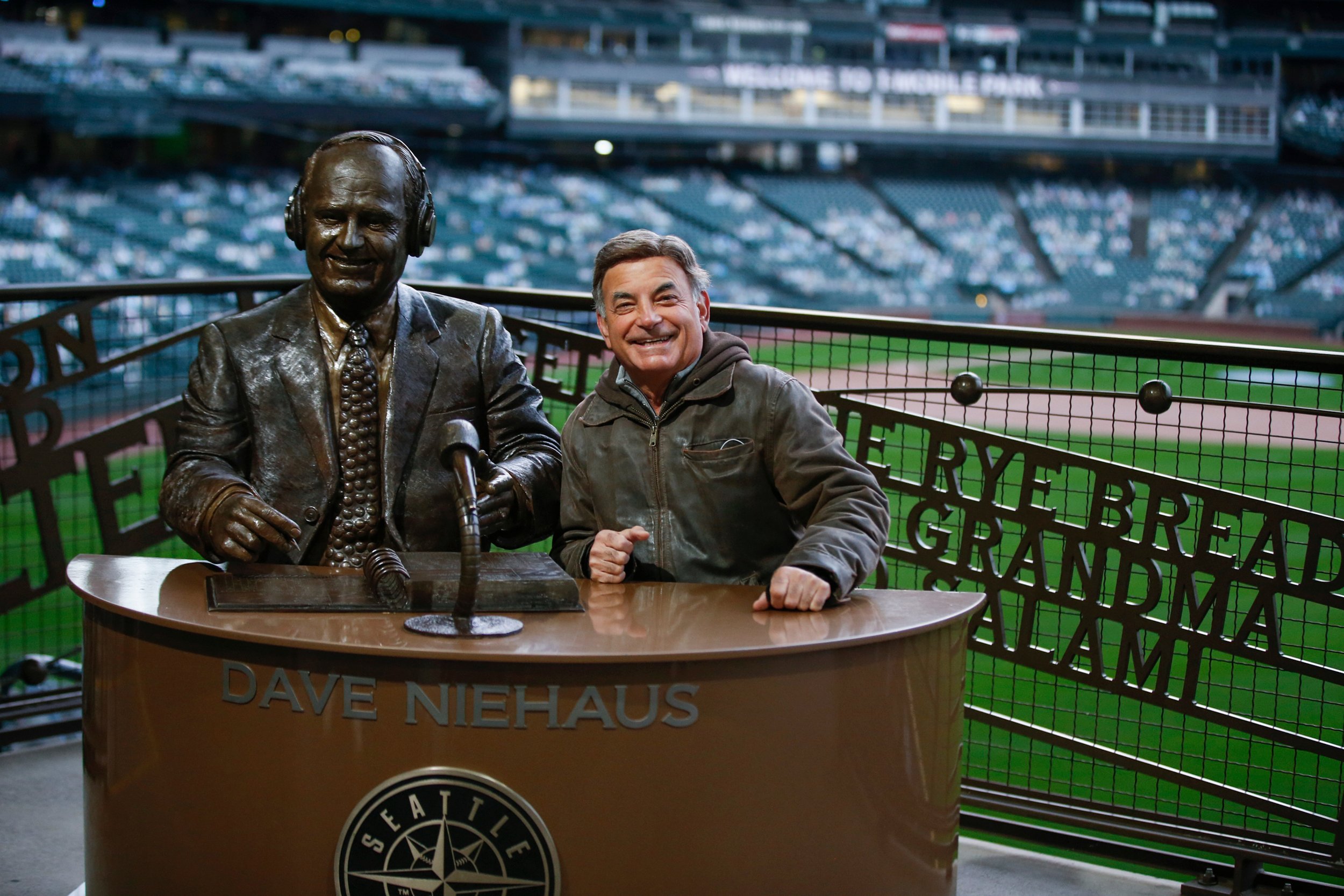
Rick Rizzs sits next to the statue of Dave Niehaus, his longtime broadcasting cohost. Credit: Ben Van Houten/Seattle Mariners. [/caption]
SEATTLE, Wash. - Few things are as stable in Mariners baseball as the velvet voice of Rick Rizzs, who so defines the phrase “human institution” that it can be hard to remember a time where he couldn’t be found describing the national pastime into a microphone. But Rizzs announced his upcoming retirement from broadcasting on Tuesday, and on Wednesday, he found himself taking questions from the media.
Of course, this was the reverse of the usual state of affairs. Rizzs goes down to the dugout before every game to take part in media scrums, often talking one-on-one with the manager (or whoever else is taking questions in the dugout) after the general scrum has concluded, and all the other media members are his peers. He can be found an hour or two before a game chowing on stadium meals, where he shares his stories in the same easy voice that can be heard for three hours later that day.
Rizzs will be telling those stories for as long as he lives, but younger voices will have the task of stepping into some of the biggest shoes in the business come 2027, as Rizzs readjusts to upcoming retirement.
“I love baseball, and I love broadcasting, but let’s face it, everybody in the game - players, managers - we make sacrifices because we’re not at home. As you know, I lost my son two years ago, and I want to spend more time with my grandkids now,” Rizzs said. “I lost a lot of friends over the last 15 to 20 years … you know, at 72, you start to think, ‘what do I want to do with the rest of my life, what is the next chapter going to look like?’”
While Rizzs still wants to have some sort of affiliation with the Mariners after his retirement, his days as a play-by-play broadcaster will come to a close after the final pitch is thrown in the 2026 season. He had been considering hanging it up after 2025, but he decided to go for one more year on the radio after discussing things with those around him.
Like the players he colorfully describes, Rizzs’ career comes from the combination of a natural aptitude of storytelling and a life spent honing his craft. He has spent more than a half century in the broadcast booth, a baseball announcer across 10 presidencies and nine Rocky films. He first spoke into a minor league microphone the same year as the release of Jaws and The Rocky Horror Picture Show, the same year Jeanne Calment turned 100.
And yet, through a rather bizarre series of events, Rizzs nearly missed out on his chance to fulfill his lifelong dream of becoming a big league broadcaster, perhaps a reminder that your journey does not have to be perfect. He went into a story about missing his flight (and nearly his Mariners career) because of a foolhardy decision to enter a Girl Scout cookie-eating contest.
“The day before I was to fly out from Columbus to meet with (then Mariners owner) George Argyros in Southern California, the Girl Scouts had a kick-off (for) their cookie campaign,” Rizzs said. “I went to the local mall in Columbus, Ohio as the announcer for the Yankees’ Triple-A team and I ate 33 cookies in three minutes - dumbest thing I ever did besides trying to follow a legend in Detroit, but that’s another story - but the next morning, I was to fly out to Southern California, and I thought I was having a heart attack.”
As Rizzs tells it, the team doctor told him to go to the hospital, where he ended up taking blood tests instead of taking flight, and he had to place a last-minute phone call and schedule a meeting the next day before Argyros went off to a cruise in Greece. He had a long interview with Argyros, who, upon learning of the source of the delay, took him onto the team.
“He (Argyros) said, ‘anybody willing to sacrifice his life for the Girl Scouts is my kind of guy’,” Rizzs recalled with a laugh. “So, I became a big-league broadcaster, and it was up to me, and I worked with the greatest announcer in the history of the game of baseball.”
Rizzs’ appreciation for Niehaus is clear as day. Although he had spent eight years as the voice of four minor league teams, Niehaus showed him the ropes of big-league broadcasting, even and especially during the “lean years” of near-winless 1980s Mariner baseball.
“He taught me that it may be a bad game, but it doesn’t have to be a bad broadcast,” Rizzs said.
The appreciation, like the voice, is something that doesn’t shut off with the camera. I remember talking with Rizzs over T-Mobile Park’s media dinner once last year - I can’t recall if it was burger and fries or barbecue chicken and mac-and-cheese that day - and asking him if there was a singular moment where he knew he was working alongside an all-time broadcasting great. I had an idea that perhaps it might have coalesced over time in the subconscious and arrived to his conscious mind some time along the journey, but that’s not at all the way it was for Rizzs.
Instead, as Rizzs recalled to me, he instantly knew.
It seems he has never lost that admiration for his late cohost, or his memories of childhood broadcasting heroes that unwittingly pushed him to become one himself. Rizzs became emotional early on in the presser as he put into words a realization that he had fulfilled his dream.
“You get to a certain point where you’re not that little kid watching the games on TV, wishing you were Jack Brickhouse, you know,” Rizzs said as tears welled in his eyes. “I’m going to try not to use this, OK?” he continued, pushing a box of tissues away to his right.
Brickhouse, the longtime television voice of the Chicago Cubs, had an influence on the young Illinois native. Rizzs uses the phrase “happy totals” to describe the score of a Mariners win, much the same as Brickhouse would call a Cubs victory. Like many young kids, he likened himself to the voice from the television that he heard every day - and would often turn the volume down and practice his own announcing during his teenage years - but unlike many, he actually wrote Brickhouse a letter when he was 12, asking what steps he should take to become a major league broadcaster.
Rizzs would end up meeting Brickhouse the first time he went down to spring training with the Mariners. Although Brickhouse didn’t recall the letter exchange upon meeting the new Mariners announcer, the encounter between the two formed one of Rizzs core experiences as his lifelong goal began to be realized. Having long dreamed of hearing his voice on a transistor radio, Rizzs brought one up to the Kingdome booth for a Mariners home game in 1983. Niehaus was initially confused, Rizzs remembered, but he explained his dream, they put on the headsets, and he heard his own voice where he had always wanted it to be.
“After eight years in the minor leagues, and being a 12-year-old kid, I was finally that voice coming out of a transistor radio,” Rizzs said.
Initially, Rizzs’ goal was to spend one year announcing big league ball. Instead, 1983 began a nine-year Mariners broadcasting run that was followed by three years with the Tigers and a return to Seattle in 1995. All together, that makes 43 years of broadcasting in the majors and 51 years broadcasting professional ball. Much of the latter part of his career has been spent as a radio voice, something that ties back into Rizzs’ childhood listening to Chicago’s teams play the game.
“That’s the way I grew up loving the game of baseball. You know, playing out there on the sandlot, but listening to the game on the radio (too). Fortunately, we had WGN, we could see a lot of games with the Cubs - not as many with the White Sox, or the Game of the Week, that was it for the national - but listening to the radio was magical to me,” Rizzs said. “I could picture Wrigley Field, I could see the green ivy, I could picture Comiskey Park.”
Two metaphors came to Rizzs’ mind as he discussed the art of radio: theater and painting. He described the game of baseball as an open-ended “theater of the mind”, where the lack of script gives magic as the outcomes become known, and as visual artistry, where the broadcaster starts with big strokes and fills in details to produce a full mental image over the course of nine innings. He recalled discussions he had with the greats of baseball broadcasting such as Vin Scully that helped cement this view of what it means to be a broadcaster, but that ability to see the games through midcentury Chicagoan voices in his childhood was the driving desire behind his dream career.
“I wanted to be that guy to paint the pictures,” Rizzs said. “And hopefully I’ve done that for the last 40 years here and the last 51 years doing this, but that’s the magic of radio.”