How Will Randy Arozarena Fit into Mariners’ 2026 Plans?

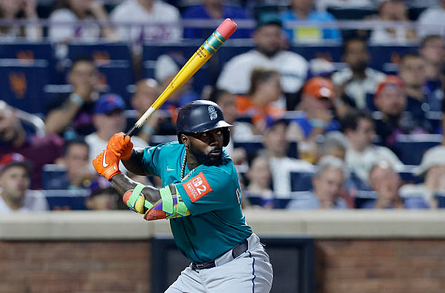
Between June 28 and July 20, 2025, Randy Arozarena had a slash line (batting average/on-base percentage/slugging percentage) of .329/.400/.786 (236 OPS+ where 100 is league average) with 10 home runs, seven doubles, and 17 RBIs. He still struck out in a full 25% of his plate appearances during that stretch, but for whatever reason, those 18 games (of which the Mariners won 11) saw a whole lot of beach balls blasted off the bat of Seattle’s left fielder.
In the 148 games outside of that stretch, Arozarena went .227/.326/.379 with 17 home runs, 30 doubles, and 59 RBIs. That’s still a 103 OPS+ when taking T-Mobile Park into account, but it still left some uneasy watching as he started and ended the year relatively quietly.
Other streaks of his went less noticed. Before May 1, Arozarena walked 21 times in 131 plate appearances, an elite 16% walk rate. For the rest of the year, however, he held a much more pedestrian 7.4% walk rate, and he took a free pass 21 times in the whole second half of the season, needing 297 plate appearances to do what he had done in 131 appearances earlier in the year. By the end of the season, his walk rate was 9% - a decline from his 12.2% in 2023 and 11.3% in 2024.
Randy Arozarena is a streaky player, after all. He emphatically stamped himself into baseball legend with a perfectly-timed (well, except for the lack of fans) sizzler during the 2020 playoffs, where he hit a record 10 home runs during that postseason as well as what was then a record 29 hits (though the Blue Jays’ Ernie Clement got 30 knocks in 2025) as his Rays went all the way to Game 7 of the World Series.
None of that materialized in October 2025. Instead of crushing nearly everything he saw, Arozarena hit .188 with a paltry .574 OPS, his only home run coming with nobody on base in the eighth inning of a long-lost ALCS Game 3. So can be the downside of a streak-prone player.
On the whole, though, Arozarena put together one of the better seasons in his career with the 2025 Mariners, slashing .238/.344/.426 (119 OPS+) with 27 home runs, 32 doubles, one triple, and 31 stolen bases. Seattle bought relatively low on Arozarena after a slow start to his 2024 season with the Rays, and the ups and downs averaged out about where the M’s wanted in 2025. His 60 extra base hits were the second best in his career, only behind 64 (20 homers, 41 doubles, and three triples) in 2022.
For just the second time in Arozarena’s career - after his 2021 Rookie of the Year campaign - he accrued four Baseball-Reference wins above replacement (bWAR), though his FanGraphs WAR (fWAR) lagged behind at 2.9 due to difference in defensive metrics. A big part of that jump was the nature of his base-stealing. Over the previous four seasons, Arozarena had stolen 94 bases - but in 136 attempts, it was only a 69.1% stolen base rate, notably below the roughly 80% rate where taking off becomes a positive contribution (and he had led MLB in times caught stealing in both 2021 and 2022).
Arozarena’s sprint speed declined in 2025, but his stealing decisions took three times the jump. His 31 swipes came in 37 attempts, good enough for a 83.8% success rate and a markedly sunny contribution on the basepaths. Arozarena had negative baserunning runs created above average (Rbaser) in each of his previous three seasons but a positive figure (three) in 2025 thanks to this improvement.
Defensive metrics, as they often do, differ, but I’ll start by going over what the eyes can see when he plays left field and then explain why the stats are what they are.
Arozarena was definitely a middling-at-best defender in left field. He doesn’t move particularly quickly or get a great jump on the ball, meaning that he isn’t going to make many particularly difficult catches (and often allows doubles to fall in that are caught by most other defenders). His route-taking is usually fine, but when it’s bad, it can be woefully bad. He’s certainly able, however, to pull in the occasional highlight reel grab.
Both defensive runs saved (DRS) and outs above average (OAA) are sour on Arozarena’s defense, though his -1 DRS is just slightly below average while his -5 OAA is a markedly low 13th percentile among MLB outfielders. It’s often given as a general rule of thumb is that DRS is more accurate for infielders while OAA is more accurate for outfielders, and while that does have merit (OAA in and of itself is a range metric and is less reliable for infielders), defensive metrics are often best buoyed by the eye test [1].
I personally would lean more towards OAA’s notably below average fielding for Arozarena rating rather than DRS’ slightly negative score [2]. With the way the M’s are currently set up for 2026 - swapping him to DH for, say, Refsnyder would forfeit the DH if the team attempted to pinch-hit for Refsnyder and move Arozarena back to left - that’s just something they will have to live with unless they trade him somewhere else.
While trading Arozarena would open up a decent chunk of budget space, as estimates for his arbitration sit in the $16-18.2 million range, there hasn’t been much in the way of Mariners brass declaring their willingness to deal him elsewhere. Precisely because he is expected to make so much in arbitration (plus the fact that he is already 30 years old), his trade value would be a bit less than his production might imply, and Seattle would have to make a late pivot to a left fielder market that has dwindled in the past few months. There’s also the very real possibility that the team avoids arbitration with a fairly club-friendly deal, opening up the checkbook anyway.
Given that Seattle will almost certainly be looking to run it back with Arozarena, what can the team expect from him in 2026?
The Steamer projection system predicts a .233/.331/.403 slash line, 114 weighted runs created plus (wRC+) where 100 is league average [3], 21 homers, 27 doubles, 22 stolen bases in 29 attempts, and 1.9 fWAR. Marcels expects a very similar .237/.338/.414 line with 22 homers, 26 doubles, and 21 steals in 28 attempts.
Both these projection systems expect his walk rate to rebound to above 10% and both expect him to continue getting hit by pitches at a sky-high rate, as he led all MLB in that statistic in both 2024 and 2025. Both walking and getting plunked are repeatable skills, so the projection systems’ reliance on previous seasons to inform its predictions does make sense, although the decreased walk rate post-April in 2025 gives a bit of pause.
Taking the as-is Steamer projection and replacing the 10.1% walk rate with a roughly 7.1% walk rate would give Arozarena 45 walks instead of the projected 64, meaning that 19 plate appearances would switch from walks to something else. Assuming the same amount of home runs, strikeouts, hit by pitches, and balls in play per non-walk plate appearances in the projection (and also assuming the same hit distribution per balls in play), an alternate projection of .232/.309/.402 - which would be just a hair above league average.
Still, that likely represents somewhere near the lower bound of his possible outcomes for 2026. Even with the reduced walks, turning five flyouts into home runs (for a total of 27, since one of the 19 non-walks becomes a projected home run) would give him a .241/.316/.438, a slightly better OPS compared to the original Steamer projection. Adding five homers to the original Steamer projection, meanwhile, gives a .242/.339/.439 slash line, well above league average production and 0.018 points of OPS better than his 2025 season. Obviously, there’s no particular reason why five extra fly balls should become home runs, it’s just an example of how slight changes in luck can affect someone’s profile.
All this is an exercise in how much variance Seattle has to expect from Arozarena, but in truth they should expect variance from all of their players (and fiddling with numbers too much can bring an attempted analysis into the realm of the truly farcical [4]). Given Arozarena’s tendencies, however, a big part of his production will come in a sun-hot stretch or two somewhere in the season.
Arozarena’s position in the lineup should depend on whether his walk rate recovers to form. He hit leadoff during August and September, but only had a .299 on-base percentage in those two months thanks to a 7.1% walk rate during that time. Now, it was a general slump with a low slugging and low average, but if the walk rate doesn’t recover, Seattle should probably move him to a spot in the lineup more suited to a slugging-focused profile.
[1] A keen eye test, to be sure: look at the jump, the route, the speed, and the catch (or non-catch) all together to make sure you aren’t fooled by, say, a flashy grab making up for a bad route.
[2] In stats terms, I’d say Arozarena is definitely at least one standard deviation worse than the mean on defense, which is what OAA says.
[3] wRC+ is similar in concept to OPS+ as a catch-all measure of offensive production adjusted to league average, but is based largely on weighted on base average (wOBA) and - to simplify a lot - values the on-base component a bit more than OPS+ does.
[4] Changing numbers should come with a rationale; in the case of this Arozarena article, it’s about changes in discipline and approach (affecting walk rate) and the effect of, say, wind environment on deep fly balls (affecting homer totals).