Five Utility Guys Mariners Should Examine to Reinforce 2026 Roster

Pieces are beginning to fall across the league as spring training approaches, with Nolan Arenado sent to Arizona and Ranger Suárez signing with Boston being just a couple of the notable deals in recent days. It’s ever more clear that the American League will be jam-packed with teams vying to reach the top, and although the Mariners have already made some of their big moves for the winter, there’s still more to be done.
Seattle is depending on three young prospects to fill out two infield spots for 2026, but beyond Cole Young, Ben Williamson, and the yet-to-debut Colt Emerson, the rest of the infield depth is made up of Miles Mastrobuoni, Leo Rivas, and Ryan Bliss. There’s plainly a need for another guy to be able to pick up the slack at multiple positions, hence why Seattle has been connected to a number of players.
Outside of the obvious Brendan Donovan, however, I’m going to be looking at a number of utility guys (Nico Hoerner’s arm isn’t quite where it needs to be for a third baseman, and I’ve written about him as a second base target before) that Seattle hasn’t been meaningfully linked to.
It’s worth noting that each of these non-Donovan potential pickups is someone with meaningful doubt as to how much they can perform. Seattle long sought to build a super-utility guy out of Dylan Moore, and although it appeared like they had finally done so in 2024, he all but crashed and burned in 2025. Still, the balance on each of these players favors positive output in 2026.
1. 2B/3B/LF Brendan Donovan, 28 years old, St. Louis Cardinals.
Donovan is the Mariners’ current will they/won’t they trade target, but developments in the saga have long since slowed to a crawl. St. Louis has drawn interest from other teams, notably the Giants, about their swell-swinging utility man, and although the Mariners’ offers aren’t well known outside of potentially Jurrangelo Cijntje and/or Lazaro Montes, Seattle might also have to pony up a young major leaguer if they want Donovan.
Donovan can play second and third, both spots where Seattle’s current plan is to trust their prospects to make good jumps in development, and he also can fill out some reps in left field. His .282/.361/.411 career slash line has shown remarkable consistency year-over-year, and he’s a good pest at the plate, rarely striking out (13.5% career strikeout rate) and drawing good amounts of walks (9.1% career walk rate) as he shows consistency in just about every part of his game.
It should be noted, however, that the lefty Donovan is a fairly platoony hitter, with a career .293/.373/.439 slash against right-handers compared to .249/.325/.326 against lefties. He’s not a guy you would take out of the lineup when a team brings in a southpaw, but it would be prudent to use him more frequently against right-handers.
Ultimately, when it comes to Donovan and other fairly big names on the market, the game of hurry-up-and-wait will continue until it doesn’t.
2. LF/3B Miguel Andujar, 30 years old, free agent.
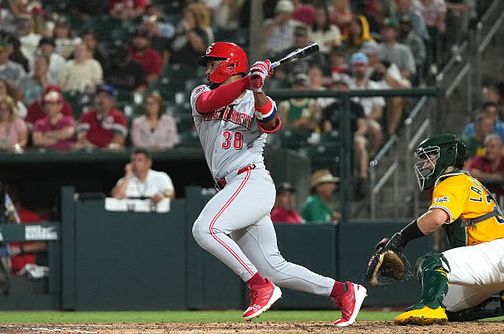
If Jerry Dipoto ends up drawing the short straw in the Donovan sweepstakes, a good potential pivot would be Miguel Andujar [1]. Right on the heels of a smashing 2018 season in the Bronx, Andujar spent the next four years seeing ghosts before finally putting things back together with the 2023 Pirates.
Over the past three seasons, Andujar has slashed .296/.332/.431, building a batting profile off of low whiff rates and low strikeout rates. Some of the foundations are a little shaky, however - his .325 batting average on balls in play (BABIP) over those three years is unlikely to maintain itself [2], and regression there could turn him into more of a league average bat. Andujar may be a right-hander, but there isn’t much of a difference in platoon splits over the course of his career.
Andujar typically plays in third and left, limiting his usefulness compared to a guy like Donovan, and he hasn’t been a particularly good infield defender in a number of years. Seattle might be able to add second base to his repertoire, but the team wouldn’t come away with a true utility or super-utility type of profile. Depth is never a bad thing, however, and the Mariners need it.
Spotrac estimates that Andujar’s market average annual value (AAV) is about $6.1 million. Anywhere in the $4-7 million range would be a fair price for Andujar, in my view, and that’s well within the Mariners’ budget as it currently stands.
3. INF/OF Willi Castro, 28 years old, free agent.
When it comes to positional versatility, Castro certainly has the ability to play wherever the Mariners would need. Defensive metrics, however, can’t seem to agree even directionally across different years and different metrics, so I wouldn’t expect a true defensive wizard out of him - but he could take a big step forward working with the Mariners’ crew.
He’s not a complete black hole on offense, but if he’s the Mariners’ top guy with the stick at any position, that means one of two things: Castro is getting lucky, or the M’s infield prospect tricycle has a dodgy wheel. Over Castro’s seven-year career, he has needed more than his fair share of BABIP luck in order to reach league average production in a given season. When his BABIP is around the league average .290 mark, he ends up being around 15% or so worse than league average at the plate.
Castro is fairly speedy, but he dances around the cusp of usefulness when it comes to his base-stealing ability. He has a career 72.8% stolen base percentage, a little bit above the rough 70% benchmark for when a team gets positive returns. His best baserunning year in 2023 saw him swipe 33 bags in 38 attempts (86.8%), but like his hitting, he hasn’t shown the year-to-year consistency to make this part of his game a lock.
The real benefit to Castro is the fact that he can play any position well enough to be a perfect depth guy. He can play anywhere in the infield and anywhere in the outfield, and that fits well with a Mariners team lacking in depth.
Payment-wise, Spotrac estimates his AAV around $10.9 million whereas MLB Trade Rumors places him in the $7 million per year range. I think both are overvaluing a guy with a good amount of consistency questions, but if Seattle could pick him up for something in the $5 million range, it would be a pretty good offseason grab.
4. IF Ramón Urías, 31 years old, free agent.
Unlike the previous three players on this list, Urías wouldn’t give Seattle any outfield flexibility - but he’s certainly a better infield defender than Andujar and Castro. He can play well at both second and third, with strong range and infield ability, and would at the very least provide viable injury cover while holding down the house for the Mariners’ ground ball pitchers.
Urías didn’t burn down any barn doors with his bat in 2025, slashing .241/.292/.384, but the quality of his contact was only slightly weaker than average while he pulled the ball in the air at a fairly higher rate than baseball at large, meaning that there’s a fair amount of bounceback potential in his bat. Much of his hitting decline in 2025 can be attributed to the fact that he chased and struck out more. If he improves some of his underlying skills from slightly below average to slightly above average, he could turn into a stealthy pick for whatever team adds him to their roster.
In the pretty likely case Urías doesn’t surprise the baseball world, he would still be able to provide the basics of what the Mariners still lack for 2026. Although Spotrac estimates that he will pull in $5.8 million per year in free agency, I’d venture to say the M’s should stick to the $4-5 million range with Urías unless they’re truly out of options.
5. IF Isiah Kiner-Falefa, 30 years old, free agent.
Like Urías, IKF is an infield utility guy, and although his defense isn’t as good as Urías (and a notably weaker arm might limit him at third), he would still play the same role as Urías would in a Mariners roster that needs some “next guys up” to deal with any potential injuries the team might face.
And while Kiner-Falefa isn’t exceptional overall with the stick - slashing .262/.297/.334 in 2025 - he does have a particular profile that lends itself to pinch-hit opportunities and giving fits to opposing teams. Put simply, he’s a pest at the plate, rarely missing when he swings and striking out considerably less than most. On the flip side, he doesn’t walk often, meaning that he might not be the guy to put in when an opposing reliever is having control issues, but he can play the late game disruptor role quite well when he needs to.
Even though I would recommend the four guys previously mentioned over IKF, there’s definitely a place for him on the Mariners’ roster if they need an infield utility guy. Spotrac’s estimated $5.3 million price tag is a little much in my view, but Seattle has the budget space for it.
[1] Clint Frazier not included.
[2] BABIP tends to regress to a mean of around .290, and it’s something hitters have relatively little control over. Batters with higher line drive rates do tend to maintain higher BABIPs, but Andujar doesn’t have an exceptionally line drive-heavy profile.