Baseball’s Back: Five Notes from Mariners’ First Spring Training Action of 2026

[caption id="" align="alignnone" width="5289"]
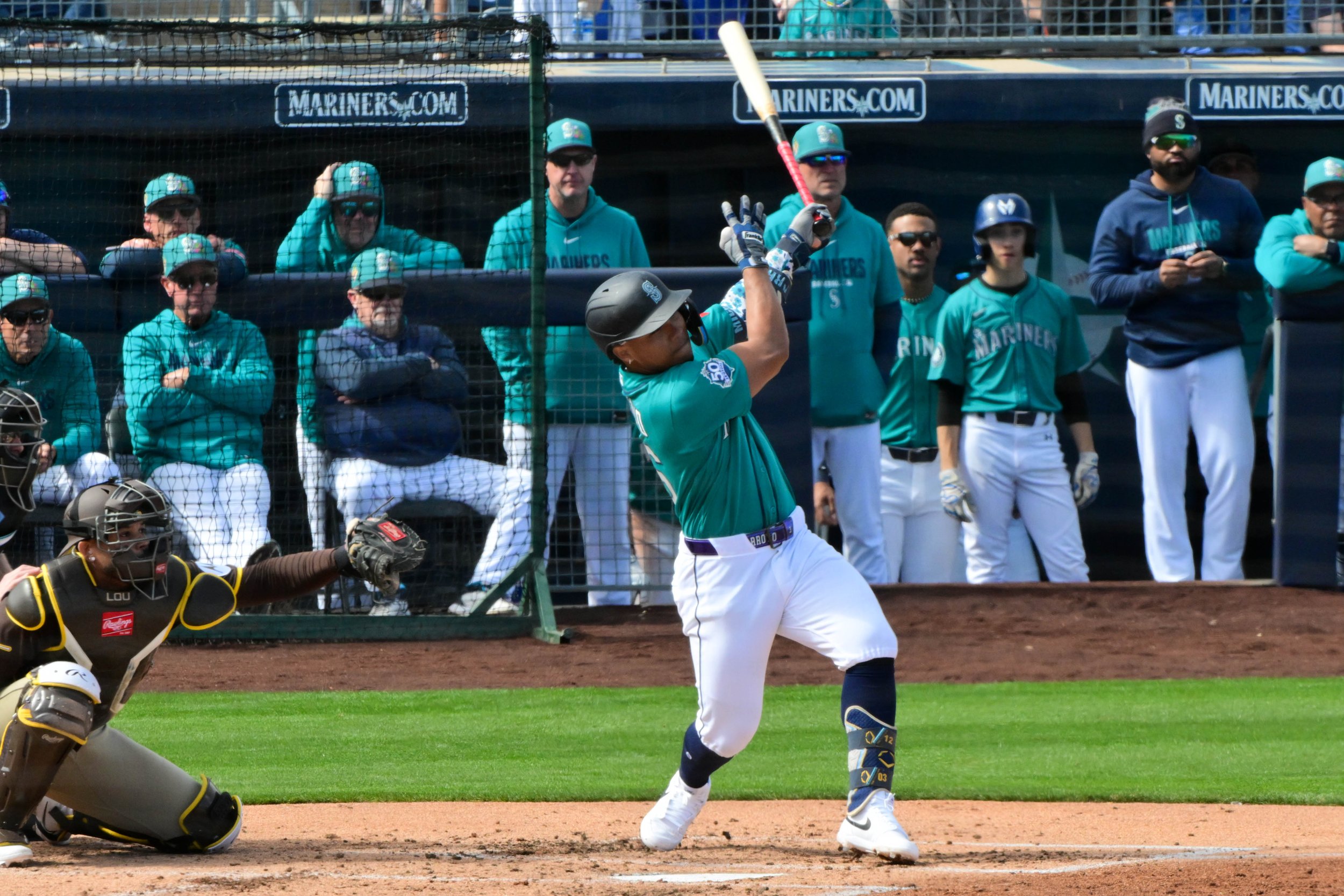
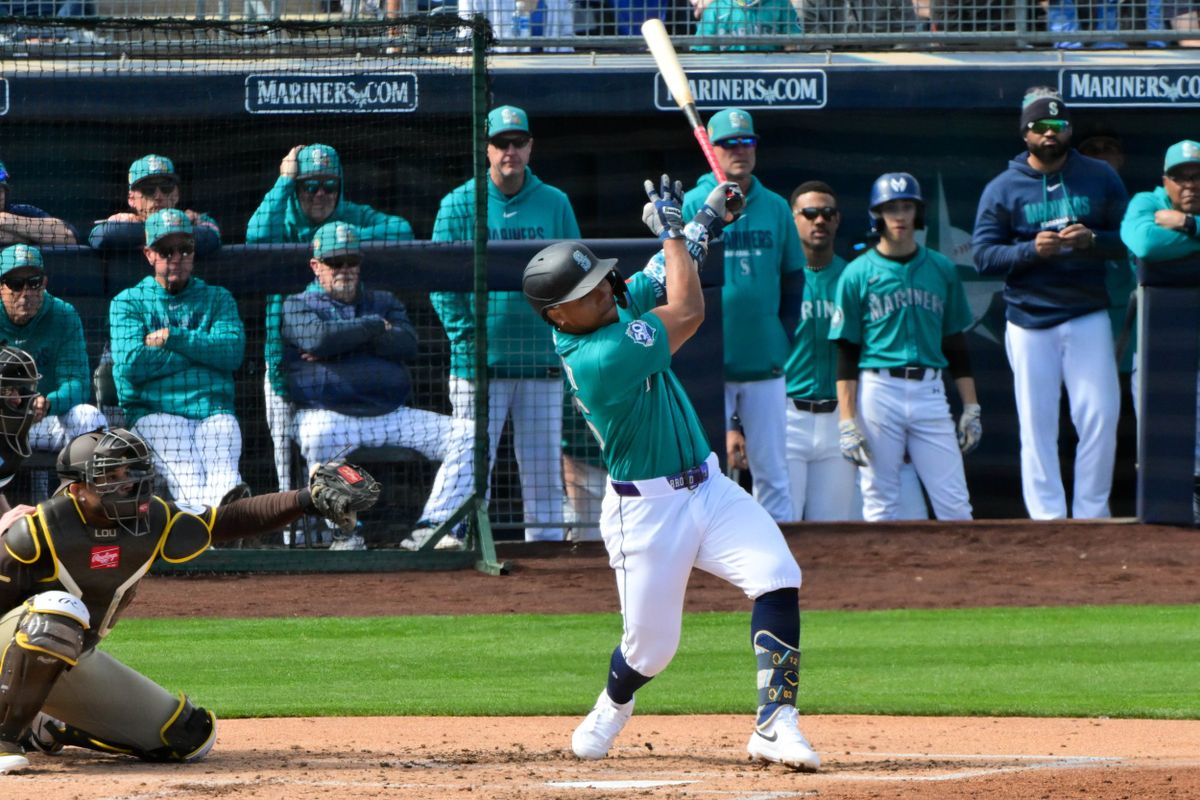
Seattle Mariners shortstop Michael Arroyo (96) hits a two run home run in the second inning against the San Diego Padres during a Spring Training game at Peoria Sports Complex. Mandatory Credit: Matt Kartozian-Imagn Images [/caption]
PEORIA, Ariz. - With blue skies above and many excited fans all around in that picturesque Cactus League ballpark, the Seattle Mariners played their first game of 2026 Spring Training on Friday, Feb. 20. The first day of spring is perhaps the most hopeful time for all 30 teams in any given year, with a nearly clean slate injury-wise and the first harsh reality checks of the regular season still a month and change away.
A quite packed house of 9,956 spectators dotted the Peoria Sports Complex to see the Mariners and Padres both take to their home Spring ball yard. They saw prospects go up against powerhouses in exciting duels and yet also witnessed players trip over each other, lose cans of corn in the sun, and make Little League errors in base coverage. No one got hurt and the game doesn’t count, so both sides came away with a smile in a 7-4 win for Seattle. But what does the first preseason action of 2026 tell us about how things might go when real chips are down for the Mariners?
Michael Arroyo put on a good display at the dish, with a homer and double to power early Seattle production.
Seattle’s system has a fair amount of top-end hitting prospects, and although Colt Emerson and Lazaro Montes headline the system, the crown in Peoria bore witness to another of Seattle’s guys in the farm system. Michael Arroyo, who struggled a bit with his power after his promotion to Double-A in 2025 with a .255/.376/.341 slash line (though this was still a 121 OPS+ where 100 is league average) - and yet decreased his strikeout rate against better pitchers - went into Spring with the chance to show what exactly the Mariners have with him.
A bat-first prospect, Arroyo is often billed as a pure hitter, and that fact came through in the bottom of the second. Padres starter Jagger Haynes threw an 0-2 changeup over the plate and Arroyo put a quick and precise inside-out swing on the ball. This swing showcased the high end of both his hit tool and his power tool, as he torched a 102.4 mile per hour high liner to right center field that ended up in a lucky fan's clutches. Arroyo put almost the exact same swing on a first-pitch slider from Wandy Peralta in the bottom of the fourth and cracked a fly ball to deep center, this one ending up as a double. It was a performance that bolstered his billing, with consistent swings and constant pressure for the pitcher.
Arroyo's glove is often given less pedigree than his bat, and that also showed in the top of the first as he bobbled a difficult play up the middle to begin the game. It was ruled a hit, but it showed his limitations with the leather. There was a moment that showed a bit of untapped potential in the field, however: in the top of the fifth inning, Ty France hit a blooper to center, perfectly between Arroyo and Jonny Farmelo in the shallow outfield. Farmelo, who can light up the radar gun with his legs, took off for the ball, but so did Arroyo, who got a good jump and took an efficient route and nearly put himself in place to make something happen. It didn't amount to anything, but perhaps there might be something for Seattle's infield crew to work with.
But unlike Farmelo, whose good defense and great speed give him a major league floor as something of a Billy Hamilton type even if he doesn't improve with the stick, Arroyo's career hinges entirely on his hitting prowess. If it's anything like what he showed on Friday, the M's could be in good hands.
Dane Dunning shows craftiness and limitations in his first Spring outing.
One of Seattle's minor moves in the offseason was to bring in beleaguered pitcher Dane Dunning on a minor league contract. With ERAs, FIPs, and WHIPs that ballooned in 2024 and 2025 and a notable lack of velocity, Dunning's ceiling is quite apparent as an emergency starter or long reliever in the event of injuries to guys higher in the depth chart.
Dunning gave up an infield single-slash-error and a walk to lead off the game. He was able to get some soft contact from Machado for his first out and mixed his pitches effectively against Fernando Tatis Jr. for his first strikeout of the spring. Dunning, with little velocity to speak of, had to work around the edges. This meant a couple bad counts, and Jake Cronenworth squared one up into the gap, but Dominic Canzone managed to get to the ball with a dive.
Control and velocity issues were a fair bit more notable in the second, with his sinker declining from 89.5 miles per hour to 88.7 miles per hour and Dunning finding himself in two three-ball counts in two straight batters. Dunning once again managed to prevent any runs from getting across the board as he logged two outs. But with the M’s giving a short pitch count leash on the first day of spring, Dan Wilson gave Dunning the hook after 1 ⅔ innings of work with two walks, one strikeout, one hit, and no runs allowed.
Dunning’s start didn’t change many outlooks. He still has notable flaws that aren’t likely to go away, but there is a little bit of craftiness there that could play in an inning or two when the M’s absolutely need him.
Luke Raley looked nice and comfortable at the plate, a hopeful sign for a player with a dogged 2025.
Few Mariners had as frustrating a year in 2025 as Luke Raley. After being one of the league's best platoon bats in 2024 (.255/.333/.497 for a 131 OPS+ against righties that year), he struggled to get in any kind of groove in 2025, with back discomfort coming and going and his swings looking stiff and awkward. This made him one of Seattle’s less-discussed wild cards, with a range of possibilities from a continued wash to an unexpected breakout. He still entered with a solid chance to return to form, and his odds of regaining his regular roster spot took a nice hike after a solid performance on Friday.
With a comfortable, easy swing reminiscent of his strong 2024, Luke Raley got a liner into center field - against the left-handed Haynes, no less - to start off the bottom of the first at 108.9 miles an hour off the bat. Another at-bat in the third ended with a bloop single, and although he got quite a bit lucky in the fact that it fell in for a hit, the most important aspect of it was the aforementioned comfortability.
That easiness with the bat, something that seldom showed in 2025, is exactly what the Mariners wanted to see out of Raley. Right field is one of the weaker positions in the Mariners’ roster at present, but if Raley has a great (or even a good) year, one of the last remaining holes in the roster will be plugged. It’s too early to tell whether the skies are clearing, but it seemed that way in sunny Arizona.
Cooper Criswell has similar limitations to Dunning, but a better trickiness gives him an edge in the depth chart.
Criswell jumped into the game in the top of the third, and unlike Dunning in the first two, he worked a clean inning. He has similarly low velocity - with a sinker averaging 90.3 miles an hour in the third and 89.3 miles per hour in the fourth - but he has a sidearm angle, a nasty sweeper, and a sneaky cutter, all of which caught the Padres off-guard in his outing. Criswell struck out Jackson Merrill and Manny Machado in the third inning and Luis Campusano in the fourth, though undoubtedly his third inning was more impressive.
There were still issues in his game, however. A 14% whiff rate echoed his abyssal whiff rates of years past, meaning that Criswell is going to have to continue relying on soft contact and ground balls to get outs. Contact improved against him in his second inning as his velocity decreased and the Padres began to see more of him, though he counter-adjusted and put the inning away without too much issue.
Still, the inning-over-inning decline - assuming it’s not just a quirk of early spring - could limit Criswell’s ability as a sixth starter and push his usage into the long or middle relief roles.
Edge Depth Ma-Rainiers seal the deal for Seattle in the late innings.
Like any Cactus League game, most of the major league starters worked their way out of the lineup by the final few innings and a collection of up-and-coming prospects and Quad-A depth populated the diamond for both squads. Seattle’s 3-0 lead dwindled to 3-1 in the sixth as Romeo Sanabria took Troy Taylor deep and Jose Miranda tied it back up with a two-run shot of his own against a mightily struggling Alex Hoppe.
Will Wilson walked to begin the bottom of the seventh and Jonny Farmelo managed an infield single, and both were knocked in by Connor Joe (who is on the sixth MLB team of his career) two batters later. Leo Rivas led off the bottom of the eighth with a solo shot and a bases-loaded wild pitch later in the inning from Friars hurler Garrett Hawkins put in the Mariners’ final run of their 7-4 victory.
While guys like Rivas and Joe aren’t often the center of attention, the magic of baseball sometimes puts them in spots to make or break a season. Rivas had such a moment in the ALDS last year; who’s to say what unlikely hero might appear in October 2026?