Keys to Victory: How Can Seahawks Beat 49ers to Kick Off 2025 Season?

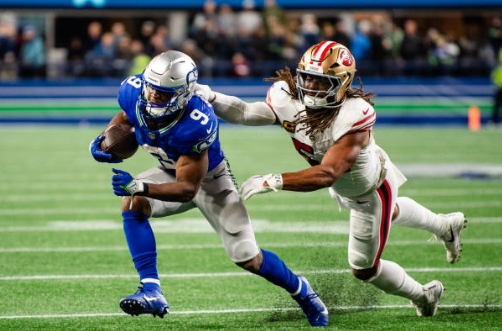
After failing to beat the San Francisco 49ers in 2022 and 2023, including suffering a wild card loss in January 2023, the Seattle Seahawks finally got the proverbial monkey off their back by ending a five-game losing streak to their rivals last November in Santa Clara.
But as coach Mike Macdonald’s squad prepares for their much-anticipated season opener against the same hated 49ers, the Seahawks still have a crooked number to deal with when it comes to defeating their foe on their home turf. Seattle has suffered three consecutive losses in the rivalry series at Lumen Field, including a 36-24 defeat on Thursday Night Football last season, last beating San Francisco in front of the 12s way back in 2021.
Looking to start their own winning streak against the Niners for the first time since that 2021 campaign, what must the Seahawks accomplish to snap another streak against their biggest adversary? Here are four pivotal keys to victory heading into Sunday’s Week 1 battle:
1. Win in the trenches on early downs on both sides of the football.
Amid their three-game skid against the 49ers on their own home turf, the Seahawks have struggled to stay on schedule offensively, in large part due to their inept run game on early downs. In those three games, omitting quarterback scrambles, per Pro Football Reference, Ken Walker III and the rest of the team has rushed 27 times for 88 yards on first down, averaging a poor 3.25 yards per carry on those play calls. Though they have ran the ball better on second down averaging north of four yards per carry, the lackluster production on first down frequently put the team behind the sticks, resulting in an average of 8.1 yards to gain per third down conversion attempt and a poor 32 percent conversion rate on those opportunities. Not surprisingly, they passed on 39 out of 43 of those attempts with the consistent long distances to the marker taking runs off the table.
As for the 49ers, with coach Kyle Shanahan dialed in on his play sheet, the visitors have excelled on first down in general, averaging an impressive 6.6 yards per first down play in the past three games at Lumen Field. Much of this success was fueled by a potent rushing attack, as Christian McCaffrey and company have produced 336 yards and 5.7 yards per carry on first down run plays, giving Shanahan his entire playbook at his disposal by regularly setting up 2nd and 4 or shorter and putting Seahawks defenders on their heels. San Francisco has also been rock solid on second downs, averaging north of six yards per play and almost 4.5 yards per rush, setting up average third downs of nearly a full yard less than Seattle and yielding a 10 percent better conversion rate to extend drives.
If the Seahawks want to change the narrative after being dominated by their rivals on their own turf for close to a half decade, setting the tone on early downs on offense and defense will be critical for multiple reasons. On offense, running the ball much more effectively on first and second down will ensure coordinator Klint Kubiak isn’t constricted as a play caller with a bunch of third and long situations and has more opportunities to call play action and bootlegs for Sam Darnold. Meanwhile, on defense, it will be much easier for Macdonald to dial up exotic blitzes and unleash his pass rush up front with stunts if Seattle isn’t getting pushed around and has more obvious passing downs to attack Brock Purdy on.
2. Limit yards after contact in run and pass game, swarm to the football defensively.
Playing a role in their troubles on early downs, the Seahawks have had major issues bringing down running backs, receivers, and tight ends alike when facing the 49ers at home in recent years. In Week 6 last season, according to Pro Football Focus charting, backup running back Jordan Mason rushed for 54 of his 73 yards after contact, forcing three missed tackles and averaging an unacceptable six yards per carry after contact, while receiver Deebo Samuel amassed three forced missed tackles, 73 yards after the catch, and a whopping 24.3 yards after the catch per reception. Back in 2023, San Francisco rushed for 169 yards and 105 of those came after contact, while Samuel again eclipsed 40 yards after the catch. One year earlier, McCaffrey and Mason had 56 yards after contact apiece and George Kittle torched the defense with 59 yards after the catch and three missed tackles forced.
In summary, the 49ers eclipsed 100 rushing yards in two of those three games after contact alone, approaching 10 missed tackles forced in both of those contests. The poor tackling at all three levels translated to the pass game as well with Samuel, Kittle, and others regularly slipping through arm tackles to rack up YAC in bunches, turning a few of those busted plays into back-breaking touchdowns along the way. Stating the obvious, cutting missed tackles in half would work wonders for the Seahawks heading into Sunday’s rematch, helping first and second down yields along with eliminating some of the explosives that have doomed them in the past. Not having to account for Samuel should aid that mission along with the improved linebacker tandem now featuring Ernest Jones and Tyrice Knight to bottle up the run.
3. Avoid special teams miscues, particularly in the turnover department.
It’s difficult to beat quality football teams without missing field goals or coughing up the football in plus territory on special teams, so the Seahawks’ perpetual gift giving in the third phase of the game has allowed games against the 49ers to get out of hand early. Jason Myers endured an 0-fer in 2022, missing both of his field goals in a 21-13 loss where six extra points would have come in quite handy down the stretch. Then in 2023, he only connected on one of his two field goals, while former running back DeeJay Dallas muffed a punt late in the second quarter that allowed San Francisco to tack on three points to take a 24-3 lead into halftime. Following Dallas’ footsteps, Laviska Shenault fumbled on a kickoff and set up a field goal to give the 49ers a 13-0 lead last year, though he did amend for that with a 97-yard touchdown in the second half.
Adding up all of the damage from those mistakes, Myers left nine points off the scoreboard in the kicking game, while muffed punts and fumbled kickoffs also gave San Francisco six more free points with great starting field position. 15 points may not seem like a lot, but those miscues deflated the team in two close contests and helped expediate a blowout in the other, turning out to be massive momentum changers where Seattle contributed to beating itself as much as its hated rival. Playing well on special teams will be vital to the Seahawks’ chances on Sunday, and while they don’t need splash plays to make that happen, they can’t afford to have botched field goals or turnovers in the return game if they are to curb their home losing streak to the Niners.
4. Stack up sustained drives to dominate the time of possession battle.
Holding onto the football more than the opponent doesn’t guarantee a victory, but it certainly helps the cause, and the 49ers have been masters at this throughout much of the Shanahan era. Though they slipped down to 12th last year, they have finished in the top eight in average time of possession in four of the past six seasons, bullying the opposition with their run game and regularly orchestrating long, physical scoring drives. Their matchups against the Seahawks have provided textbook examples of their dominance in that regard, as they have won the time of possession battle by at least six and half minutes in each of the past three contests at Lumen Field.
Running the football effectively has been the key recipe for San Francisco, which has easily topped 100 rushing yards in each game. But Seattle has allowed this to happen in part due to ineptitude on offense leading to quick punts and putting more pressure on a tiring defense. As mentioned earlier, less-than-ideal early down production regularly put the Seahawks in third and long situations, and they didn’t move the chains near enough as a consequence, converting only four out of 13 third downs in 2022, three out of 11 in 2023, and seven out of 16 last year. Not shockingly, the lack of sustained possessions yielded only one red zone trip in two of those games.
Of course, third down efficiency is only part of the equation, as the Seahawks could have helped themselves by getting more first down conversions on early downs, and that statement remains equally true going into Sunday. But it will be extremely difficult to buck the past trend of being dominated in the time of possession metric by the 49ers or create more red zone opportunities for Darnold and company to cash in on if they can’t at least be around 50 percent in the third down conversion column, so it would be a development that does not bode well for their odds of snapping the losing streak.