Analysis: Identifying Best Guard Fits for Seahawks’ 2026 Draft Picks


[caption id="" align="alignnone" width="3165"]
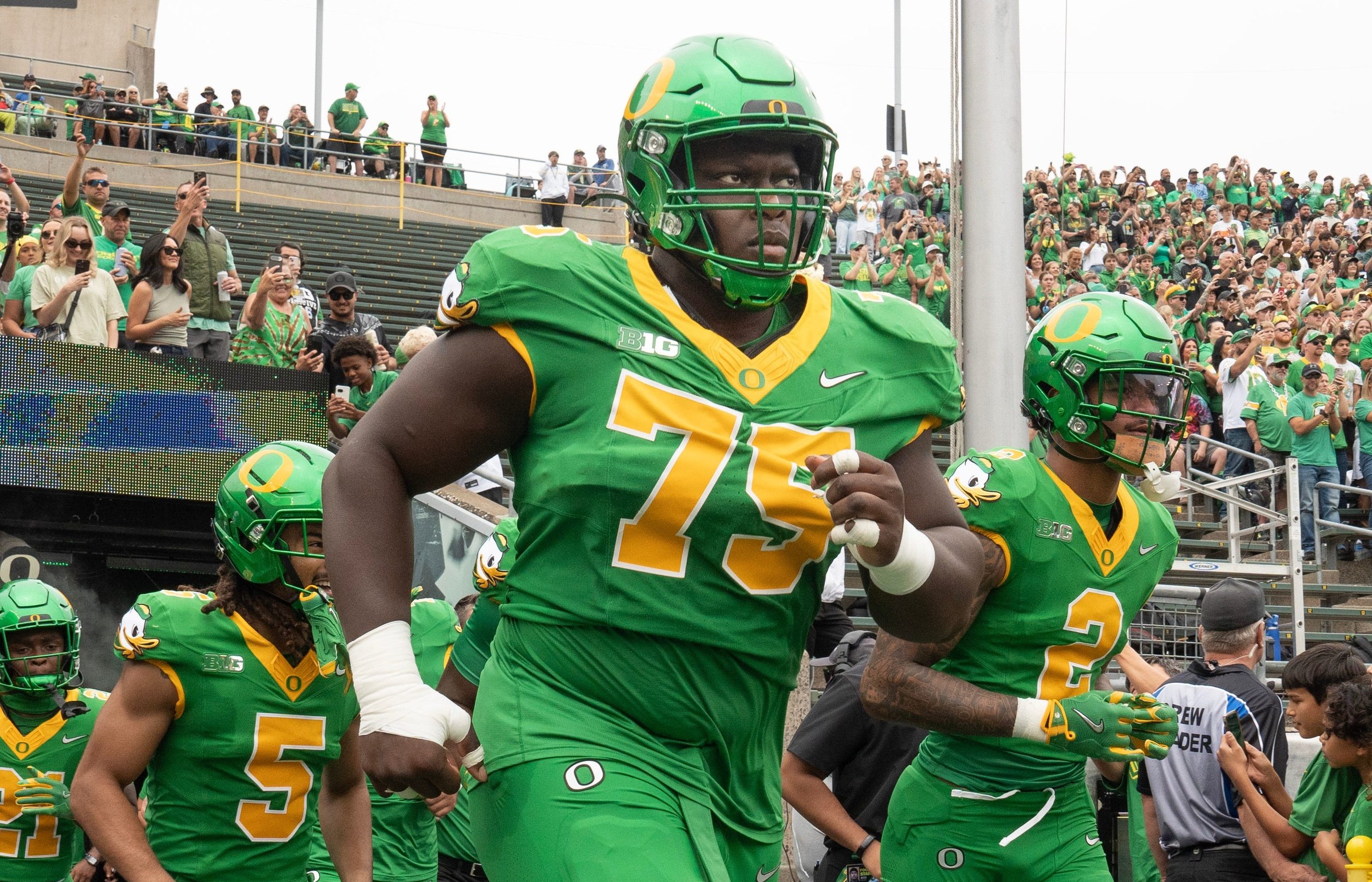
Oregon’s Emmanuel Pregnon, center, takes the field before the game against Oklahoma State at Autzen. Credit: Chris Pietsch/The Register-Guard / USA TODAY NETWORK via Imagn Images [/caption]
In quite the turn of events, after years of struggling to maintain continuity and playing an endless game of musical chairs on the offensive line, the Seattle Seahawks look to be well set in the trenches for the foreseeable future thanks to a strong commitment from general manager John Schneider drafting, developing, and retaining talent up front.
Over the past calendar year, Schneider invested a first round pick in an instant starter in Grey Zabel at left guard, unearthed an undrafted gem in center Jalen Sundell, and locked up bookend tackles Charles Cross and Abraham Lucas with multi-year extensions, ensuring all four of those players would be under contract together for at least the next two seasons. Of those four players, only Sundell may hit free agency before 2028, as he will be a restricted free agent next spring.
With most of the offensive line under club control, the Seahawks only have one significant question on their offensive line with starting right guard Anthony Bradford entering the final year of his rookie deal. The oft-maligned former fourth round pick out of LSU has been wildly inconsistent in his first three seasons, but under the tutelage of coach John Benton, he made substantial improvements last year, including allowing just one sack in Seattle’s final 10 regular season games. Still, the jury remains out on whether he should be brought back on a second contract, making the position a potential area of need for the 2026 NFL Draft.
Looking at this year’s latest crop of guards, which players stand out as the best potential fits to compete against and/or eventually replace Bradford for 2026 and beyond with each of their four selections?
Round 1, Pick 32 - Emmanuel Pregnon, Oregon
Beginning his career at Wyoming before spending two seasons at USC, Pregnon saved his best for last in his senior season at Oregon, emerging as a catalyst in the trenches for the College Football Playoff-bound Ducks at left guard. While he isn’t the most athletic guard in this year’s class and struggles at times getting to the second level off combo blocks along with getting beat by quick counters, he’s more agile than advertised in the zone blocking game and takes stellar angles to his spots to win at the point of attack, finishing his blocks with authority and a nasty edge. Hand usage stands out as a major plus in his all-around game as a punishing run blocker and an unyielding pass protector, as he regularly delivers heavy blows with massive paws to opponents square in the chest and once he gets his mitts onto a target, they won’t be getting away from him as he stays locked on. A physical player with the attitudinal demeanor teams desire in the interior, he should be a solid fit in any offensive scheme and picking him at this stage of the draft would be a signal Seattle intends for him to vie for a starting job right away or in 2027 at the latest.
Also in Consideration: Chase Bisontis, Texas A&M
A rare athlete for the position with five-star pedigree, Bisontis may be the best zone blocking prospect in this year’s draft class, blending heavy hands with fluid mobility to effectively strike targets in space. Lack of length with 31 3/4-inch arms will occasionally create problems for him dealing with NFL power, but his physicality and elite quickness should help mitigate the impact of that deficiency as a Day 1 starter with Pro Bowl and potentially All-Pro potential.
Round 2, Pick 64 - Keylan Rutledge, Georgia Tech
Making the jump from Middle Tennessee State to Georgia Tech, Rutledge’s arrival coincided with the Yellow Jackets climbing in the ACC standings each of the past two seasons with him anchoring the front line as one of the conference’s top blockers. At 316 pounds, he’s equally capable of bullying a nose tackle off the line as a drive blocker as he is swiftly reach blocking a 3-tech on a zone concept, demonstrating the all-around skill set to excel in any scheme. He plays with rapid hands in pass protection that sync up well with his feet, allowing him to mirror effectively with sticky control throughout the rep. He can get caught in no man’s land after lunging out of his stance, leading to occasional trouble with quick slants working his edge, and his biggest question mark coming into the NFL will be his persistent issues setting up a cement anchor against power, though it’s not a physical problem as much as a technical one that can be coached up in the league. An experienced guard who has schematic flexibility and plenty of pop to go with elite athletic traits, he has a chance to be a starter quickly and put together a long career, making him an intriguing candidate to compete with and eventually usurp Bradford as Seattle’s right guard.
Also in Consideration: Gennings Dunker, Iowa
A tackle for the Hawkeyes, Dunker’s athletic limitations will force him inside at the next level and even as a guard, his best fit may a system leaning more on gap schemes where he can rely on his power and feistiness as a drive blocker. Still, his edgy temperament and propensity for driving opponents into the turf to finish blocks will endear him to teams of all systems and he gets the most out of his ability in pass protection, making him a prime candidate to come off the board in the middle of Day 2.
Round 3, Pick 96 - Fernando Carmona Jr., Arkansas
Play strength-wise, after playing left tackle at San Jose State before transferring, Carmona doesn’t always play to 316 pounds, as opponents can get into his narrow frame and he becomes exploitable at the edges, particularly against strong counter moves. His accuracy firing his hands at the point of attack leaves room to be desired as well, as he has a tendency for his hands to leak out wide and has had issues with holding penalties in the past. But he’s a fluid mover whose background as a fleet-footed left tackle became a major asset in the zone run game at Arkansas, evidenced by his stellar 76.8 zone run blocking grade from Pro Football Focus, and that mobility shows up more times than not mirroring opponents in pass protection with nimble footwork as he allowed only one sack last season. He would have to adjust to playing on the right side in Seattle, but his athleticism and SEC pedigree could make him an intriguing competitor to pit against Bradford as a Day 3 selection with the ceiling to start.
Also in Consideration: Jalen Farmer, Kentucky; Beau Stephens, Iowa
A two-year starter for the Wildcats, Farmer cut his teeth against SEC competition as a mauling drive blocker, but he surprised with better than expected athletic testing scores at the combine. Whether or not an NFL team can get those traits to translate better in zone schemes remains to be seen, but he undoubtedly improved his stock in Indianapolis and has a chance to develop into a long-term starter with proper coaching. Allowing just four pressures and finishing with a top-five zone blocking run grade from PFF last season, Stephens has the production to warrant being drafted earlier, particularly in a zone-centric offense. However, he did not test well at the combine and has sub-optimal 31-inch arms, casting some doubt on whether his college success will continue at the next level.
Round 6, Pick 188 - Evan Beernsten, Northwestern
After starting for three seasons at FCS level South Dakota State, Beernsten decided to test his mettle by jumping up to Big Ten competition and handled the transition seamlessly in Evanston. A refined technician in every sense of the word, he maximizes his physical and athletic tools by taking excellent angles to his gap responsibility in the run game and nimble footwork to take away the edge from interior rushers who test him with counters. Barely weighing over 300 pounds with short 32 1/8-inch arms, he demonstrated remarkable resolve each week managing to hang tough with bigger, longer opponents, but masking those deficiencies will be far more challenging as a pro. He also didn’t test well in Indianapolis at the combine, creating questions about a perceived strength in his toolkit. With him being an older prospect after seven years at the college level and underwhelming physical specs, earning a backup role may be his ceiling in the NFL, but his savviness and experience would allow him to have a shot at beating out Christian Haynes or Bryce Cabeldue in Seattle as a mid-Day 3 pick.
Also in Consideration: Caden Barnett, Wyoming; Micah Morris, Georgia; Logan Taylor, Boston College
A tackle for three years with the Cowboys, Barnett slid inside as a senior and excelled in the run blocking department, though he did allow 18 pressures in pass protection in the Mountain West and concerns in that area likely will put mid-Day 3 as his ceiling for the draft. Morris has upper tier athletic traits and only gave up four pressures in pass protection for the Bulldogs, but questions about technique and consistency in the run game remain viable concerns for NFL teams. At 6-7, Taylor has a built in challenge maintaining pad level and winning the leverage battle, but he’s a savvy Power 4 prospect who exhibits sound technique and has enough athletic talent to push for playing time early somewhere.