Spread Thin: Huskies Coach Jedd Fisch Put Too Much on His 2026 Plate

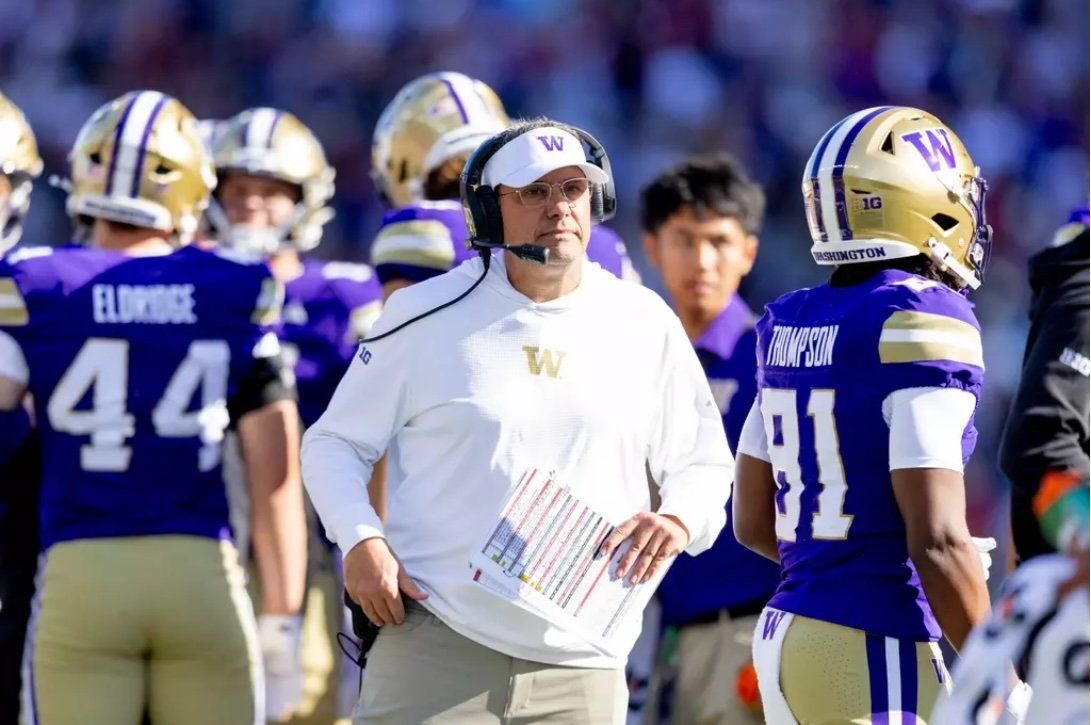
SEATTLE, Wash. — Huskies head coach Jedd Fisch needs to do something about his offensive coordinator.
The thing is, being a head football coach is hard.
So is being a CEO. An offensive coordinator. A quarterback coach. A recruiter. A counselor. A fundraiser. And a person forced to deal with the media and the helicopter nature of many college football parents.
Fisch is good at all those things. But perhaps not all of them at once.
Saturday’s disappointing loss to Minnesota in the Big Ten opener of a 2026 season UW entered with high expectations featured a blunder that forced the Huskies into needing a miracle for any chance to win a home game against a middle-of-the-pack conference team.
Trailing by 10 points to the 10-point underdog Golden Gophers, Washington attempted to rally as time dwindled — and dwindled and dwindled — in the waning moments of the fourth quarter.
The Huskies drove deep into Golden Gophers territory, and after a rare, quick on-schedule pass by quarterback Demond Williams Jr., the UW faced a first-and-10 just 13 yards away from cutting its deficit to one score as receiver Chris Lawson tumbled out of bounds with 2:27 to go.
As the umpire placed the ball on the hashmark at the 13 on the UW bench’s side of the field and the clock began to run, a meltdown occurred that essentially killed any non-miracle chance Washington had to win the game.
With only one timeout in his pocket, Fisch had several options, which included a quick pass into the end zone or a field goal to give the Huskies an opportunity for a stop and a score.
In that moment, it’s all on Jedd Fisch. He’s doing football clock math and making a decision about which play to call. There’s no phone-a-friend offensive coordinator up in the coach’s box to offer feedback. Though he hired Matt Cavanaugh — a 69-year-old long-time NFL coordinator who had been out of football for five years — it’s essentially all Fisch during every crucial moment for Washington football.
After Lawson’s catch at 2:27, the Huskies huddled.
Tick tock, tick tock.
Demond Williams looked to the sideline with 2:22 on the clock.
Tick tock, tick tock.
Fisch called a play that included a player substitution, which requires officials to grant the defense time to substitute. The Golden Gophers made the most of that allotted time. Though players are required to move on and off the field “at an athletic pace,” it doesn’t specify what type of athlete. In this case is was the slow, lumbering type like Paul Bunyan himself.
Tick tock, tick tock.
Instead of being able to run a play — or two or three if they involved incomplete passes — the clock ran all the way to the 2-minute timeout as boos reigned down from purple-clad fans still in the stadium after thousands departed, disgustedly, throughout the second half of a game they expected UW to win.
The play Fisch wanted worked, but the strategy was deeply flawed. Williams ran the ball into the end zone with 1:53 remaining to pull the Huskies within 27-24, but it was all but over.
Minnesota recovered the onside kick, and with no 2-minute timeout in the way to stop the clock, the Golden Gophers ran the clock down to 11 seconds before Tom Weston’s punt landed at the 1-yard line, bounced backward and into the awaiting arms of Minnesota’s John Nestor at the 2.
By then, all but 3 seconds of ticking and tocking was done, as there was no winning 98-yard play to call.
“We wanted to get a certain red zone play in because we felt how valuable we needed it,” Fisch said after the loss. “And we wound up subbing, and the sub came in way too late, and with that, then they got to hold another 10 seconds. So that's my fault. There was a certain personnel group that I wanted in the game for that play, so we wound up having to call it after the 2-minute warning.”
If Washington scores and kicks off prior to the 2-minute timeout, the clock would have stopped after two Minnesota plays — the 2-minute timeout and UW’s final timeout — meaning the Golden Gophers would have faced third down with about 1:40 to go.
Instead, with UW only able to stop the clock once, Minnesota’s third-down play began with 53 ticks left. While a game-tying drive in 40-50 seconds and no timeouts is still dire, it happens. The Huskies could have considered booting a kickoff deep after Williams TD run instead of the onside kick. Get the same three-and-out from Minnesota, and it’s conceivable that UW’s final drive begins at its own 30, needing just 30-35 yards to give kicker Tyler Robles a chance to tie.
Instead, Washington faced a hopeless situation. They got there, in part, because Williams took a sack at his own 32 on third-and-5 with 5:36 to go, which led to Fisch sending on the punt team on fourth-and-17 down 10 points.
That’s a mistake Williams must avoid, and something the head coach, the offensive coordinator or the quarterback coach must fix.
Fisch and former offensive coordinator/quarterback coach Jimmie Daugherty “parted ways” after a 9-4 season in 2025. Fisch has called offensive plays for all of his six seasons as a head coach at Arizona and Washington, but leaned on Daugherty in 2025 and Brennan Carroll in 2024 for much of the install portions and some game-planning details. Citing a desire to simplify the communications with Williams, Fisch took full control of the offense.
That change occurred six weeks after Williams announced he planned to enter the transfer portal before reversing course two days later.
With a couple of strong recruiting classes and an experienced quarterback, the Huskies, ranked 17th prior to the season, became a popular candidate to make the 12-team College Football Playoff. Though still possible, that seems highly unlikely now.
The Huskies looked rickety in underwhelming wins against Washington State and Utah State. Fisch called a pass play late in the Utah State game that went incomplete to stop the clock to give the Aggies a chance. The game ended with Utah State throwing into the end zone with a chance to win, though UW held them out to escape 16-14.
The warts that showed in those early games cost Washington against Minnesota. Fisch’s offense isn’t working. The quarterback is not playing well. The running game is lifeless, in part because it is abandoned too quickly. There are deeper issues with the program, including fundraising that is not where it needs to be to compete for titles.
And it only gets tougher with No. 18 USC looming in Los Angeles this week and four additional ranked opponents after that on the schedule.
Though Fisch has indicated he’d never stop calling plays, he needs to give up something. If not, it’s just a matter of time before he loses all of his jobs.