Analysis: How Can Seattle U Star Will Heimbrodt Build Off Breakout Season?
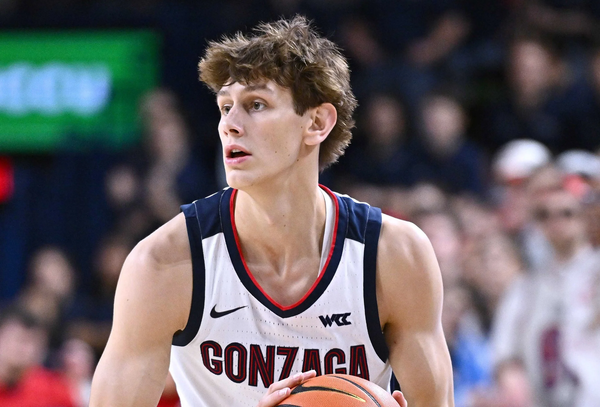
The biggest domino to fall in Seattle U’s favor over the offseason was retaining junior Will Heimbrodt. The rising forward broke out last season, becoming a full-time starter, emerging as the Redhawks’ second leading scorer, and earning WCC Defensive Player of the Year honors.


The biggest domino to fall in Seattle U’s favor over the offseason was retaining junior Will Heimbrodt. The rising forward broke out last season, becoming a full-time starter, emerging as the Redhawks’ second leading scorer, and earning WCC Defensive Player of the Year honors.
Redhawks’ head coach Chris Victor already knows what he’s getting out of Heimbrodt on the defensive end, but there’s reason to believe there is still untapped ability on the offensive end as a playmaker.
Following a season in which Seattle finished 21-14, the program retained only six players, with only Heimbrodt and Junseok Yeo being the two noteworthy returnees. If the Redhawks were to take a step forward, Heimbrodt will have to be one of many that needs to step up and fill the void in talent left this offseason.
What does Heimbrodt reaching his ceiling look like, and what does he have to do to reach it?
Midseason Struggles
An impressive stat line consisting of 12.3 points, 5.2 rebounds, and 2.2 assists per game on 42% from the field and 29% from three-point range does not tell the full story for Heimbrodt’s offensive season.
At his best finishing around the rim, Heimbrodt is a crafty finisher, but he suffered from inconsistency getting clean looks last season, especially after non-conference games turned into the WCC schedule.
He entered WCC play averaging 13.8 points per game on an efficient 49% from the field. Heimbrodt served as the perfect No. 2 option behind the Redhawks leading scorer, Brayden Maldonado. Maldonado spaced the floor, averaging 6.5 three-point attempts per game, while Heimbrodt added rim pressure through driving and cutting.
But Heimbrodt’s stats dropped at the start of Seattle’s first season back in the WCC conference play. His scoring dipped to 9.9 points per game on 33% shooting from the field in the first 14 games of WCC play. During that stretch, Victor gave some insight into some of Heimbrodt’s struggles.
“When he’s aggressive playing off two feet, attacking the rim, he’s pretty good. But when he’s driving soft and going on one foot is when he struggles and he really has not improved on that yet, so he's got to fix it,” Victor said after Seattle’s 70-58 loss to Washington State in January.
Heimbrodt's offensive game starts at getting to the basket. But throughout WCC play, he had to do so against much bigger frontcourts. Specifically in that WSU game, the Cougs ran lineups with two big men. He finished with six points on 3-of-11 shooting, as that size created problems for him.
Part of Heimbrodt’s struggles resulted from rushing looks at the rim and taking bad shots, which he could not get away with going against bigger frontcourts. After the season, Heimbrodt reflected on that stretch of games in which he involuntarily tried being a "scorer."
“I saw myself scoring more points at the start of the year and kind of put that expectation on myself that for us to win games, I had to score, which was not the best mindset to be in,” Heimbrodt said. “It wasn't from a selfish perspective of, you know like, ‘I want to see my stats.’ It was just from like, ‘We were winning and I was scoring. So, shoot, do I have to be a scorer?’”
Getting Back on Track
Heimbrodt’s bounce-back from a rough start to WCC play coincided with an injury that sidelined Maldonado for three games. Maldonado went down in a game against Oregon State on February 15. Those three games put a heavier emphasis on Heimbrodt as Seattle U’s primary scorer.
Heimbrodt averaged 16 points per game during those three contests, with arguably his best performance of the year against Pepperdine. In the Redhawks’ 87-80 win, Heimbrodt finished with 24 points on 10-of-13 shooting, five assists, five blocks, five steals and four rebounds.
Heimbrodt looked more decisive in these games. He did not force shots but took his time around the rim and ‘played off two feet’ like coach Victor advised. He let the game come to him and that mentality helped turn the tide.
“My coaches have been great staying confident in me, and telling me to relax and breathe,” Heimbrodt said. “When I play tight, I force shots and turn the ball over, but I was definitely more relaxed on the court trying to slow down and that helped a lot.”
“When my mindset goes to trying to be a scorer, I'm not super effective,” Heimbrodt added. “So I was just trying to continue to play hard on offense and do the little things.”
Taking the Next Step
Heimbrodt had the highest usage rate for Seattle last season (25.3%) and ranked ninth in usage rate among WCC players. Among the top 25, with first being at 30.4% and 25th being at 21.8%, Heimbrodt ranked last in offensive rating.
Another blemish of Heimbrodt’s season was turnovers. He finished the season with 82 of them, the most on the team. During that mid-season slump, he averaged 2.7 turnovers per game, drawing the ire of Victor on the sidelines.
Heimbrodt will need to be able to more effectively create his own shot this season, and there is no reason to believe he cannot. But there is reason to believe that he will not have as high of a usage rate due to some of the inefficiencies that came with last season and the understanding he’s not as effective when he tries too hard to be a “scorer.” Thus, the shots he does take need to look like they did in the latter half of last season.
In other words, Heimbrodt needs to be able to take what the defense gives him. In the aforementioned Pepperdine game, he was not forcing shots. Instead, he was posting up and reading the defense. If there is an avenue to the basket, he drove and played off two feet.
Seattle will need Heimbrodt to score at the volume he did this season, but he needs to be more efficient in doing so. Another way for him to add value is becoming a better player without the ball in his hands, which lends itself to generating more opportunities if he’s moving well away from the ball. Being an active cutter and setting good screens can provide easy looks when at times last season, his handle alone could not manufacture those looks.
The most important thing for Heimbrodt is to become a better spacer. He finished last season shooting 29.7% from three on nearly two attempts per game from behind the arc. This will immediately benefit the Redhawks offense, but even if he cannot become an effective three-point shooter, there is reason to believe the spacing as a whole will be better.
Seattle's best playmaker a year ago, Maleek Arrington, graduated, and while he did lead the team in assists, he was a negative as a floor spacer. Teams dared him to shoot and while he was a good playmaker, his ability to create for others became limited in certain games without the threat of being able to shoot from distance.
Holy Cross transfer Tyler Boston is the projected point guard starter. Boston will not bring the presence Arington did on the defensive end, but he will bring more juice on the offensive end.
In his sophomore season, Boston averaged 14.2 points and 3.6 assists on 36% shooting from three on four attempts per game. Other guard additions like Iowa State transfer Mason Williams, a 35% three point shooter, and Saint Martins transfer Kaden Hansen, a 46% shooter, will benefit the Redhawks offense as a whole.
That’s especially true for Heimbrodt, who must continue to do the 'little things' to truly build off the promise he showed last season and take a leap towards being a more efficient player for the Redhawks. If the program has any hopes of improving from the 21-win effort last year, he will have to take a true star turn, shouldering more of the leadership and scoring load without Maldonado drawing much of the attention.