Ford for Ferrer: Mariners Bolster Bullpen at Cost of Planned Backup Backstop

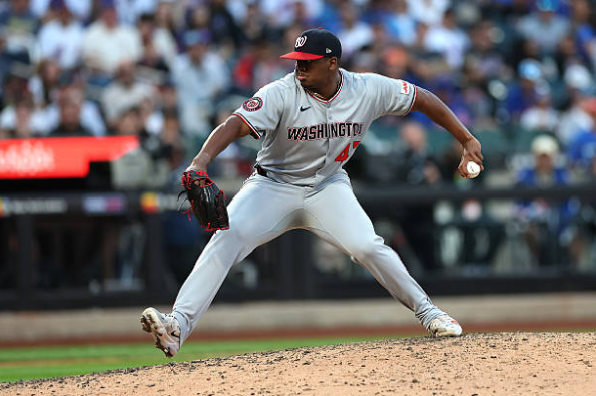
SEATTLE, Wash. — The Mariners announced a deal with the Washington Nationals on Saturday, Dec. 6 that sent Seattle’s now-former fourth-ranked prospect (and the 42nd ranked prospect nationally) Harry Ford to the nation’s capital in exchange for southpaw reliever Jose A. Ferrer. As part of the deal, the Mariners sent pitcher Isaac Lyon, the team’s 10th round draft pick in the 2025 MLB draft, over to Washington.
Ford had only eight plate appearances in the regular season and one in the playoffs during 2025, as the team was reluctant to use him in high-stakes situations during their deep playoff push. Upper brass had said, however, that their going game plan into 2026 was to use him as their backup catcher, filling in the spot left by newly minted free agent Mitch Garver, and with a good eye at the plate and a contact-first approach, the Nats could be set to have a plus bat on their hands for quite some time.
Coming to Seattle is a relief pitcher with something of a unique profile. A left-hander, Ferrer sports a three-pitch mix anchored by a sinker-changeup duo with the occasional slider thrown in. His sinker averaged 97.7 miles per hour in 2025, eighth most of any sinker that year, and it topped out at 100.7 miles per hour. For an organization in need of lefty relievers and in need of elite velocity, Ferrer does fill some holes. Both his sinker and changeup are very horizontal-moving pitches with around 18 inches of arm-side run, and although he doesn’t strike out an inordinate tally of batters, his changeup gets a whole lot of swing and miss.
Despite a 3.03 FIP and an elite 4.9 percent walk rate, however, Ferrer had a 4.48 ERA in 72 appearances last year. This was largely a result of bad luck, as hitters had a .345 batting average on balls in play (BABIP), well above the league average that hovers around .290. BABIP is very prone to regression, making Ferrer’s a good bounce-back candidate for 2026. Ferrer’s 64.3 percent ground ball rate is better than 99 percent of all MLB pitchers, meaning that good infield defense will be key for Seattle to get the most out of their new reliever.
The 25-year-old Ferrer will first be arbitration eligible in 2027 and is set for free agency in 2030.
Trade Grades
Instant Trade Grade: B
Ferrer’s aforementioned peripherals offer a good range of possibilities for the Mariners’ newest reliever, and with some quite pricey Devin Williams and Emilio Pagán signings already accomplished by other teams, the potential free agent arms that the team could have looked at might come at an overburdensome opportunity cost. The team’s payroll in 2026 will probably be in the $160 million-$170 million range come Opening Day 2026, and with the return of Josh Naylor, that figure is already approaching the low end of that range, pending arbitration for several players.
Seattle will have to look elsewhere for a backup catcher and designated hitter, although there is a wide range of possibilities for what will effectively be his rookie year in 2026, and in the case of Ford not panning out, Seattle would have to find someone to fill that role anyway.
Ferrer fills two niches that the M’s needed in 2025, that of an extra lefty specialist and of a guy who can hit triple digits. The distance between the floor and ceiling of this trade is quite broad, although the possible outcomes for Ferrer are more constrained than those for Ford.
There are multiple avenues for development for the hard-throwing southpaw. If Ferrer develops his slider from an afterthought third pitch to a mainstay of his arsenal, he will keep hitters on their toes and increase his strikeout rate. Increasing the usage of his changeup would likely also augment his baseline, especially against the right-handers who see his sinker more clearly than lefties.
Even if Ferrer doesn’t make a significant improvement in his process, his results should improve over what we saw in 2025. His 1.271 WHIP would have been 1.045 given a league-average BABIP, and since ground balls typically have a slightly lower than average BABIP, the southpaw sinkerballer should be able to pitch closer to his FIP in the upcoming season.
Seattle could also come out ahead in the trade if Ford turns out to be a dud at the major league level, as they would have sold their prospect at his highest value.
The flipside of that, of course, is that if Ford becomes a mainstay big leaguer, the trade will end up a lot less positive for the M’s. If both Ford and Ferrer develop to full potential, the outcome of who “won” the trade will depend on the niche that each player fills in their organization: if Seattle has a host of hitters that step to the plate (pun intended!) in 2026 and beyond, then trading one for a reliever makes perfect sense; if T-Mobile Park once more has a lack of bats more than a lack of arms, the absence of Ford could be sorely felt at the corner of Edgar and Dave.
The worst-case scenario for the Mariners is that Ferrer is either unavailable with injury for much of the next few years or simply fails to perform all while Ford blossoms in Nationals Park. The new Nationals catcher certainly has the capability of consistently putting up something like a .250/.350/.400 slash in the big leagues, something that Jerry Dipoto and company were surely well aware of when they pulled the trigger for Ferrer, who has had notable issues dealing with right-handed bats. Further development would patch that issue up, however, and it looks like Seattle’s front office has bet on Ferrer’s development over Ford’s.