Good Season, Peppered with Bad Starts? Analyzing George Kirby’s Mixed-Messaged 2025 Campaign

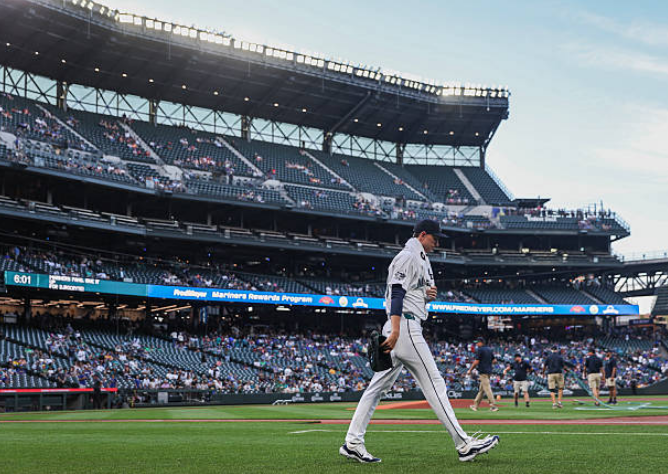
It’s not often you hear tell of a fourth-year slump. Injury slumps, however, are more common, and that’s what happened to George Kirby in 2025. Throwing shoulder inflammation announced on March 7 set him back until late May, when he opened the season with 3 ⅔ innings of five-run ball against the Astros. His second start wasn’t much better: he went five full frames this time, but gave up three homers and six runs in total.
Blowup starts appeared throughout the season, as Kirby twice gave up seven runs and thrice gave up four runs from June onward. Uncharacteristic control issues often cropped up during these outings, often followed by an overcorrection to groovy down-the-middle meatballs. Kirby, who consistently boasted some of the lowest walk rates in baseball in 2023 and 2024, took a notable step back in that area, and the opposing hard hit rate jumped from 36.3 percent to 43.9 percent.
The top line stats show a season that was in many ways a step back: his 4.21 ERA was the worst of any season in his career. But there are plenty of high points to be found in Kirby’s season despite the struggles. His strikeout rate took a noticeable jump from 23 percent in 2024 to 26.1 percent in 2025, concordant with a whiff rate increase from 24.1 percent to 26.7 percent, and his 3.37 FIP was right in line with career numbers.
Breaking things down pitch-by-pitch, we can see that while some of Kirby’s offerings had consistent upside, others failed to fool opposing bats in any real measure. Just in 2024, he most commonly used his four-seamer, sinker, and slider for more than half of his total workload.
[caption id="" align="alignnone" width="1320"]
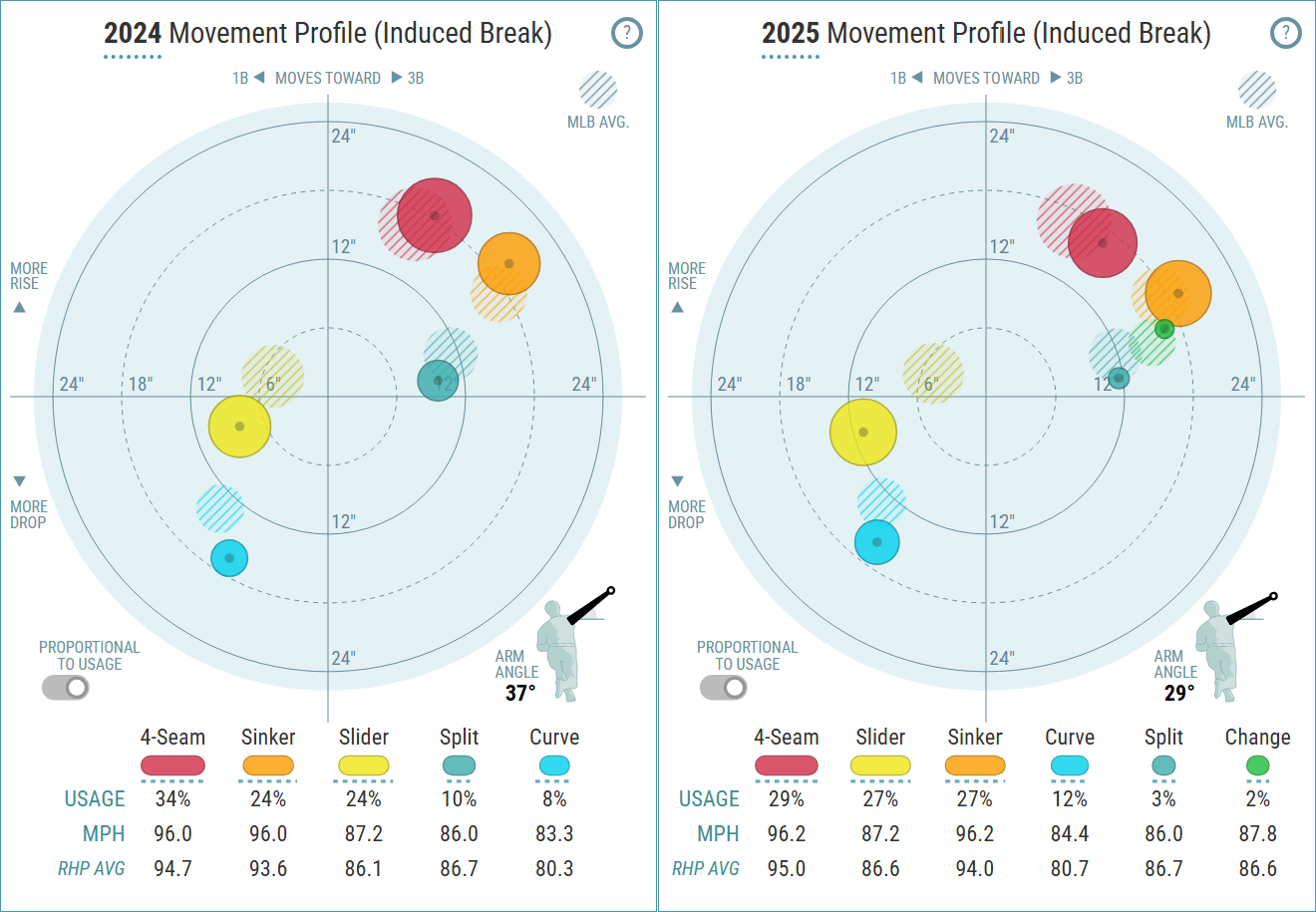
Sourced from StatCast data, here we see George Kirby’s movement and pitch selection profile between 2024 and 2025. He dramatically lowered the usage of his splitter, a matter which is discussed later in this article. [/caption]
Although his four-seamer and slider mostly maintained their effectiveness year-to-year, opposing batters caught up to his sinker in 2025, improving their slash line against the pitch from .221/.242/.312 to .309/.373/.518. Batted ball data also jumped for the hitters, with the pitch’s hard hit rate going from 39.9 percent to 43.5 percent, but the big thing that happened was that flyouts became line drives.
[caption id="" align="alignnone" width="2000"]
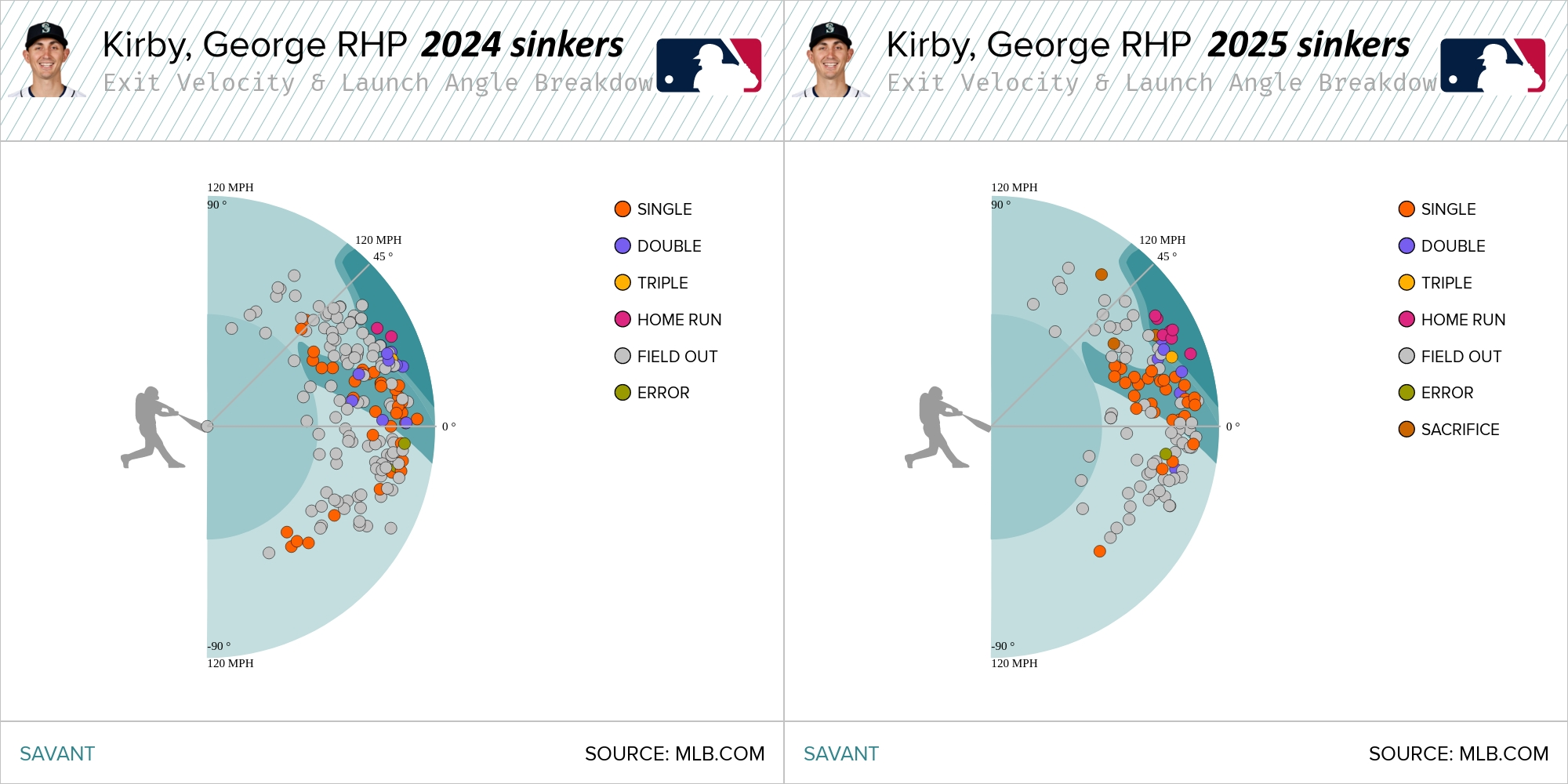
Again sourced from StatCast data, this is a map of each batted ball against Kirby’s sinker in 2024 and 2025 by launch angle and exit velocity. Different combinations of these two factors tend to lead to different outcomes, with the darker blue areas better for hitters. [/caption]
The reason for this, in turn, was that Kirby’s sinker - and his four-seamer, for that matter, though it had little effect in that case - had more vertical drop than it had the year prior. The way Kirby uses his sinker, and the way the pitch was shaped in the 2024 season, is more along the lines of a two-seamer. Unlike a classic sinker that is thrown in the bottom of the zone to get ground balls, Kirby typically throws his sinker near the top of the zone to get weak fly balls.
The extra 2.6 inches of vertical drop on average was enough to turn some of these weak fly balls into line drives that scraped the outfield grass. Despite the sinker’s struggles, Kirby had success during the last four starts of the season (with a 2.95 ERA, 2.43 FIP, and a 0.984 WHIP in 21 ⅓ innings) while using that pitch the most out of any in his arsenal, even though hitters continued to attack the sinker well.
Perhaps Kirby never quite found a feel for his sinker after recovering from injury, or perhaps his struggles with the pitch had some other source. The velocity on his fastballs didn’t drop year-to-year, only the induced vertical break or “rise,” and for his sinker, this seems to have been important.
Although Kirby’s slider proved effective through the 2025 season, his other breaking pitch, the curveball, was not quite as good. The curve, however, did offer some mixed signals, with a .254/.266/.349 slash against it but a 50 percent hard hit rate and 91.7 mile per hour average exit velocity. The pitch improved over its 2024 performance, but it was still a start-to-start option for Kirby: if he had a feel for it early, he would throw it; if not, he would save the curve for another day.
The usefulness of Kirby’s curveball depended mainly on location. Hitters would often pick up the pitch out of his hand, but if he got it low enough out of the zone, they would still swing over the top of it. The flip side of that, of course, is that when the curveball clipped the strike zone, batters squared it up relatively easily. Kirby’s curveballs in the lower third of the “shadow” attack zone had a 58.3 percent hard hit rate, a 48.1 percent whiff rate, and a 93.5 mile per hour average exit velocity, while those in the “chase” zone had a 33.3 percent hard hit rate, a 69.2 percent whiff rate, and an average exit velocity of 90.1 miles per hour.
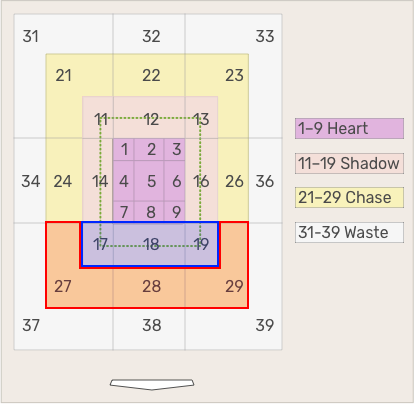
However, it should be mentioned that hitters benefited from a fair amount of luck on his “shadow” zone curveballs, with a .333 batting average on balls in play in the lower third of the shadow zone, while Kirby still had a 45.5 percent strikeout rate on such pitches and a positive run value. The curveball, for Kirby, was often more about general “feel” than location per se.
The off-speed pitches didn’t make very many appearances in 2025, and for good reason. Kirby only threw his splitter 56 times and his changeup 46 times - 2.7 and 2.2 percent of his total pitches, respectively - but there did appear to be something of a difference between the two. Batters had a .364/.380/.417 slash line against the splitter with a 75 percent hard hit rate, 36.7 percent whiff rate, and 97.1 mile per hour average exit velocity. The changeup appeared much brighter for Kirby, with a .111/.160/.111 slash line, 14.3 percent hard hit rate, and an average exit velocity of 88.4 miles per hour against the pitch.
The whiff rate, however, was astronomically lower at 9.5 percent, and the miniscule sample size removes us from very many conclusions other than the feel he had for the pitch on any particular day. He didn’t throw very many of either pitch later in the year in any case, and he only threw three changeups total in the postseason.
2025’s ups and downs affected Kirby notably, but after his late-season success, “Furious George” got some of the most important starts of the playoffs: Games 1 and 5 of the ALDS and Games 3 and 7 of the ALCS. His only blip against the Tigers was a meatball to Kerry Carpenter that led eventually to the Mariners’ loss that game, but Kirby ended up being ground zero for the Blue Jays’ offensive firestorm in Game 3, giving up eight earned runs as he worked into the fifth. Blowup outings, it seemed, could not escape him fully in 2025. Perhaps a more consistent feel for the curveball or off-speed stuff could have prevented these outings from getting out of hand, but there is no way to prove such a hypothetical until games are played in 2026.
Kirby dealt in Game 7 nevertheless. He headed off a first-inning rally at the pass with just one run allowed and worked around two lone singles over the next three innings to keep the Jays in place over the first four frames. He had only thrown 65 pitches and probably could have kept going, but with the order due to turn over for the third time, manager Dan Wilson took him out for a bullpen-available Bryan Woo. The ball was out of Kirby’s hands, and it was out of Woo’s as well by the time the seventh-inning disaster was complete.
Kirby had a 6.00 ERA, 1.389 WHIP, and 4.52 FIP through the entire 2025 postseason and averaged 10.5 strikeouts per nine innings, two walks per nine, two homers per nine, and a 5.25 strikeout-to-walk ratio. Despite the three solid starts, his one blowup hung like a shadow - forgotten by many, but likely not by him - as the moment when the Blue Jays turned the series on its head.
Like many Mariners, the 2025 season had a lot of hardship, a lot of resilience, and an incredibly distant run that ended in heartbreak for George Kirby. The Mariners’ 2026 season is as of yet unwritten, but every fifth page of that book will bear Kirby’s writing.
Unless another injury or something else that hampers his feel comes around to nag at the Mariner hurler’s feel, he will likely return to full form in 2026. But the year might need to be about more than just a return to previous years - the M’s will be looking for an improvement to new heights.