Glimpsing Offseason Priorities: Four Takeaways from Mariners’ End-of-Season Interviews

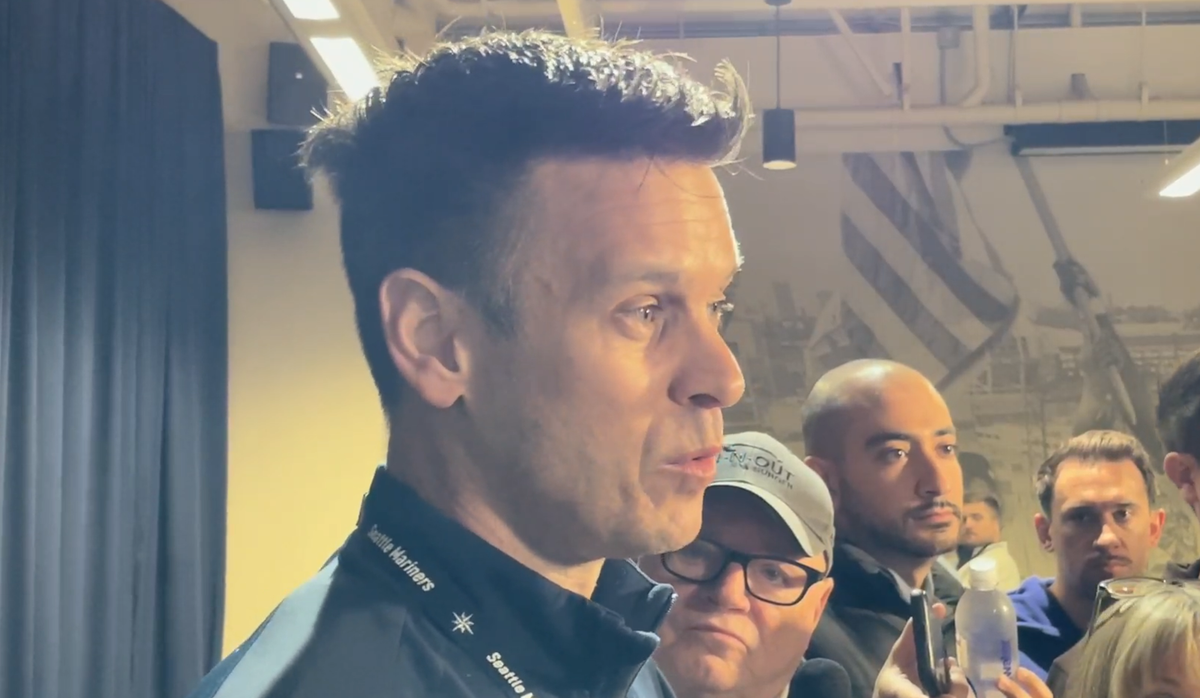
SEATTLE, Wash. — After a heartbreaking end to what had been one of the most magical seasons in Mariners history, members of the media interviewed three figures in the Mariners organization on Thursday—president of baseball operations Jerry Dipoto, general manager Justin Hollander, and manager Dan Wilson—about how the season had gone and the going plans for the following year.
Wilson somberly discussed what it was like coming off the team’s tragic loss, describing a “quiet” atmosphere in the clubhouse and on the flight back. But with the end of the Mariners’ season, the buck passes to Dipoto and Hollander and to the moves that might come in the upcoming offseason and at the trade deadline. They offered four interesting nuggets that reveal how they will approach things this winter.
I: Re-signing Josh Naylor is “a priority” for the Mariners, but Dipoto says the team will “take a step back” before assessing decisions.
Seattle’s most productive splash at the 2025 trade deadline was the acquisition of Diamondbacks first baseman Josh Naylor for pitchers Ashton Izzi and Brandyn Garcia. Naylor, who had slashed .292/.360/.447 in the first four months of the season, kept up his production with the bat for his new team. Unlike many past players who have complained about the batter’s eye in T-Mobile Park, Naylor found the confines of T-Mobile Park to be quite friendly, often commenting about how he sees the ball well in Seattle.
An .831 OPS would have been a boon all by itself, but the M’s got a full package in their new first baseman. An aggressive contact hitter, Naylor offered a far different approach than much of the Mariners’ take-heavy, homer-focused lineup, and as such could often ambush opposing pitchers who had gotten used to the rest of Seattle’s roster.
The most surprising aspect of Naylor’s game was his baserunning. Despite having a sprint speed in the second percentile in MLB, he stole 19 bases with the Mariners without being caught a single time. His ability to pick the exact pitch to run on bested opposing batteries again and again, and without a second-inning steal of third in Game 5 of the ALDS, the M’s wouldn’t have made it to the ALCS at all.
Even on defense, where Naylor hadn’t been particularly proficient for Arizona and a skill that first basemen are rarely sought for, saw a big improvement once he started working with Mariners infield wizard Perry Hill. He proved quite able to pick quick skippers off the dirt, both from the right arms of the Seattle infield and the bats of his opponents. Although he had six defensive runs saved below average for the Diamondbacks, that figure with the Mariners was five defensive runs saved above average.
Naylor, however, will be an unrestricted free agent this winter. As a 29-year-old, Naylor likely has quite a few productive years left, meaning that multiple organizations will be chasing after the first baseman. For the Mariners, who have had issues finding offensive production, getting Naylor back for 2026 is a massive item on the checklist.
“Obviously, it’s a priority,” Dipoto said about re-signing Naylor. “But we will take a step back from where we are before we truly assess, and we’ll communicate with the players before we say anything publicly.”
Spotrac estimates Naylor’s average annual market value at a little over $15 million, a contract that would mark about $5 million dollars per win above replacement given his full 2025 performance—or about $10 million per WAR if the ZiPS 2026 projection of 1.5 fWAR is correct. Seattle and Naylor are both expecting a better year than 1.5 fWAR, however, and so the contract could get a little pricier.

The M’s have not made a whole lot of big splashes in free agency during Dipoto’s tenure, but if the Spotrac estimation is anywhere close to the eventual reality, the cost would not be prohibitive for the Mariners. The exciting environment of the clubhouse and city during Naylor’s three months on the team could offer some incentive to stay in the Emerald City.
“Josh just got two months plus the playoffs of what Seattle is like as a sports town, he got a behind the scenes tour from the Kraken. I believe he’s negotiated some ice time with [Kraken president of hockey operations] Ron Francis as well,” Hollander said to laughs. “He’s a really good dude, and I really think he liked it here a lot, not just downstairs—teammates, coaches, hopefully Jerry and I—but I think the city, the environment, the region, the whole vibe of it all.”
Regardless of how well Naylor liked Seattle as an ambience, however, the front office will have to pony up some amount of dough to keep him with the Mariners. As to what “taking a step back” means, there is only speculation.
II: End-of-season payroll is a “starting point,” but there’s no indication that M’s payroll will take any big leaps in 2026.
The Mariners had a payroll of $146,793,414 on Opening Day 2025, but deadline acquisitions have likely pushed it up somewhere into the realm of $165 million by the end of the year.
“I would say, similar to where we ended the year, as a starting point [for 2026 payroll],” Dipoto said. “We ended the season, I think, with the second-highest or highest payroll we’ve ever had as a franchise.”
The behind-the-scenes operations are as of yet unknown—we don’t know if, say, any of the team’s recent moves had strings attached about future payroll, or if ownership philosophy has changed at all in regard to spending. However, without any further information or concrete commitments from any part of the front office, Occam’s razor suggests that the Mariners’ payroll will remain in the $160 million range.
In addition to Josh Naylor, both Eugenio Suárez and Caleb Ferguson will be unrestricted free agents going into 2026. The M’s have a club option to extend Andrés Muñoz that they would be fools not to take, but it’s unlikely that the team will exercise their side of Mitch Garver’s $12 million mutual option, and it’s unknown whether Jorge Polanco will take his $8 million player option or test the waters of free agency.
III: Hollander says that there was “more we could have done” to secure a championship.
Although the Mariners had a good trade deadline overall, there was clearly stuff on the table when the MLB’s flurry of moves concluded at the end of July. They got the two bats they wanted, sure, but the Phillies swiped Jhoan Duran, their initial bullpen target, and so Seattle pivoted for Caleb Ferguson to add a potential lefty specialist to the relief staff.
Ferguson, unfortunately, didn’t pan out as Seattle had hoped. His first few weeks on the team went well enough, but he quickly started getting lit up by bats across the league and never truly settled back down in September or in the postseason. A mop-up relief appearance in Game 3 of the ALDS quickly went off the rails and forced Dan Wilson to use Muñoz in a game that had been a blowout win. With Ferguson clearly not an option against the powerful and largely right-handed Blue Jays lineup, they were able to get more familiarity with the rest of the bullpen, and Springer’s seventh-inning Game 7 game-winner was a season-ending reminder that the lack of different options in the bullpen mattered dearly in the playoffs.
“We didn’t get it done, we did not get far enough, and I take responsibility for that,” Hollander said. “There’s more that we could have done to give our players one percent more of a chance to get there.”
Hollander very well could have been picturing the failure to get Jhoan Duran at the trade deadline, but the idea of “not enough” applies far more fittingly to quite a few of the previous offseasons where the M’s stood incredibly pat as prime free agents were plucked by organizations more willing to open their wallets. Some of the Mariners’ reclamation projects and smaller contracts proved keen, but others fizzled out, and teams that get to the promised land typically add a playoff-tested All-Star to the ranks of their core.
IV: “These guys aren’t role players”: the Mariners will likely lean more heavily on homegrown players than outside talent.
One piece of persistent good news for the Mariners is that the team has one of the best farm systems in the league, with eight top 100 prospects at various places in the organization. If all goes well, these prospects could fill out some of the glaring holes in the roster.
But we know not everything will go well. It is not a question that some of the prospects will be busts, that much is certain, but it is a question if any of the hitters, who the organization has struggled to develop for two and a half decades, will become the players the Mariners need going forward. A good sign for the future does come from the success in developing Cal Raleigh and Julio Rodríguez into strong men with the bat, but their ability to develop guys whose potentials can only be reached through a contact-oriented approach—like Ben Williamson and Cole Young—is still very much an open question.
Dipoto and Hollander are putting a lot of chips on the prospects booming more than they bust.
““They [the prospects] are going to be part of what we do going forward,” Hollander said. “It’s our job to build a roster that can support the growth that they’re gonna need to have in order for us to reach the ceiling that we need to have, which is going and winning a World Series, and you can’t do that without developing your own homegrown players, and your own homegrown difference-making players. These guys aren’t role players; these guys are everyday guys to All-Stars to maybe more than that.”
With that in mind, alongside the high likelihood of a noticeable degree of budget constraints, the general Dipoto M.O. of staying largely pat in offseason free agency, testing out the riper prospects in the first few months, and making trades to augment the roster at the deadline is likely the script that the Mariners will follow in 2026.