Five Key Moments from Mariners’ Demoralizing Game 1 Defeat to Detroit

SEATTLE, Wash. — The 2025 Mariners had their first playoff test, and in partial accordance with Murphy’s Law, a lot went wrong. The offense tried to play hero ball far too often, letting down a series of pitchers who gave their all as they let ample hanging breaking balls and middle-middle cheese go unpunished. The only two Mariners with hits were Julio Rodríguez and Cal Raleigh, and even Raleigh missed some meatballs he should have crushed.
Still, it was close, and could very well have ended up in the Mariners’ favor. Five moments stand out above the others, however, as to why the Mariners dropped Game 1.
I: The wind contains a Josh Naylor fly ball that would have doubled a 1-0 Mariners lead in the bottom of the fourth.
The Mariners opened the scoring in the bottom of the fourth with a dead center blast from Julio Rodríguez, and just two pitches later, it seemed as if the lead would be doubled. Tigers starter Troy Melton fired a 1-0 fastball right down Broadway and Naylor put a Broadway-sized swing on it, crushing a fly ball to right. Although it launched off the lumber at 108.3 miles an hour with a firecracker of a sound, it flew at an angle just barely too high.
Still, balls hit at a combination of 108 miles per hour and a 40 degree launch angle travel 377 feet on average, more than enough to clear the right field fence in T-Mobile Park. But with the wind blowing in from that direction and the cold marine air suffocating the ball’s flight, the hit died on the warning track, 352 feet from home plate.
That insurance, had it gone through, would have—ignoring the butterfly effect—given Seattle just enough margin to hold out a win in regulation innings. Mother Nature had other ideas.
II: Kerry Carpenter annihilates a two-strike two-seamer from Kirby, putting up Detroit’s regulation runs.
All game long, George Kirby had been living between the top three inches of the zone and half a foot above it. Early in the game, curveballs at the base of the strike zone had found their way into the outfield, so the Mariners’ starter kept Detroit’s eyes up at the letters through the middle innings.
With a man on second and two outs in the top of the fifth, Kirby once again busted a hitter inside and up. Kerry Carpenter, like many others before him, fell behind 1-2. Another high fastball came towards the plate, but this time, Carpenter predicted its location exactly.
You can’t hit a ball much harder than Carpenter did at that moment. The ball flew off the wood at 112.5 miles per hour and left the ballpark in a hurry, descending into a sea of dejected Seattle faithful. The score was flipped in an instant; a gleeful grin grew wide across the visage of Tigers manager A.J. Hinch.
Kirby got out of that inning without any damage, Carpenter’s homer the only blemish on an eight-strikeout start. But with his pitch count up to 94 and Detroit starting to get better contact, Dan Wilson went to his bullpen for the sixth.
III: Josh Naylor grounds into a rally-killing double play in the bottom of the sixth.
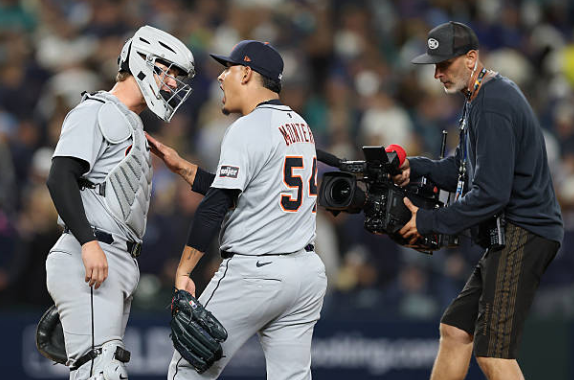
There was one moment when it seemed Seattle was finally on the verge of putting up a crooked number. In the bottom of the sixth, right after Carpenter’s mammoth blast, Hinch brought in Rafael Montero to pitch to the top of the Mariner order. Although Montero has been solid for the Tigers this year, with a 2.86 ERA after arriving from Atlanta, the ghosts of his uneasy at best Mariner past haunted him awfully.
Montero walked Randy Arozarena after going up 0-2 on the leadoff left fielder and gave up a single to Cal Raleigh that put runners at the corners with nobody out. Julio Rodríguez shot a game-tying liner into right field, forcing Hinch to pull Montero and try to put out the fire with Tyler Holton.
Josh Naylor, who had been a Mariners hero all season long—especially at home—came to the plate. But when it all mattered on Saturday night, he put a weak defensive swing on a sinker over the outside edge, and chopped into a tag-and-throw double play.
A Jorge Polanco lineout officially ended the inning, but the momentum had crashed as soon as the pitcher’s best friend came to Detroit’s aid.
IV: Dan Wilson brings Gabe Speier on for Eduard Bazardo to start the seventh, contracting the Mariners’ bullpen options.
This one is a moment that matters in its knock-on effects. Gabe Speier himself had a beautiful 1 ⅓ innings of work, shutting down all four batters he faced. He came in for the seventh because three of the four upcoming hitters were left-handed, but some things are more important than platooning.
Seattle has four relievers that can be accurately relied upon in late innings of close playoff games: Eduard Bazardo, Gabe Speier, Matt Brash, and Andrés Muñoz. Caleb Ferguson had already gone out for two outs of the sixth, but was pulled for Bazardo with a man on first and the right-handed Javier Báez coming up.
That decision in itself is defensible but a little iffy, given how much of a feast-or-famine hitter Báez can be. Still, it worked out, as Bazardo got a weak popout to end the half-inning.
With a tie game in the top of the seventh and only two hitters on the entire squad having recorded base knocks, however, the Mariners dugout needed to be more cognizant of the possibility of extra innings. Taking Bazardo out reduced the number of playoff-caliber relievers to three—and with Seattle’s fairly strict one-inning game plan for its bullpen, that only covered the nine regulation innings.
Speier got the extra man in the eighth due to Riley Greene’s left-handedness, but Brash finished out the frame. Muñoz, luckily for Seattle, got through the ninth quickly and was able to pitch in the 10th, but when nothing happened for the Mariner offense in that inning, Dan Wilson was out of premium bullpen arms.
V: Carlos Vargas throws a wild pitch and allows Spencer Torkelson to second base.
Wilson went to the next best man. Carlos Vargas posted a 3.97 ERA in 70 appearances during the regular season, mainly in mop-up duty or extra innings, but he had been frustratingly inconsistent, with stretches of excellence mixed in with bad blowups. With Tarik Skubal on the mound for Detroit in Game 2, Wilson was putting a whole lot of Seattle’s remaining chips on the good Vargas showing up.
In fairness to Vargas, he was given a nonexistent margin for error. The offense had been dead since the seventh; by the 11th inning, they were already skeletonizing. It was some déjà vu from Game 3 of the 2022 ALDS; the only way Seattle was going to win was if someone managed a random homer, and this was a cyclical issue: practically the whole lineup (except Julio Rodríguez) was playing pretty sloppy hero-ball in their at-bats.
Spencer Torkelson walked to lead off the 11th, but Vargas appeared to recover, striking out the next two. But during Wenceel Pérez’ at-bat, he had overcooked a heater, spiking it for a wild pitch that brought Torkelson to second.
Zach McKinstry was Detroit’s hero, sneaking a ground ball perfectly through the hole up the middle to score Torkelson easily and give the visitors a 3-2 lead. Although Rodríguez gave the M’s a tiny spot of hope with a two-out single, Josh Naylor weakly grounded out to end the ballgame, and the M’s now face a must-win Sunday evening matchup against Tarik Skubal.