Film Study: 11 Observations From Seahawks’ Week 1 Loss to 49ers

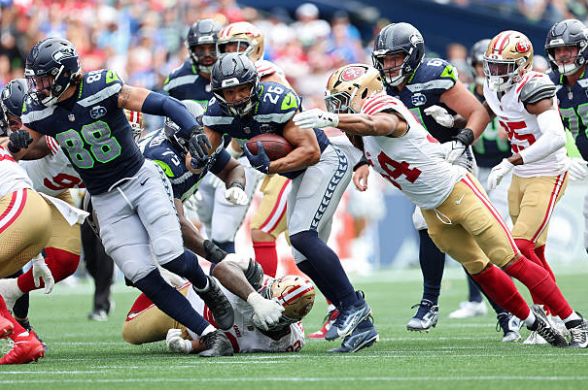
Failing to capitalize on a couple of late opportunities that slipped through their grasp, the Seattle Seahawks opened their 2025 season with a 17-13 loss to the San Francisco 49ers at Lumen Field, extending their home losing streak to their rivals to four games.
While the end result obviously wasn’t what the Seahawks wanted to begin year two under coach Mike Macdonald, after combing through All-22 film rewatching the game, more positives emerged than negatives, particularly for a defense that dominated for a large stretch of Sunday’s opener by holding Christian McCaffrey to 3.1 yards per carry and intercepting Brock Purdy twice in defeat.
Looking back at the opener, what stood out from the Seahawks’ gut-wrenching loss? Here are 11 observations backed up with specific film clips and advanced statistics:
1. Quick-triggered Sam Darnold least of Seattle’s problems leading sluggish offense.
For those already wanting to proclaim the Seahawks’ decision to sign Darnold in free agency as a dud, this column may not be what you want to read. But factually speaking, the veteran quarterback checked off a number of boxes in his team debut, starting with quick processing and a fast release from the pocket orchestrating a timing-based passing game. Per Pro Football Focus charting, he finished tied for third fastest among quarterbacks in Week 1 with 2.48 seconds on average per drop back, consistently getting the ball out of his hands in rapid fashion, helping limit the number of pressures on him to just seven on the afternoon.
Right out of the gate, Darnold showed off his quick release by firing a dart over the middle to Jaxon Smith-Njigba for 21 yards on the first play from scrimmage. He did this on several occasions with JSN, hitting the receiver on crossing routes twice for 20-plus yard gains. When the pocket got muddied up, he wisely escaped the pocket a few times either to scramble or continue looking for receivers downfield, including a 16-yard completion to Smith-Njigba coming back to the football for a key first down.
Though he didn’t get to over 100 passing yards until late in the fourth quarter, that had more to do with the game plan than Darnold, who didn’t get many chances to push the ball downfield but did well on the few occasions where he was granted the opportunity. He didn’t have any turnover-worthy plays and his receivers not named Smith-Njigba let him down a few times, including an uncharacteristic third down drop by Cooper Kupp, so he wasn’t anywhere close to the reason why the offense was stagnant.
2. A couple notable differences have vaulted Zach Charbonnet ahead of Ken Walker III on depth chart.
After missing a decent chunk of training camp nursing a sore foot, it remained a bit of a mystery how much the Seahawks would deploy Walker in his first game action since last December. As it turned out, the team leaned more heavily on Zach Charbonnet, who played 30 snaps compared to Walker’s 21, and the former earned those reps as the game went on by being more effective on the ground, averaging 3.9 yards per carry compared to the latter’s 2.0 yards per carry.
Digging into the numbers, there’s some truth to the narrative that Charbonnet received better blocking in front of him than Walker. He averaged 3.9 yards per carry before contact, while Walker was more than two yards less at 1.8, which would seem to indicate more running room to work with created by blockers up front. But additional context via All-22 end zone film provides more depth showing that Charbonnet made some of that yardage with his vision and decisiveness as much as the way the blocking unfolded in the trenches.
Looking at one specific example from Sunday’s contest, the Seahawks dialed up an inside zone out of 21 personnel with fullback Robbie Ouzts in front of Charbonnet in an I-form look. To the play side, right guard Anthony Bradford got beat off the snap by defensive tackle Kalia Davis, looking poised to blow up the run before it could even get started. But Charbonnet quickly broke down and cut back against the grain, slipping past the defender’s outstretched hand and shrugging him off with an arm shiver, sticking his cleat in the turf and powering downhill to turn the play into a successful six-yard run.
From that standpoint, Charbonnet appears to be more comfortable with Kubiak’s scheme, having a better feel for the zone schemes, at least at this point. He also generated more yardage after contact than his counterpart in the opener, producing two missed tackles and well over a yard per carry after contact more than Walker. As Mike Macdonald said on Monday, both backs will get their opportunities, but right now, the offense seems to have a better rhythm with Charbonnet on the field.
3. Klint Kubiak didn’t do his quarterback - and receivers, for that matter - any favors game plan-wise.
Sometimes, offensive coordinators can outsmart themselves trying to throw a changeup, and that appeared to be the case for Kubiak going against his former mentor in Kyle Shanahan. Going against past tendencies as a play caller with the Vikings and Saints, the Seahawks ran 12 personnel with two tight ends on the field on just seven snaps at a 14 percent clip, shifting away from using multi-tight end sets as he had utilized extensively in training camp and the preseason up to this point. But that wasn’t the most shocking development game plan-wise.
Despite calling 26 run plays in an effort to establish the ground game, the Seahawks only called two play action passes - or eight percent of their attempts - the lowest rate in the NFL in Week 1. In the clip above, Darnold turned the first attempt into a 21-yard completion to a wide open Smith-Njigba, enjoying an excellent pocket without any pressure and the time to fire a strike over the shoulder to his receiver after he came uncovered on a corner route. The other attempt turned into a five-yard scramble for a first down, but no other play passes were called in an unexpected turn of events.
Kubiak also suffered from getting too cute at times over the course of the game, most notably on a bizarre three-play sequence in the fourth quarter. On first down, without having any screens that sprung for positive yardage earlier in the game, he called a rollout throwback screen that the 49ers snuffed out for an eight-yard loss. After Charbonnet got stuffed for no gain, he then pulled out some trickery out of his bag of tricks with Smith-Njigba throwing a backward pass after being initially targeted by Darnold, only for his throw to sky over the receiver’s head and shoot out of bounds for a fumble. It’s safe to say that drive should be put in the recycle bin, never to be seen again.
4. Pass protection generally held up well against Nick Bosa and company with a few exceptions.
Considering the Seahawks ultimately lost in the closing seconds on a strip sack when right tackle Abraham Lucas was overpowered back into Darnold’s throwing hand by Nick Bosa, it would be easy for fans to blame the offensive line and bemoan the same Achilles’ heel haunting the team once again. That play served as an all-too-familiar reminder of the numerous times Russell Wilson and Geno Smith were ambushed by opposing rushers with subpar protection in front of them and frequently had the ball punched out of their hands when they tried to throw over the years.
But with the exception of that final fateful play and a big hit on Darnold on the game’s opening series that led to a punt, Seattle’s offensive line did a stellar job of protecting the quarterback and keeping pass rushers away from him. The group allowed a grand total of five pressures on 28 drop backs with four of the five starters posting 98 percent of better pass block efficiency rates. Darnold helped by getting rid of the ball fast and few plays required extended time in the pocket with mostly a conservative game plan on that front, but the line did a fine job of mitigating quick pressures and giving him time to operate throughout the afternoon.
5. Targeting off line of scrimmage, out of backfield biggest issue behind inconsistent run game.
While the Seahawks played a mostly clean game in pass protection, the same can’t be said for the run game, where the offensive line turned in an inconsistent performance. Going into Sunday’s game, the expectation was that Kubiak would mostly lean on zone concepts, as he had a 72/28 percent split between those and gap schemes with the Saints last season. But interestingly, the ratio hovered a bit closer to 50/50 in the opener with 14 zone runs and eight gap runs, and the difference in effectiveness couldn’t have been much more stark on film.
When Kubiak called gap concepts, Seattle’s front line as well as Ouzts out of the backfield struggled from a targeting standpoint, failing to get into position to execute blocks and allowing defenders to win in their gap far too often. In the clip above, the Seahawks ran a Power concept out of a strong I-formation set with left guard Grey Zabel pulling to the right and Ouzts expected to kick out the defensive end. Unfortunately, the play got mucked up right off the bat with Lucas getting beat inside and Ouzts unable to get inside leverage against defensive end Mykel Williams, preventing Zabel from turning upfield as a lead blocker and forcing Walker to bounce into a scraping linebacker for no gain.
On the flip side, the Seahawks put much better blocking reps on film in the zone game from a targeting standpoint to provide running lanes for Charbonnet and Walker. Running split zone out of shotgun in 11 personnel, tight end A.J. Barner motioned across the formation pre-snap and kicked out the backside end, while the entire offensive line flowed to the left in sync to create a big crease for Charbonnet, who quickly got downhill and bowled his way to a seven-yard gain on one of the longer runs by the team on the day.
6. At 33 years young, Demarcus Lawrence still packs a mean, ferocious punch.
For anyone who wondered how much Lawrence had left in the tank, just as he did during training camp, the veteran wasted little time making an impact with contributions that both showed up in the box score and didn’t. On the opening series, he physically redirected fullback Kyle Juszczyk and running back Christian McCaffrey on back-to-back snaps with chips off the line of scrimmage before going after quarterback Brock Purdy, later adding a run stuff on the same possession.
Lined up in wide-9 alignment, Lawrence initially hesitated off the line to maintain the edge, but once he read that McCaffrey had received the ball on a quick-hitting dive, he sprinted down the line of scrimmage to pair up with linebacker Ernest Jones for the stop. He later added two tackles for loss, regularly creating problems for the 49ers with quick penetration into the backfield and playing the ball fast down the line in pursuit, while also producing two pressures and a quarterback hit on Purdy as a pass rusher and consistently using his physical presence to knock blockers onto their heels.
7. A regression to the mean after a dominant season doesn’t look to be in the cards for Big Cat.
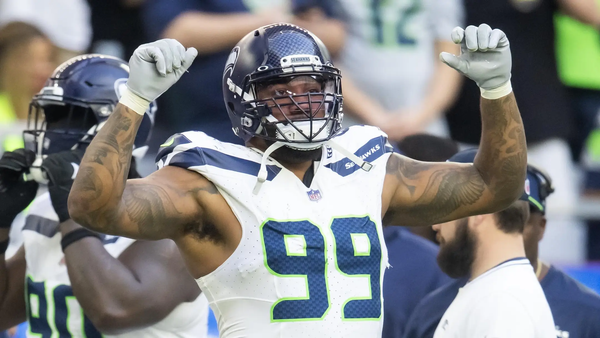
Last season, Leonard Williams put together a season for the ages for the Seahawks, eclipsing double digit sacks while tallying 16 quarterback hits, returning an interception for a touchdown, and racking up tackles for loss in bunches. Though he didn’t get to Purdy for his first sack on Sunday, no player may have been more dominant on either side than the Big Cat, as he devoured ball carriers at the line of scrimmage, blew up shovel passes, and simply made life rough for the 49ers’ interior offensive line from the opening snap through the final whistle.
During the second quarter, the 49ers called a split zone toss out of a strong I-formation, but running back Brian Robinson didn’t have a fighting chance thanks to Williams. The veteran defender, who originally lined up in 3-tech alignment, took a hard step inside and rocketed past center Jake Brendel with the blocker barely getting a finger on him as he exploded into the backfield, meeting the back three yards behind the line, wrapping him up, and tossing him to the ground for a loss.
In another example highlighting Williams’ dominance on Sunday, the 49ers initially doubled him off the line with Brendel and right guard Dominick Puni on an outside zone concept. Demonstrating his immense power, after Brendel worked off the combo trying to get to another defender, he violently threw Puni off to the side with his right arm and then gobbled up McCaffrey with Lawrence and Jones coming in as extra reinforcements to hold the back to no gain. With plays like these, it’s safe to say No. 99 has sights on replicating his disruptiveness from a year ago and then some.
8. A tough conversation may await regarding outside cornerback snaps.
Like his predecessor Pete Carroll, Macdonald has been all about competition since coming on board as coach last season, and he’s maintained that stance with running back and inside linebacker being two positions that currently have jockeying for snaps taking place in the early stages of the schedule. After Sunday’s opening tilt, the secondary may soon be in that mix as well with Josh Jobe gunning for more playing time and Riq Woolen having the veteran nipping at his heels.
Whether fair or not, Woolen has been under fire since the 49ers’ game-winning touchdown drive, as the athletically gifted cornerback yielded a 45-yard reception to Ricky Pearsall and then allowed backup tight end Jake Tonges to snatch a potential interception in the end zone away from him for six points instead. Those miscues overshadowed a spectacular pass breakup earlier in the quarter where he got his fingertips on a potential touchdown to Pearsall that forced San Francisco to kick a field goal.
On the first play, Woolen did a great job of not biting on a double move from Pearsall, staying in his hip pocket as the receiver accelerated out of an out route down the sideline. But he misjudged the ball through the air, allowing the wideout to gain separation and reel in the explosive catch to put the 49ers in business. Only a few snaps later, he again put himself in great position with Purdy lobbing what looked to be a gimme interception opportunity to close out the game. However, he drifted towards the sidelines and didn’t necessarily attack the football, which created enough room for Tonges to slide in front of him and bring in the touchdown.
Meanwhile, with Woolen failing to finish key plays down the stretch, Jobe turned in the finest game of his NFL career to this point. Playing air-tight coverage all afternoon, he allowed one catch on five targets for a single yard and made a leaping interception against Purdy after staying in phase with the speedy Pearsall in man coverage against a crossing route from numbers to numbers. In addition, he made a key stop on McCaffrey in the run game, showing his well-rounded game and physicality. The pressure has now been put on Woolen, who will need to bounce back quickly or else Jobe may be gunning for 100 percent of the boundary snaps.
9. Three-safety looks could be off the menu without Nick Emmanwori available.
Time will tell how long the Seahawks will be without their dynamic rookie defender, but the coaching staff had to adapt early to not having Emmanwori on the field after getting a brief taste of his capabilities on the opening drive. Lined up in the slot, the second round pick crashed hard off the edge and shrugged off a block attempt by right tackle Colton McKivitz, discarding the block and swooping in on McCaffrey for his first career tackle for loss. But it became apparent quickly that something was wrong as he got up and hobbled through a celebration, pogo-sticking his way to the sideline before going to the locker room.
At first, the Seahawks tried to stay with their game plan of using three safety sets even without Emmanwori available, subbing in Ty Okada for a handful of plays in the first half. But the 49ers picked on the third-year defender every time he was in the game, including George Kittle beating him on a five-yard out route for a touchdown on the opening possession and Jauan Johnson easily evading him on a bubble screen to turn a short completion into a 15-yard third down conversion in the second quarter. From there, Seattle pivoted with only Julian Love and Coby Bryant on the field for the remainder of the game.
Looking towards Week 2 against Pittsburgh, while D’Anthony Bell coming up from the practice squad would provide a better alternative for Seattle to deploy a third box safety, nobody on the roster has anywhere close to the size, athleticism, and overall talent Emmanwori brings to the mix. Until he’s healthy and ready to return, expect to see a shift back to the schematics from last year with Devon Witherspoon primarily in the slot and not a lot of three-safety groupings for the time being.
10. Timely, well-executed blitzes fueled several of Seattle’s best defensive plays.
In the past, the Seahawks have not had much success getting heat on Purdy, which played a major role in losing five of the previous six matchups between the two teams. In Sunday’s rematch, the defensive line provided sporadic pressure on the quarterback, but Macdonald decided to go into aggression mode sprinkling in blitzes to ramp up the duress, and two calls in particular stood out as highly successful ones that thwarted 49ers drives in the second and third quarter.
With the Niners deep in their own territory midway through the second quarter, Macdonald called a zone fire blitz, dropping outside linebacker Boye Mafe into coverage while still sending five rushers after Purdy, including safety Julian Love and linebacker Tyrice Knight. The scheming ended up being perfect against San Francisco’s play call, as the 49ers ran play action the left. With Love blitzing through the strongside A-gap away from the play fake, McCaffrey couldn’t get over to the defender in time as he came through untouched, corralling Purdy for a 12-yard loss that all but ruined the drive.
Fast forwarding to the third quarter, San Francisco started the second half with a promising possession that moved past midfield thanks to a 25-yard catch and run by McCaffrey. Sensing another opportunity to get after Purdy with a blitz, Macdonald sent Drake Thomas, who had checked in for Knight with the latter being on a pitch count, as a fifth rusher. McCaffrey tried to cut down Thomas, but the linebacker stayed on his feet and delivered a hit on Purdy as he threw, leading to a highlight reel interception by the dropping Jones at full extension that sent the visitors back to the sideline empty handed again.
11. More love for Love as the veteran masters the art of blocking field goals with today’s rules.
Blocking field goals at any level has never been an easy task, but it’s certainly tougher in the NFL than it used to be. At one time, defenders could leap over the top of blockers, something Kam Chancellor, Bobby Wagner, and the Seahawks excelled at doing during the “Legion of Boom” era before the league banned such techniques. Now, with leaping over blockers no longer an option, players have to truly master timing, both from when to attack gaps and when to extend their arms and make a leap for the football.
Still an outstanding special teams player even with his role reduced on that front as a defensive starter for Seattle, with blocked kicks each of the past two years, Love has those boxes checked off. Starting in a four-point stance flanking the 49ers outermost blocker on the left side, he jumped between the tight end and defensive lineman Matt Hennessy, maintaining enough momentum that he was able to dive and extend his arms right after his feet his the turf, perfectly timing his block attempt to get all ball off the foot of now-free agent kicker Jake Moody as Lawrence recovered and tried to return the ball before the half.