Double Negatives: J.P. Crawford Smashes Slump with Walk-Off Moonshot in Mariners’ 4-3 Win

SEATTLE, Wash. – A double negative can equal a positive in four things: English, Latin, mathematics, and baseball.
J.P. Crawford came into the bottom of the ninth inning on Friday night in a pretty bad slump. In his last 46 plate appearances, the Mariners shortstop was slashing .067/.087/.067. And the drought for the ages at the plate was being replicated out in the field, too: balls skipping off his glove after bad efforts, slow jumps on hot shots in his direction, key outs that could have been made were not being made.
You would think that the odds against Crawford were already high, but he was also facing a left-handed reliever in Robert Garcia. Crawford – a lefty at the plate – had a batting average against right-handers this year of nearly .300. Against lefties, just over .200. A 111 OPS+ against righties vs. an 82 OPS+ versus southpaws.
But in baseball, a double negative more often than not equals a positive. Crawford already had bad timing. A lefty pitcher gives the lefty batter bad timing.
And so, on a 2-0 count in the bottom of the ninth inning on Friday, August 1, 2025, Crawford had good timing.
Let’s rewind just a bit.
The Seattle Mariners were locked in a tight battle with the Texas Rangers in the second game of an important August set of four. Going into the series, the two teams were tied in the standings, each with 57 wins and 52 losses. Each team made moves at the trade deadline, jockeying for position in an American League with no clear favorite.
But for eight and a half innings, the Rangers held a slight edge. Seven men came to the plate for the visitors in the third inning and three scored. The Mariners had a run in the second and a run in the fifth. Eugenio Suárez, the returned Mariner, twice with runners on base launched fly balls high into the Seattle night – and twice, the ball died out in the marine layer and fell into an outfielder’s glove mere feet from the fence. 3-2 was the tally as the last of the ninth began.
Leading off the bottom of the ninth was Dominic Canzone. Seattle’s right fielder had made a key error in the Rangers’ big third inning; he redeemed himself by blasting an 0-1 fastball into right field for a single.
That was when Crawford stepped into the batter’s box for the fourth time. His first three at-bats were ones to forget: a bases-loaded strikeout on a fastball down the middle, an infield popout, and grounding into a double play.
But the only way to make the world forget failure is to smother it with success.
Robert Garcia’s first pitch was a fastball. It was perfectly placed, an unhittable pitch that nicked the low and outside corner by about half a millimeter. Home plate umpire James Hoye called it ball one.
Garcia kept the location but switched up the pitch type on his next delivery. A slider flew in about seven miles an hour slower than the fastball and with a late break that took it off the plate past the point a hitter’s eyes could tell what had happened. Crawford laid off it once more. Ball two.
Even in a mammoth slump, Crawford still knew how to work the count. He had been putting together a not unnoticeable amount of solid at-bats throughout his cold streak, but the contact in play had been weak and the balls had been finding nothing but fielder’s gloves.
Having gone low and away with his first two pitches, Garcia went for it again. Garcia fired a fastball. 95 miles an hour. Right on the inside edge of the plate.
Crawford is a very situational hitter. On a zero-strike count, he will sometimes go for power despite being a more contact-oriented hitter most of the time. On a 2-0 count, he went for power.
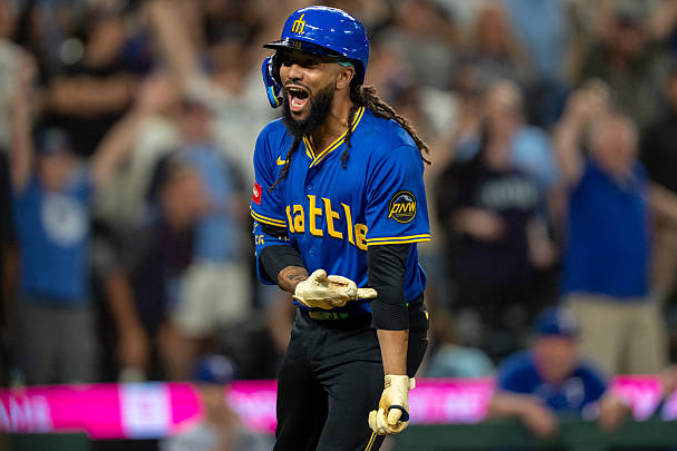
The bat struck the ball with a mighty crack. For a split second, Crawford stood in wonder at a ball flying into the air. His eyes widened for that slight moment as his brain registered what had just happened.
A rush of excitement filled all 40,984 spectators gathered in T-Mobile Park. That same rush swelled in Crawford, too – his eyes sharpened, his head turned to the Mariner dugout, and he shouted in celebration two phrases that don’t bear repeating in print. The bat flipped out of his hand as he began the trot around the basepaths; his right hand removed his helmet and propelled it into the earth.
Pandemonium. It was pandemonium in Seattle. The cheering and jumping shook the edifice of the ballpark as he leapt into a mob of teammates at home plate. A deafening chant of “J.P.” roared around SoDo as he received a second hero’s welcome in the Mariners dugout.
Crawford, aside from all else, is often seen as the heart and soul of this Seattle Mariners ballclub. And in the biggest moments of his Mariner career, he has often come up with the big hit.
“He has been made for the big moments in this ballpark. We’ve seen it a lot from him, and tonight – wow. What a huge moment for J.P. and the ballclub,” Mariners manager Dan Wilson said after the game.
His Friday night blast was the seventh walk-off plate appearance of his career, but his very first walk-off home run. There is no bad time for a walk-off moonshot, but to win the second game of a key series against a divisional rival (and gain a game in on the division-leading Astros) – someone call Jake Jarmel, because that is an exclamation point!