Does Mariners’ Bryce Miller Have Brighter Days Ahead after Injury-Laden 2025 Slump?

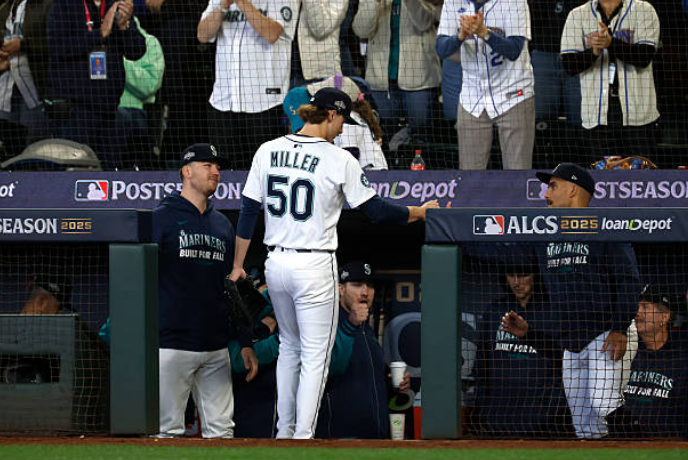
There’s a mystery wrapped in a riddle on the Mariners staff, and it’s a man from Mount Pleasant, Texas. Bryce Miller had an unexpected year as one of the best pitchers on the Mariners in 2024 and then was chased around by elbow inflammation and found himself raked over the coals for much of 2025. The two lines could not look more different on the surface: 12-8 with a 2.94 ERA, 0.976 walks and hits per innings pitched (WHIP), and 3.58 fielding independent pitching (FIP) in 2024 compared to 4-6 with a 5.68 ERA, 1.406 WHIP, and 5.17 FIP in 2025.
But what’s going on underneath the hood, and what does that mean for Miller and the Mariners in 2026?
What happened to Bryce Miller in 2025?
The most visible outcome of Miller’s injury recovery was the diminishing of his zippy four-seamer, which declined slightly in average velocity from 95.2 miles per hour to 94.8 miles per hour. Hitters around the league, as you might expect, fared better against his slower heaters, with a .970 OPS and .856 expected OPS (xOPS) against Miller’s four-seamers 95 miles an hour or slower, while those above 95 miles per hour faced a .702 OPS and .772 xOPS. Batters had a 26.5% whiff rate against the faster set of four-seamers and a 20.1% whiff rate against the slower set, again to be expected.
Miller’s sinker didn’t suffer an overall decline in velocity and yet was also hit more in 2025. Slower pitches fared slightly better than faster ones, but this was a result of luck that reversed when analyzing expected outcomes, as batters had a .911 OPS and 1.000 xOPS against sinkers 95 miles an hour or slower and a .947 OPS and .889 xOPS against those faster than 95 miles an hour. Still, the big difference was the amount of vertical movement - Miller’s sinkers sunk less in 2025 and had more of a two-seam action, and yet he used them like sinkers, going for the bottom of the zone.
The other big item in Miller’s 2024 repertoire, his killer splitter, was similarly neutralized during the 2025 season, as batters improved their OPS against it from .395 to .701. It didn’t change a whole lot in movement or velocity, but where it did change was in location. During the 2024 year, Miller peppered the lower armside corner of the zone with his splitter, a perfect spot that gave hitters an uphill battle against his out-pitch. But in 2025, that pitch found its way towards the middle of the plate far too often, where hitters were able to catch up to it and drive it.
The prescription for Miller’s splitter woes is simple, but astute readers will note that his fastballs were hit better than average whether they were above 95 miles per hour or not. Hitters’ OPS against his 2024 four-seamer was .595 and their xOPS was .748, a somewhat similar expected number to Miller’s high-velocity subset in 2025, but that same subset in 2024 had a .650 xOPS. Something was clearly going wrong with the four-seamer beyond just its velocity.
Miller’s issues with the fastball in 2025 have a lot to do with opposing slugging percentage. Hitters only had a .237 average and .315 on base percentage against his four-seamer in 2025 but benefitted from a .556 slugging percentage, buoyed by a big bunch of home runs. Of the 17 longballs Miller conceded, 11 of them (64.7%) came on four-seam fastballs; compared to 36.2% of home runs hit off four-seamers for the whole MLB, that’s a big jump. In 2024, Miller gave up 10 of of his 21 homers (47.6%) on the heater - still above average, but it’s worth noting that he relied on his fastball for a hair over 40% of his work in both seasons compared to a league average four-seamer rate of 31.7% in those years.
What’s with the hitters getting all the jacks? A useful thing to look at is home run to fly ball rate (HR/FB%), a simple metric that shows the percentage of fly balls that end up as home runs. Like batting average on balls in play (BABIP) for hitters, it’s very volatile year-to-year, essentially making the metric a judgment of luck. In 2024, Miller’s HR/FB% was somewhat lower than league average, while in 2025, it was quite a bit higher than league average. Simply speaking, he got a bit lucky in 2024 and quite unlucky in 2025.
This bad luck was especially pronounced against his four-seam, where hitters had a 29.7% HR/FB%, almost twice as high as the league average both overall and against four-seamers. So too was it more of an issue in the second half of the season, when he had a 37.5% HR/FB%, than it was in the first half of the season, when he was in a similar range to his 2024 season.
But even with that bad luck, Miller’s expected FIP (xFIP) - which replaces the home run component of FIP with fly balls multiplied by the league HR/FB% - was still 4.60, around 11% worse than league average. For what it’s worth, Miller’s 2024 xFIP was 3.85 in 2024, still good but above his actual FIP that year and well above his ERA.
Some of that just comes with the territory of giving up fly balls, but Miller’s fly ball rate was lower than league average in 2025 after being above average the year before. More pressing issues were his line drive rate - which jumped from below league average in 2024 to above league average in 2025 - and a walk rate that went from 75th percentile to 36th percentile. The bulk of Miller’s walk trouble came in the beginning of the season, as his 10.6% walk rate before going to the injured list would have been 15th percentile had it held for the full season, but the line drive rate betrays something else that dogged Miller in 2025.
Even in his standout 2024, batters still accrued a strong hard-hit rate against him, though he effectively worked around that issue - but in 2025, Miller’s hard-hit rate and average exit velocity went from worse than average to 2nd and 1st percentile, respectively. Just eight qualified pitchers suffered higher hard-hit rates than Miller in 2025, and of those eight, only one - Cubs triple-digit flamethrower Danny Palencia - had a better than average ERA.
This kind of stark struggle can be expected when a guy reliant on top-rope fastballs suffers a midseason injury. We can see that although his four-seamer produced a lot of fly balls in both 2024 and 2025, the threat that those fly balls produced was far greater in 2025.
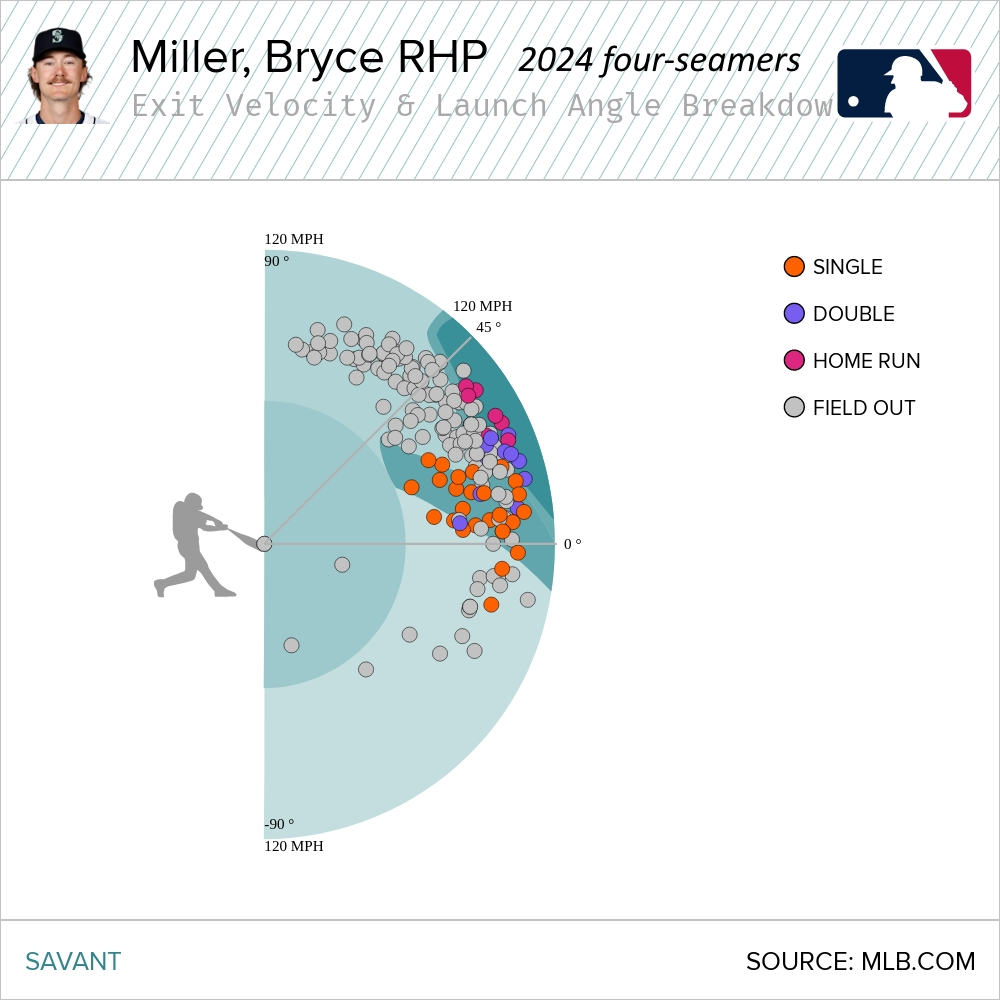
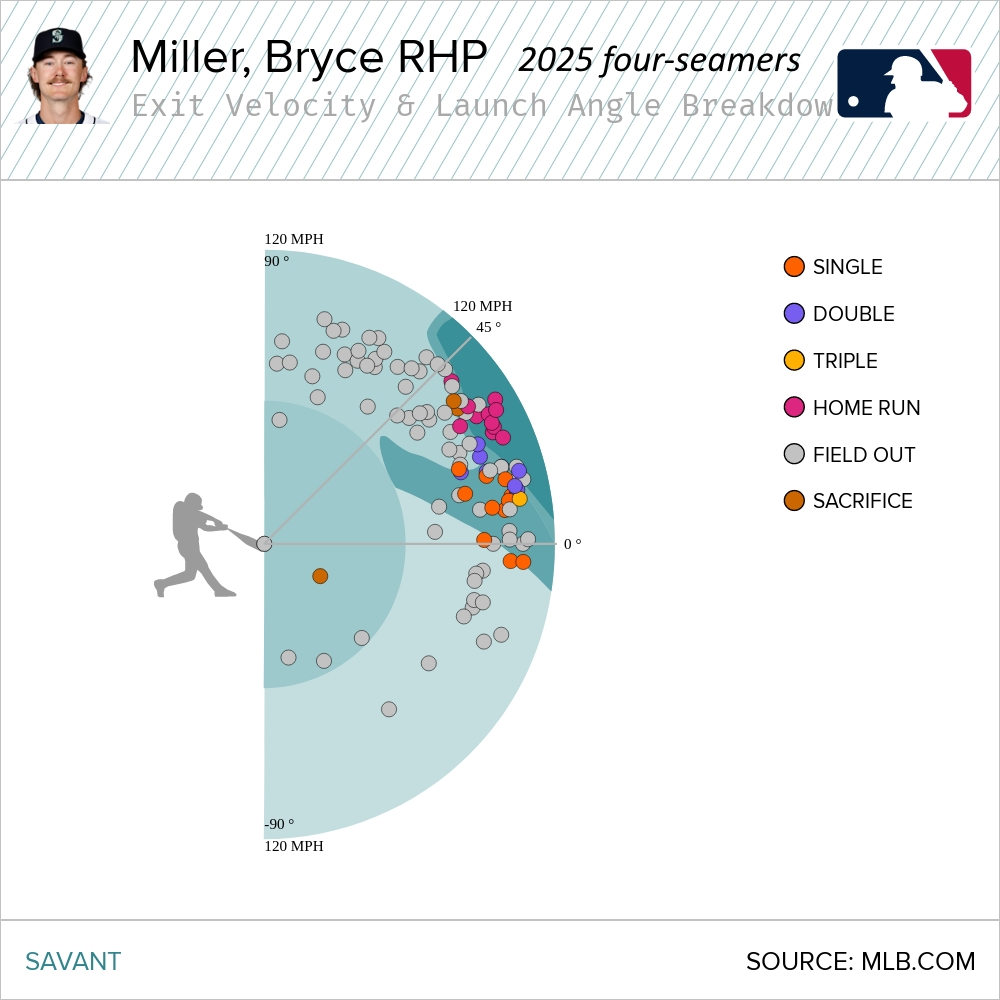
Although the physical facts about his fastball took a measurable hit, the biggest issue was probably the way the injury impacted his feel for pitching - his ability to be able to tighten his zone when necessary, his sense of what pitch to use at a particular time, those kinds of things.
Because Miller is so reliant on high four-seamers, his bread and butter has to be the strikeout. Despite the fact that his walk rate dropped back to normal after returning from the injured list, his strikeout rate - 24.3% in 2024 - only went from 18.1% before his 2025 injury stint to 19.9% after his return. It’s worth noting that, in both years, the league-wide strikeout rate was a hair over 22%, meaning that Miller went from a 60th percentile strikeout rate in 2024 to an overall 22nd percentile strikeout rate in 2025.
Given all of this information, what should we expect from Bryce Miller in 2026? I’ll give three possibilities, each with my own personal estimates for how likely any given one is to pass - provided the M’s don’t move Miller in the offseason.
Scenario 1: Miller fails to make a big improvement from his 2025 season and settles into the Mariners rotation as a back-end starter.
Estimated likelihood: 25%
Estimated top-line stats: ERA and FIP between 4.25-5.25, strikeout rate between 18-22%, walk rate between 7-9%.
Representing either a repeat of the 2025 season for a full year or a slight but unimpressive improvement, this scenario is the bottom end of outcomes for Miller’s 2026 year. I find it unlikely that no improvements will be made unless Miller again suffers injury trouble, but it’s very possible that his strikeout rate remains dented while his walk rate hovers a little above what it was in the second half of 2025.
Even if Miller makes no improvements in process, however, I would expect some improvements in result, as his HR/FB% is more likely than not to regress towards league average, especially on his four-seamer. Some exceptional luck could push his ERA into the high threes; some exceptionally bad luck could shove it towards the 5.68 he actually posted in 2025. In this scenario, I’d expect his FIP to be within the ERA ballpark I’ve given, just as his 4.60 xFIP was in 2025.
If Miller fails to make a notable stride forward, you could expect the Mariners to potentially seek deadline starting pitching help and move Miller to the bullpen in the event the team makes the playoffs, either with a four-man rotation for October or a five-man if Seattle indeed trades for a top-end starter.
Scenario 2: Miller improves his underlying metrics to around 2024 levels or a little bit below, making him a more than viable starter in the team’s rotation.
Estimated likelihood: 60%
Estimated top-line stats: ERA and FIP between 3.50-4.50, strikeout rate between 22-25%, walk rate between 6-8%.
It should strike you that a return to 2024 form for Miller would not necessarily mean a return to the incredible top-line numbers he put up that season. He got quite lucky in 2024, as his ERA well outpaced what would be expected of him based on FIP and xFIP, so getting back on the horse would mean strong production, not elite production.
A big part of this scenario is a jump in strikeout numbers, perhaps to be expected with a better fastball feel in a healthy 2026. Some further good news for Miller is that playing in T-Mobile Park can be expected to give him a little bit of fly ball luck - not as much as he got in 2024, but noticeable - and an ERA in the low threes is definitely possible, even if his FIP sits in the high threes to low fours.
This is the scenario I view as most likely, and in this case, Miller would be more than serviceable as a part of what would probably be a well above average rotation. He might still end up as a fourth or fifth starter due to the skill of the rest of the starters, but the M’s probably wouldn’t see a need to find an upgrade at the deadline, and Miller would likely make starts in any October run for Seattle.
Scenario 3: Miller improves his fundamentals to a true breakout and becomes one of the team’s best starting pitchers.
Estimated likelihood: 15%
Estimated top line stats: ERA and FIP between 3.00 and 3.75, strikeout rate between 26-28%, walk rate between 5-7%.
This isn’t a very likely outcome, but Miller does carry a distinct possibility of pulling this off. It would require his four-seam fastball and splitter to return to 2024 form and then some in addition to a much better feel for his sinker and slider. An effective slider in particular would force batters to contend with gloveside movement, in turn making his four-seamer and splitter deadlier in and of themselves.
While his FIP would probably fall among the aforementioned range, good luck could push his ERA into the elite high twos as it was in 2024 - though he wouldn’t require as much of it as he did that year. His walk rate would be truly elite while his strikeout rate would be well above average (somewhat similar to what Bryan Woo did in 2025), and unlike in the previous two scenarios, his whiff rate would also jump to above average.
Miller would find himself near the top of any playoff rotation in this case, and given his success in the high-pressure environments he found himself in this previous October (especially an out-of-nowhere baller outing in ALCS Game 1), there is a good gleam of hope that the man can put in the work when the chips are down. Success in the playoffs one year doesn’t necessarily translate to similar success in another October - see Randy Arozarena - but it does indicate a good mentality around such things.
Will the Mariners trade Miller in the offseason?
Of course, there’s a slight chance that Bryce Miller isn’t wearing a Mariner uniform in spring training. His name has been floated as a return piece in potential blockbuster trade packages for Seattle’s offseason infield targets, and although the brass has publicly stated they’re not looking to trade any of their starters, that tune might change fast if the right deal comes along.
When it comes to Miller, however, different teams might have different reservations. Organizations league-wide, including the Mariners, are shifting towards high ground ball rates as a key pitching metric, and that will decrease the value of a guy like Miller for some of the organizations that are looking for pitchers. Some would see Seattle as selling low on a man right off a five-plus ERA season, while others would look to the relatively rosier underlying metrics and the fact that Miller is controllable through the 2029 season.
For Seattle’s sake, their current working plan is to see if Miller can put up a strong 2026, and unless a team comes along with a deal that’s sweeter than that, I’d expect the M’s to keep Miller on the roster going into the upcoming season. Still, the team must be realistic about Miller’s own projections, and if including him in a deal for a baller infielder means that they can keep other pieces intact, Seattle’s front office should give it due consideration.