‘Dawgs Unleashed’ Will Play Key Role For Washington in College Football’s Next Phase
Name, Image and Likeness is the new game in college athletics.
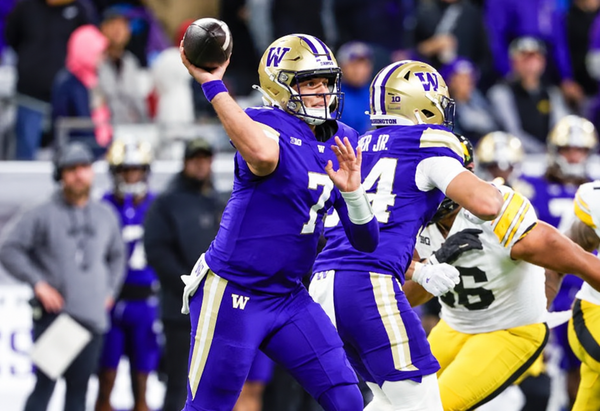
For the Washington Huskies, “Dawgs Unleashed” is responsible for helping athletes secure NIL deals that are both lucrative and pass the sniff test for approval.
Dawgs Unleashed will need to be off the chain for the Huskies to compete with the top dogs of the Big Ten and SEC. In a new world in which Washington and other athletic departments can share up to $20.5 million of revenue with athletes during the 2025-26 school year, it will be up to UW’s NIL program to form relationships with businesses interested in representation from Washington athletes. The programs that find money from third-party businesses best over the next few years will have an edge in acquiring future talent.
“House was finally passed, meaning that we’ll finally and officially share revenue with student athletes,” Dawgs Unleased executive director Joe Knight said recently on 93.3 KJR’s Dave “Softy” Mahler and Dick Fain show. “But coming with that is stark regulation to third-party NIL.”
Prior to the settlement, contracts for players were run through collectives like Montlake Futures, which were not officially affiliated with universities. While there were some deals with businesses, much of the “pay for play“ payments came through donations. As of July 1, that funding source, which Washington athletic director Pat Chun recently referred to as “fraudulent NIL” because it was rarely based on deals with businesses, will no longer be legal.
“It’s corporate sponsorship that will persist,” said Knight, who was a walk-on basketball player at UW for the 2015-16 season. “We’ve created Dawgs Unleashed, this sort of internal full-service agency for student athletes to represent them in their pursuit of third-party NIL. That’s getting with businesses, big and small, local, national, to find opportunities for compensation and promotion.”
Washington will distribute its House settlement revenue share funds with five of its 22 NCAA sports programs — football, men’s basketball, women’s basketball, softball and volleyball — Chun announced on June 18. Chun declined to discuss how much each program will receive, though Fisch indicated he anticipates that football will receive the maximum allowed 75% ($15.3 million).
NIL funds are limited only by what deals are approved by the clearinghouse. Contracts can be struck with athletes in any sport. For example, national champion pole vaulters Amanda and Hana Moll might be able to land some deals as the twin sisters head into their junior seasons — even though they’re unlikely to receive revenue-sharing money directly from Washington. Athletes who double as influencers may also be targets for larger businesses. The marketplace will likely evolve significantly over the next few years as businesses analyze returns on investment. Some of those returns, of course, may not be exactly monetary. Some boosters’ interest in NIL deals may begin with the goal of helping their favorite teams win.
The NIL situation wasn’t a surprise to colleges. The NCAA and power conferences agreed to settle in 2024, and nearly a year went by as the settlement was tweaked and finally approved by Judge Claudia Wilen on June 6.
Chun and Knight began discussing the post-House settlement climate back in August of 2024, according to Knight. Chun recognized the importance of moving quickly to establish an entity that would be ready to fire up the moment the House settlement was approved. Suddenly, schools went from not being allowed to pay athletes or have official connections with NIL deals on June 5, to being responsible for overseeing all of it starting July 1.
How college recruiting is impacted by this change remains to be seen. Athletes must now consider NIL potential and revenue share payments in addition to things like playing time, scheme fit, coaching relationships, preparing for professional opportunities and winning potential.
According to the House settlement, athletes cannot ink NIL deals until they are enrolled at the school. The athletes can be told, however, what it looked like for the players before them. So, Washington head coach Jedd Fisch can’t tell a quarterback recruit the exact deals that are waiting for him. Fisch can say, however, “This is what our starter’s getting this year, and this is what he got as a freshman backup.”
That means a program’s NIL contracts this year might affect next year’s high school and transfer portal recruiting class. Schools that deliver NIL deals — which do not count against the revenue share cap — early on will develop a reputation in the recruiting world as a place athletes can bring in extra income. Since nothing is in writing initially for a new recruit, they will have to wade through different promises from programs, evidence of prior deals and reports of deals that may or may not be accurate. So far, schools have not released details of player NIL contracts, citing student privacy laws. Knight said he and his staff hope to find “renewable opportunities,” meaning similar deals will be made available as the athletes move through the system.
Fisch and Chun have both mentioned that schools located in large urban markets should have an advantage in the world of NIL. Capturing that market will largely be up to Knight and his four coworkers. They’ll need to hit up the 12 area Fortune 500 corporations, but also the local car dealerships and other businesses that might be interested in offering cash, goods or services to athletes.
“Dawgs Unleashed is certainly a talking point throughout the recruiting process. … We cannot promise third-party NIL to recruits. What we can do — and what Coach Fisch, what any of our coaches can do — is sit down with recruits and their families and say, ‘This is what Dawgs Unleashed has done. This is where the corporate interests lie with Husky athletics. We think that you as the student athlete profile well with brands X, Y and Z. And we can even say what we’ve been able to put together with those brands in the past.”
“So much of our donor base owns businesses. So much of the Husky sports properties (broadcast) partnership base wants to get into NIL and wants to work with our student athletes.”
Knight said that Dawg Unleashed will not be bringing in funds, and will not be dispersing NIL payments to players.
“We will broker deals. We can help draft contracts, and help execute those contracts and get them through NIL Go, the clearinghouse. … This is all agreements between entities and our student athletes. We’re just here as a safeguard and to represent and procure these opportunities for them.”