College Football Schedule Needs Major Overhaul For Huskies, Rest of FBS Competitors

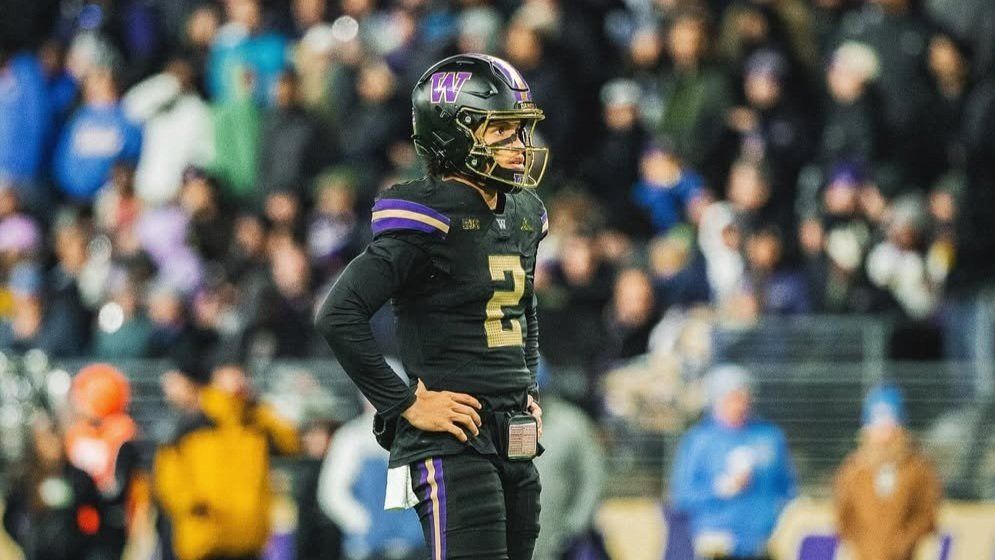
[caption id="" align="alignnone" width="995"]
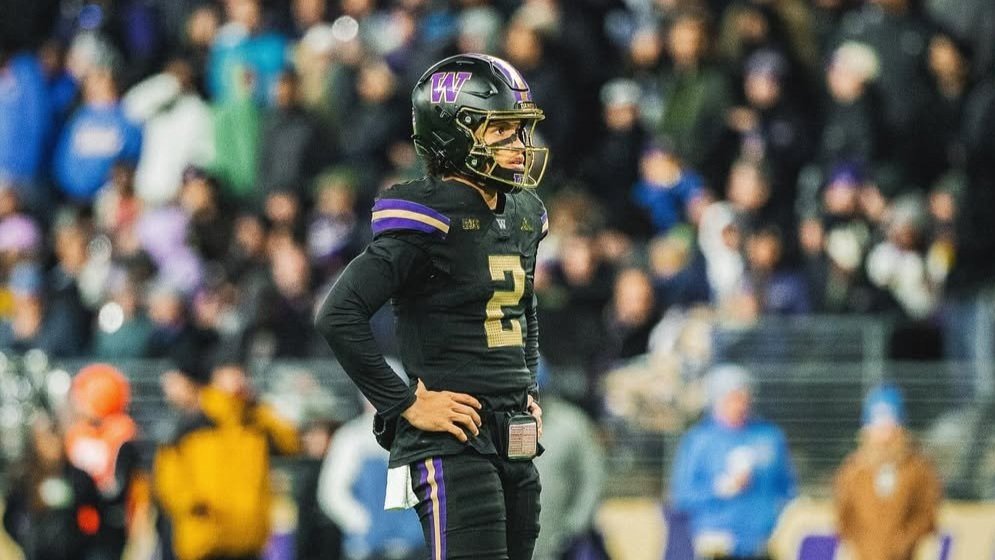
Washington Huskies quarterback Demond Williams waits for a play call during a regular season game at Husky Stadium. Credit: Demond Williams/Instagram [/caption]
If you’re a fan of college football, you’ve no doubt seen, on television at least, the sun setting over the San Gabriel mountains from the perspective of the Rose Bowl on January 1 to usher in the new year.
Those who have watched college football for decades can perhaps hear the sound of Keith Jackson’s voice describing the sun dipping below the horizon in the third quarter, signifying that the end of the college football season was near. Often, it was a nearly perfect moment.
Times have changed a bit. Eight games kicked off after the Rose Bowl, five of which were College Football Playoff games, as part of an expanded field with 12 teams. The 2024 season concluded on Monday, January 20, 2025, with Ohio State defeating Notre Dame 34-23 for the title. For those on the East Coast who stayed up for the final play at 11:08 PM ET, Tuesday was probably a tough day at the office. Despite two major brands facing off, ratings dropped 12 percent compared to the Washington-Michigan title game on January 8, 2024.
It’s hard to see the viewer dip being any reason other than the calendar. Perhaps body clocks will change over time, but concluding the college football season when the kids are going back to school after the holiday break seems about right. Mid-January is NFL playoff time, and nothing is getting in the way of that albatross.
Meanwhile, with the transfer portal being open most of December, teams fighting for a championship lost some depth as a few players took off in search of more playing time or some NIL cash. Not ideal, but the thinking of closing that window before the season ends is that the athletes needed to get to class — which at quarter schools like UW began a full two weeks prior to the national championship game this past season.
The changing world of college football became amplified for Husky fans in 2016, when it looked like Washington would have a shot at a CFP semifinal, or… ooh, yuck… a trip to the Rose Bowl. In a couple of decades, the Rose Bowl went from the ultimate goal of a program to somewhat of a disappointing consolation prize on years when it wasn’t part of the playoff rotation.
A few tweaks to the calendar, and perhaps we could have it all — a 12-, 14- or even 16-team playoff bracket, the famous sunset serving as the season sunset, and student-athletes being students. The big losers would be some of the bowl games known as the “New Year’s 6,” which would have an “ooh, yuck” game some years.
I won’t get into things like a central scheduling system or a “super league” of 32-40 teams quite yet, nor will I propose a relegation system that could lead to a super league team being relegated to a lower division as occurs in European soccer leagues. College football power brokers seem far, far away from being ready to take on that type of risk. I’m also not going to touch putting the genie back in the bottle with things like the transfer portal and NIL. Courts crush the NCAA every time, and athletes’ rights are here to stay.
14 or 16-team playoff coming
Ross Dellenger of Yahoo Sports reported last month that the SEC and Big Ten are pushing for an increased playoff for 2026 that would include four spots each for the two major conferences, two for the ACC and Big 12, one for the top-ranked Group of Five champions and 1-3 at-large spots. They’re calling it a 4-4-2-2-1-1 format, the last number being changed to a 3 if they go with 16 teams. While I don’t love handing the SEC and Big Ten guaranteed spots, I believe it would encourage more aggressive scheduling by the power schools. Currently, beating Portland State is much better than losing to, for example, Miami. Often, power programs avoid the risk, and schedule weaker opponents. The committee has to weigh a pointless win versus a loss to a quality opponent.
Former Washington coach Kalen DeBoer deserves some credit for a more aggressive move in the auto-bid direction. His 9-3 Alabama squad was left out of the 12-team bracket, while SMU got in. Perhaps that was the right decision, but not many in SEC country will buy any argument along those lines. The argument starts and ends with, “It’s ‘Bama!”
Compress the schedule
A season that concludes on January 1 fixes the issue with the academic calendar and transfer portal aligning. Here’s how you do it. Let’s pretend this happens for the 2026 season since that’s when the playoff format is likely to change.
Start the season early: Currently, the NFL does not schedule games the weekend of Labor Day. College Football should own that weekend. For 2026, start the season the weekend of Saturday, August 29 with your Portland States and Austin Peays, with perhaps a couple of Thursday and Friday games leading up to it, and a big game or two. Then, with the NFL napping, there should be marquee games occurring from the Wednesday before Labor Day through Labor Day itself. In 2026, this would occur September 3-7. As it so happens, Labor Day is the latest it can possibly be in 2026, so 2026 is as tight as this suggested schedule can get.
Regular season ends November 21:12 games, plus 1 bye week for each team.
Playoff qualifiers, November 27-28: No more conference championship games. For one thing, with a conference like the Big 10 having 18 teams, it means each school only plays half the league each year and the tiebreakers can be ugly. Also, the conference title games mean very little if both are going to the CFP anyway. So, have 3-6 and 4-5 matchups in power conferences for the two of the four spots on home campuses while Nos. 1-2 take the week off. The Big 12 and the ACC would either play an in-house 2-3 matchup or really lay it on the line with crossover games, where the No. 3 from one league travels to the No. 2 of the other in an effort to steal a bid. All of these play-in games would have massive fan interest.
First round, December 4-5: In a 14-team bracket, the top two seeds receive byes. Having a bye in this scenario is of value, unlike the rust factor some believe plagued Georgia and Oregon after three weeks prior to their 2024 playoff losses. Home teams will play on their own campus.
Quarterfinals, December 11-12, 2026: The top two seeds will be among the home teams in the next round with games still happening on home campuses.
Semifinals, December 19, 2026: At this stage, the College Football Playoff will rotate games among the Orange, Sugar, Fiesta, Cotton, and Peach Bowls each year, moving games to neutral venues.
Championship game, Jan. 1, 2027: This allows for a bye between the semifinals and the championship game, and this is when you play most of the other Bowl games. Under this proposal, the title game would always be the Rose Bowl, but it could be a rotation among the big six.
Transfer portal window, December 20-January 8: While this may slightly impact the teams in the title games, athletes would still have the opportunity to wait until after the Rose Bowl. There’s still an issue with quarter schools being in session before an athlete finds a new landing spot, but you know what? Figure out a way. During Covid, schools developed asynchronous courses to allow for students to follow their own schedules, and some of those offerings remain as options today. Athletes can do that for an academic period if they’re unable to get to in-person classes in time.
On the “Unafraid Show with George Wrighster” podcast, Fisch spoke about the issues with the transfer portal from the perspective of eliminating a window that takes place during the season.
“If we play into mid-January with the same team, without the distraction of the portal, we’re going to have better football games,” Fisch said. “We’re not going to spend time on TV, on Twitter, on Instagram, talking about who’s in the portal. We’re going to talk about the unbelievable game that, you know, Penn State is about to play versus Washington.”
Spring ball: UW is one of the few power conference schools that plans to hold a spring game this year. But, don’t expect a ton of huge hits. While Jedd Fisch has said he’s a fan of the game, he’s not going to take risks with quarterback Demond Williams Jr. and others. So, I say let’s go all-in on the NFL model Fisch speaks of often. Have an offseason training program that begins in early April, and a mini-camp or two in May. I would prefer to just have one transfer portal period. But if another one is necessary, have it open after the mini-camps. Begin preseason camp in mid-July, so transfers have an opportunity to get fully up to speed, minimizing the impact of missing spring activities.
“I’ve said this numerous times, that the NFL does things better than every other league,” Fisch said to Wrighster. “They always have. I think that they are tried and true. And if we can do our best job of replicating the NFL year… I think it gives our coaches, all of our players, the best opportunity for academic and athletic success.”
While this calendar doesn’t solve all the issues around college football, it lessens a few of them, including travel fatigue of fans following playoff teams. I think Keith Jackson would like it.