Best/Worst Case Scenarios For Every 2025 Seahawks Draft Pick
[caption id="" align="alignnone" width="1920"]
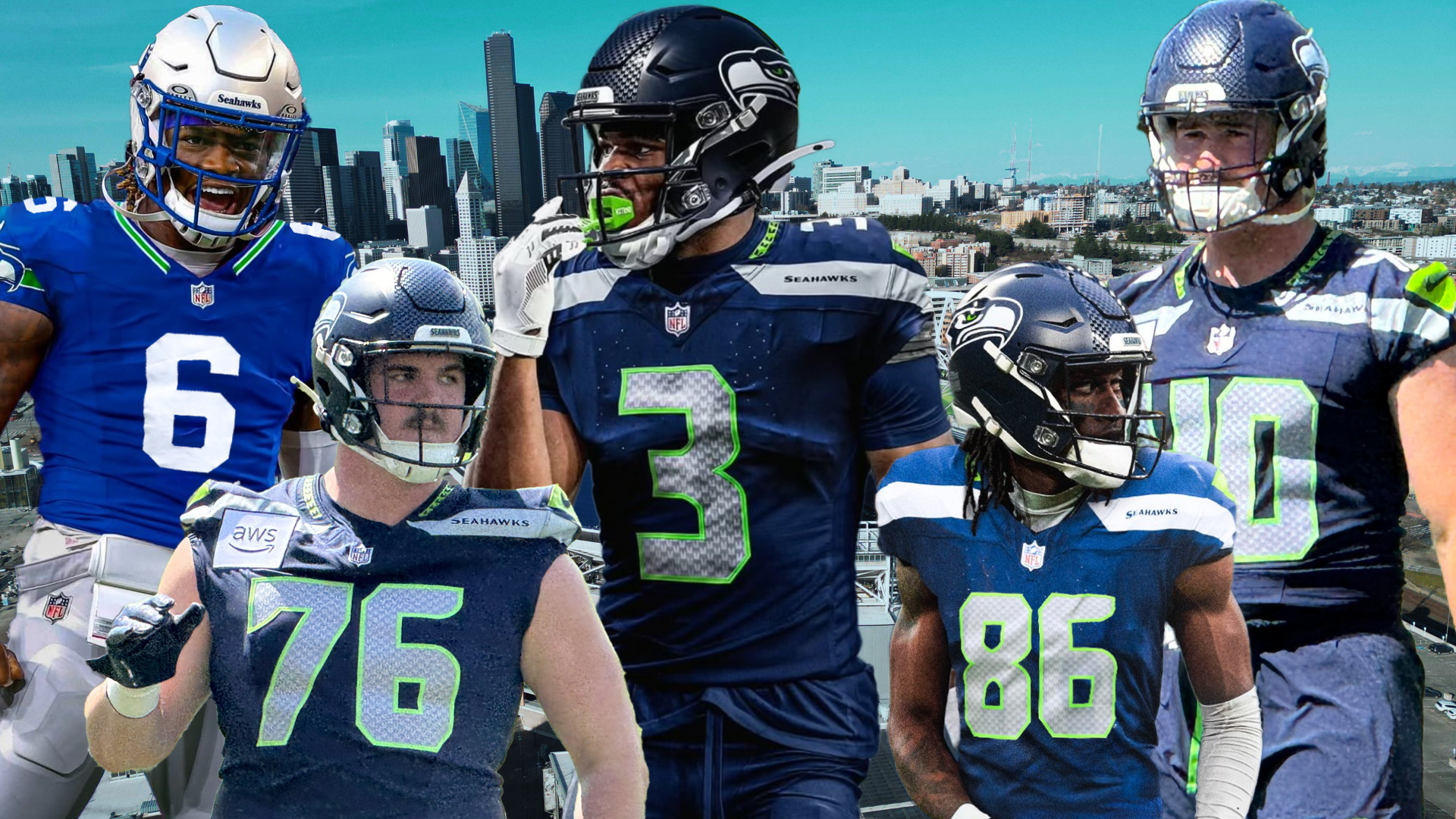
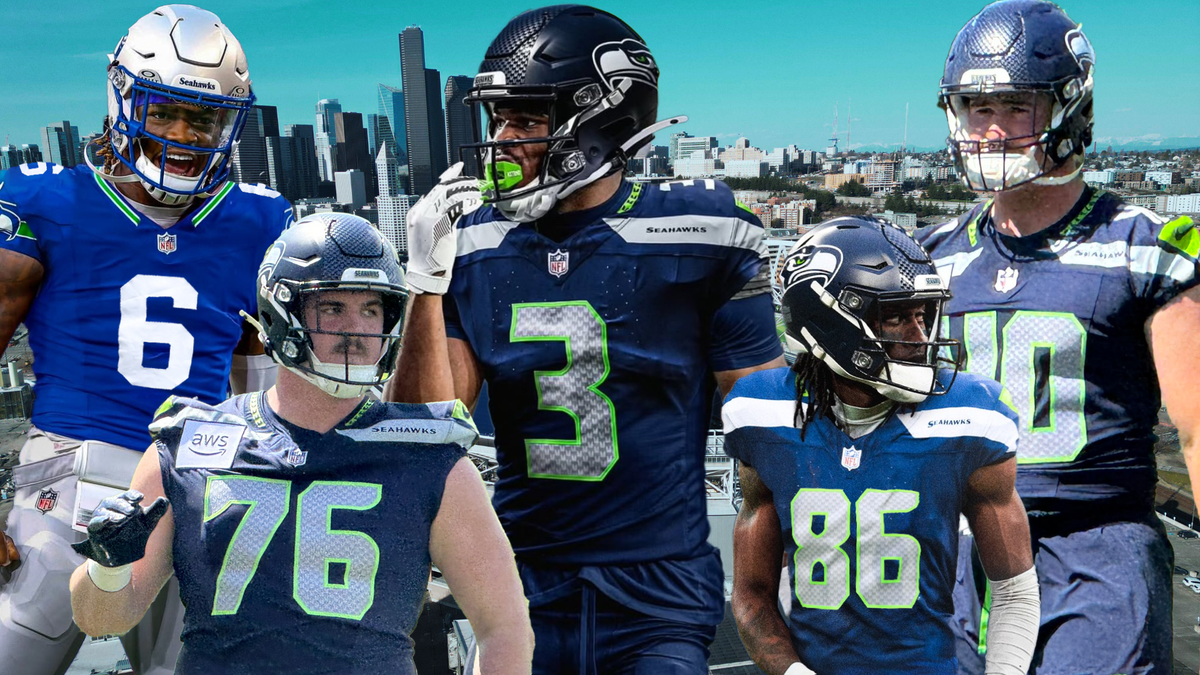
There's no shortage of excitement for the Seattle Seahawks 2025 draft class, which features left to right: Jalen Milroe, Grey Zabel, Nick Emmanwori, Ricky White III, and Robbie Ouzts. [/caption]
Now officially embarking on their NFL careers, the Seattle Seahawks unveiled their latest draft class for the first time earlier this month at their annual rookie minicamp at the Virginia Mason Athletic Center, providing an opportunity to begin evaluating first-round selection Gray Zabel and the rest of the team's 2025 draft picks before the start of OTAs next week.
While Zabel and his 2025 draft cohorts won't be playing in game action for several months, it's never too early to prognosticate how they may perform in their first season with the Seahawks. As they prepare to begin competing against veterans in the final phase of the offseason program, what can the franchise realistically expect from the second class of the Mike Macdonald era?
Looking into the crystal ball, here are best and worst case scenarios for all 11 of Seattle's incoming draft picks:
Gray Zabel
Best Case: Unintimidated by the jump in competition after starring at an FCS school, Zabel lives up to the billing of a top-20 NFL draft pick early on his rookie season, thriving in Klint Kubiak’s zone-oriented rushing attack and providing an immediate upgrade in the pass protection department for Sam Darnold. Though he gives up four sacks, he posts a rock solid 97.8 pass block efficiency rate and plays a vital role in unlocking Seattle’s once-dormant run game, allowing Ken Walker III and Zach Charbonnet to combine for north of 2,000 yards. To cap off a fantastic rookie season, he earns PFWA All-Rookie Team recognition and receives a Pro Bowl alternate selection, setting the stage for potential All-Pro honors down the road.
Worst Case: Quickly learning that he isn’t in Fargo anymore - or Mobile, for that matter - Zabel endures a challenging start to his NFL career, looking out of place with veteran defensive tackles rag dolling him in the first month and change before he begins to find his footing. With opponents stressing his edges like he never faced before, he struggles with penalties for much of the year, ending with 10 of them total and six holding flags, along with yielding seven sacks and 38 pressures. Though it isn’t quite the first season the player or franchise hoped for, optimism remains for his future as a building block piece for the Seahawks up front.
Nick Emmanwori
Best Case: Wasting no time pushing Coby Bryant for starting snaps, Emmanwori shows off his rare physical talents and polished football skills throughout training camp, forcing Macdonald’s hand for extensive reps early in the year out of three-safety packages while gradually playing his way into a full-time role. Spending extensive time near the box as well as in the slot as a big, athletic nickel, he racks up north of 80 tackles, including eight tackles for loss, while also picking off two passes and recording 1.5 sacks as a blitzer, vaulting himself into the Defensive Rookie of the Year conversation despite only starting seven games on the season. The decision to trade up for him rapidly becomes one of the shrewdest moves from draft weekend, putting a bunch of other teams on notice for passing over him in the first round.
Worst Case: Under the weight of significant pressure with Kam Chancellor comparisons, Emmanwori doesn’t play to his physical gifts in training camp and the preseason, battling through missed tackle woes and giving up a couple of big pass plays due to uncertainty on coverage assignments. As a result, Macdonald only uses him sparingly on defense in the first two months of the season before he starts to figure things out in November as a situational reserve and special teams player, ending his rookie campaign with just 35 tackles and two pass breakups, leaving the Seahawks with an interesting decision to make regarding Bryant’s pending free agency in March.
Elijah Arroyo
Best Case: Putting a series of injuries that he dealt with at Miami behind him, Arroyo impresses with his massive catch radius, soft hands, and ability to create after the catch during the preseason, usurping Noah Fant as Seattle’s primary move tight end in the early stages of the regular season. Well-equipped for Kubiak’s offense, he catches 51 passes for 534 yards and five touchdowns as a rookie while showcasing improved blocking as the season unfolds, making the investment in him as a top-50 pick look like a sound one for John Schneider and the front office while forming an exciting young duo with AJ Barner that should be a focal point for the Seahawks for the next several years.
Worst Case: Nicked up during camp, Arroyo finds himself sidelined for a large chunk of August, preventing him from making a push for significant playing time early while Fant shines in Kubiak’s scheme. Though the Seahawks mix him in as a third tight end and he sees more playing time in the second half, he only catches 14 passes for 135 yards and a touchdown. Meanwhile, Fant finally has the breakout year that the organization has been hoping for since the Russell Wilson trade, leading to a new contract that casts questions about where Arroyo fits into plans as part of the passing attack moving forward.
Jalen Milroe
Best Case: Though Milroe isn’t in a competition with Sam Darnold for the starting quarterback role, he enjoys a Wilson-like preseason wowing with his big arm and elite athleticism, creating plenty of buzz about his future in the Pacific Northwest. Even with Drew Lock listed as the primary backup, the Seahawks deploy the rookie early on in short-yardage and red zone packages with great success, as he scores a pair of touchdowns in the opening month. Turning into Kubiak’s latest wildcat gadget, he rushes for over 200 yards and four scores on the season while adding a passing touchdown, leaving fans wanting more as he heads into his sophomore season as a potentially viable threat to Darnold’s throne as a starter.
Worst Case: Viewed as a developmental project by many draft pundits, Milroe looks the part in camp and the preseason, continuing to battle mechanical issues that lead to inconsistent accuracy and taking too many sacks in the pocket. The Seahawks keep him on the 53-man roster, but with his passing still a work in progress, he’s regularly a healthy scratch early in the season before getting a handful of opportunities to run the ball out of sub packages in the second half. He ends a quiet rookie season with 45 rushing yards and no touchdowns with no further clarity on whether he could be a starter down the line.
Rylie Mills
Best Case: Making a stunning recovery from a torn ACL suffered in the College Football Playoff in January with Notre Dame, Mills makes good on his prediction for returning to football activities before the start of training camp, managing to be activated from the PUP list midway through training camp with clearance from the Seahawks medical staff. Miraculously in uniform for the season opener, he takes on an important role as a rotational defender who sees action as a defensive tackle and defensive end, filling the vacancy left by the departure of veteran Roy Robertson-Harris. Suiting up for 14 games, he records 18 tackles, 1.5 sacks, and four tackles for loss with an opportunity to take a huge jump in 2026.
Worst Case: Though Mills had been ahead of schedule for most of his recovery from knee surgery, the Seahawks err on the side of caution, choosing to keep him on the PUP list for the entirety of training camp and the start of the regular season, forcing him to miss at least the first four games. Ensuring that he’s fully recovered before activating him, he doesn’t make his team debut until Week 10 and without much practice time under his belt, he only sees a handful of snaps per game after his return, finishing a de facto redshirt season with five tackles and a quarterback hit.
Tory Horton
Best Case: Fully recovered from a serious knee/hamstring injury, the 6-2 Horton rediscovers his 2023 form at Colorado State during training camp and the preseason, snagging a long touchdown catch from Milroe and shining as a kick returner to beat out Marquez Valdes-Scantling for the third receiver spot behind Jaxon Smith-Njigba and Cooper Kupp. Providing downfield juice to complement Smith-Njigba and Kupp, he catches 36 passes for 584 yards and six touchdowns, emerging as one of the best young vertical threats in the NFC while finishing in the top five in yardage per kick return in the league to bolster Seattle’s special teams unit.
Worst Case: After missing most of the offseason program to continue rehabbing from his injury, Horton finds himself behind the eight ball when training camp opens, unable to impress enough on the practice field to push Valdes-Scantling for reps with the starting offense or create separation from other kick and punt return candidates. While he makes the 53-man roster due to his upside and special teams talent, he doesn’t see much action on offense until the latter stages of the season, finishing with 12 catches for 104 yards and no touchdowns while averaging under 20 yards per kick return.
Robbie Ouzts
Best Case: A natural at fullback after transitioning from playing tight end at Alabama, Ouzts beats out Brady Russell for the roster spot and instantly becomes a lead blocking wrecking ball in front of Walker, Charbonnet, and the rest of Seattle’s backs, leading to Kubiak calling the highest percentage of two-back personnel groupings in the entire NFL to ensure his physical presence is on the field as much as possible. He also flashes underrated hands out of the backfield, catching nine passes for 94 yards and two touchdowns, along with making four tackles on special teams.
Worst Case: While he looks the part of an NFL fullback, Ouzts isn’t able to beat out Russell, whose athleticism and positional flexibility coupled with special teams prowess puts the rookie at a disadvantage in the competition. Not winning the job out of camp and without a defined role, the Seahawks waive him as part of final roster cuts and he latches onto the practice squad, eventually suiting up for two games with no statistics.
Bryce Cabeldue
Best Case: Boasting elite athleticism that fits in perfectly with Kubiak’s system, Cabeldue surprises in training camp, thrusting himself into the heat of a four-way competition against Christian Haynes, Sataoa Laumea, and Anthony Bradford. Though he doesn’t win the starting job, he beats out Bradford for the fourth guard spot, justifying keeping him on the initial 53-man roster. Injuries during the course of the season lead to him playing in a handful of games after primarily being a healthy scratch in the first month and change, logging 84 snaps at right guard along with special teams contributions.
Worst Case: On the wrong end of a numbers game, with Haynes, Laumea, and Bradford squarely ahead of him on the depth chart, Cabeldue plays deep into the second half in Seattle’s final two preseason games before being waived in final roster cuts. Retained as a developmental prospect, he re-signs with the practice squad, earning a promotion for a single game while playing no offensive snaps as a rookie.
Damien Martinez
Best Case: Throwing his helmet into the ring in a highly-competitive running back stable, Martinez bulldozes his way to 105 rushing yards and two touchdowns in the preseason, bypassing Kenny McIntosh for Seattle’s third back role behind Walker and Charbonnet. With the two veteran backs battered and bruised over the course of the season, the rookie receives significant playing time in several games, ending his rookie campaign with 325 rushing yards and a trio of touchdowns, setting the stage for him to potentially challenge for a starting role as early as 2026.
Worst Case: Though quite talented, Martinez lands in an unideal situation with three other quality backs ahead of him on the depth chart, including a motivated McIntosh who finished the 2024 season on a strong note. With an emphasis on two-back sets in Kubiak’s offense, Martinez earns a roster spot as Seattle’s fourth back, but he only suits up for five games and sees limited action on offense, finishing with 62 rushing yards and no touchdowns.
Mason Richman
Best Case: Leaning on his experience as a four-year starter in the rugged Big Ten, Richman outperforms returning second-year tackle Mike Jerrell in training camp and the preseason, beating the former sixth-round pick for the final roster spot on the offensive line. He spends most of the year as a healthy scratch, but does dress for four games and sees a couple of snaps as a sixth lineman in heavy personnel packages.
Worst Case: With Jerrell benefiting from starting four games as a rookie and arriving to camp markedly improved from a technique standpoint, Richman doesn’t stack up against his more athletic counterpart battling for the last tackle spot on the depth chart, leading to his release at the end of the preseason. He returns as an insurance policy on the practice squad, but ultimately doesn’t dress in a single game in 2025.
Ricky White III
Best Case: Shining as part of a revamped receiving corps, White’s savvy route running and reliable hands are on fully display throughout camp and the preseason, earning the trust of Darnold in the process. He also draws positive attention from the coaching staff for his willingness to do dirty work as a run blocker on the outside and versatility on special teams, earning himself a job as one of Seattle’s kick returners along with being a gunner on the punt team, easily earning a roster spot while finishing the year with 15 catches for 167 yards and a score.
Worst Case: Unable to stand out against the likes of veterans Jake Bobo, Dareke Young, and Cody White as a receiver or special teams ace as hoped, White doesn’t do enough in the preseason to justify retaining on the roster, leading to his dismissal in final cuts. Due to his upside as a pass catcher, he’s claimed off waivers by another receiver-needy team, ending his tenure with the Seahawks before playing in a regular season game.