Analysis: Breaking Down Huskies’ Quarterback Room After Spring Ball

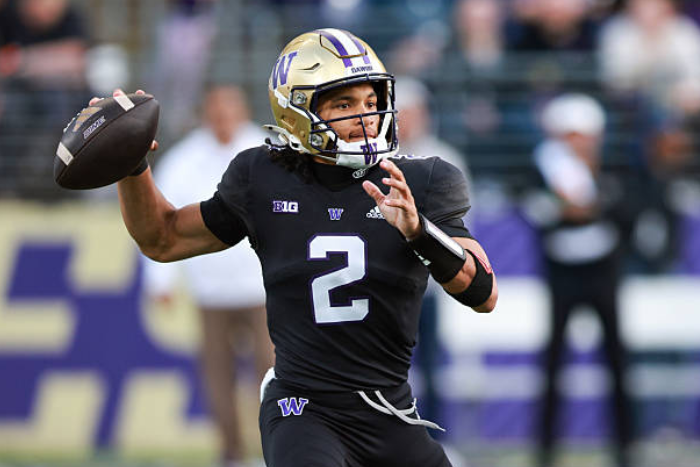
SEATTLE, Wash. — If Washington Huskies coach Jedd Fisch has made one thing clear during his year-plus on Montlake, it’s that he believes in starting quarterback Demond Williams Jr..
It’s critically important for him to be right about that.
College seasons and coaching careers have been advanced and derailed by the most important position in team sports. While Fisch appears on track to get many things right, none are more crucial than recruiting, developing, and properly unleashing the man taking snaps behind center. While some bumps in the road can be expected with a 19-year-old true sophomore starting this season, Fisch has not been shy about how much he believes in Williams.
Behind Williams, Fisch has a pair of transfers with starting experience and two true freshmen. Washington does not release an official depth chart in the spring, so the order below is based upon my observations of spring football practices.
Here’s a look at the quarterbacks coming out of spring ball:
Demond Williams Jr.
The short path to QB1 has been a windy one for Williams. Listed at 5-11, 190 pounds — though he said last month he’s closing in on 200 — the dual-threat true sophomore quarterback originally committed to Lane Kiffin at Ole Miss on December 22, 2022 before flipping to Fisch-coached Arizona on July 31, 2023 and signing a letter of intent in late 2023. When Jedd Fisch replaced Kalen DeBoer on January 14, 2024, it opened the door for Williams to follow him to Seattle.
DeBoer had nabbed Will Rogers out of the transfer portal to replace Michael Penix Jr., and the sixth-year senior from Mississippi State stuck around to play for Fisch. That didn’t prevent Fisch from finding a role for his prized freshman, however. Williams played in every game last year, and was often inserted into drives at — to the outside world, anyway — seemingly random times. Fisch referred to Williams as “the future face of the program” midseason and has indicated that he thinks Williams has a chance to get to New York at some point, insinuating eventual Heisman-finalist potential.
Williams started against Oregon in the 2024 regular-season finale, and then the Sun Bowl, finishing the season 82-of-105 (78 percent) passing for 955 yards, eight touchdowns, and one interception as a true freshman. He rushed for 282 yards, which was negatively impacted by losing 117 yards, much of which came from 21 sacks.
“There’s so much growth there, so much potential,” Fisch said on April 1. “There’s so much opportunity. His potential, you know, is great. It’s unbelievable.”
Williams possesses elite speed not just for a quarterback, but for any position. He’s not simply a one-read-and-run quarterback, though. He looks to pass first, and then takes off when other options appear to be exhausted. During spring ball, Williams showed a strong arm. He was relatively accurate on short passes, but seemed at times to sail the ball on intermediate throws and overthrow receivers on deep balls. Some of that can be attributed to working with many different receivers throughout spring. Likely starters Denzel Boston and Omari Evans missed most of the spring with injuries. Most of the other receivers are freshmen, meaning the connections have some room to grow.
Williams, like many athletic quarterbacks, gets into trouble behind the line of scrimmage, perhaps because of a gut feeling that there’s always a chance to escape. While UW’s offensive line wasn’t a strength, Rogers, who rushed for minus-395 yards during his college career, was sacked 18 times during a 311-attempt passing season, compared to Williams’ 21-105 ratio.
Holding the ball too long appeared to be an issue this spring as well. Williams, so far, has not been a “throw the receiver open” kind of passer, instead looking for receivers to have a couple of steps on defenders before he throws. Of course, there’s plenty of time for that to change as his comfort level with the offense and his targets grows. This is his first college offseason as “the guy.” He’ll continue to build rapport with his receivers over the summer and in fall camp. His continued development could well be the difference between a team that wins 6-7 games and one that approaches 10 victories and stays in the playoff conversation into November.
“We need to continue to improve the execution of our passing game,” Fisch said after the spring game, in which Williams completed 5-of-8 attempts for 41 yards. “It’s very difficult when Denzel wasn’t able to participate in the spring, when Omari was only able to participate in a week of spring, when Rashid [Williams] missed the last five practices of spring. Then you’re playing with four freshmen that you’re teaching offense to while you’re trying to go.”
Kai Horton
A fifth-year senior transfer from Tulane, Horton won the backup job as expected and started for the Gold team in the spring game. Horton appeared in 13 games for the Green Wave, compiling career stats of 64 completions in 123 attempts (52 percent) for six touchdowns and five picks. Horton is a contrast to Williams, in part because of his size (6-4, 220 pounds) and amount of time in college.
While Williams may have been overly cautious at times, Horton seemed to have no problems letting it fly during the spring. That was both good and bad, as he threw some interceptions throughout spring, including two during the spring game. Horton, though, provides some stability in an otherwise very young quarterback room. If Williams has to miss time this season, Horton seems capable of running the offense well enough to give the team a chance.
The rest of the depth chart is somewhat unclear, and likely to evolve during fall camp.
Dash Beierly
The true freshman from powerhouse Mater Dei (Santa Ana, Calif.) is considered a dual-threat quarterback who was rated on the higher end of the three-star range by 247Sports. At 6-1, 215, Beierly has a thick build and a strong arm. As should be expected, Beierly struggled at times in his first college practices. Barring significant injuries to UW’s quarterbacks, Beierly appears headed for a redshirt season. It will be interesting to see what the looks like in fall camp and how he develops during the 2026 offseason. He seems to have the physical tools to eventually start at the Power 4 conference level.
Treston “Kini” McMillan
Another true freshman, McMillan entered UW with slightly less fanfare than Beierly. Out of Mililan High School in Hawaii, the 6-0, 200-pound three-star recruit looked fearless during spring ball. He connected with fellow true freshman receiver Raiden Vines-Bright late in the spring game, helping Gold beat Purple. Though he through an interception, he found Vine-Bright for a 15-yard TD and a 35-yard completion. He also hit tight end Decker DeGraaf in the end zone, though DeGraaf was unable to hang on. The Beierly-McMillan battle will be one to watch in the spring. How long do one or both stick around behind Williams?
Shea Kuykendall
The 6-1, 203-pound junior, who started the final three games of a 2023 0-11 Northern Colorado season when former Husky Jacob Sirmon was injured, signed on with UW in the spring of 2024 when the Huskies had only two scholarship passers (Rogers and Williams). He did not see any action in 2024, and provides the Huskies with some much-needed experienced depth.