Adrift Mariners Suffer Steinbrenner Field Meltdown, Lose Rays Opener 10-2

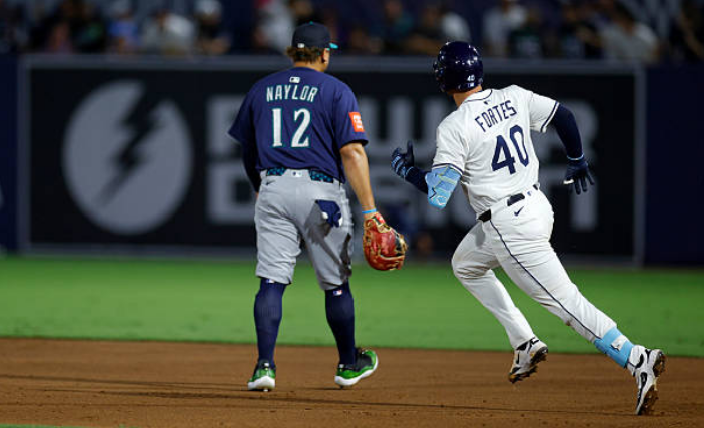
TAMPA, Fla. — Meaningful September baseball. It has been a few years since that phrase lost any magic in the Emerald City, which has traded the Bavasi-era bottom-feeders for the Dipoto-era doldrums (and that is an upgrade), sitting on the knife’s edge of the playoff race year after year, and more often than not, falling on the wrong side of that blade.
I’m pretty confident the team will repeat the near-misses of 2021, 2023, and 2024 in this campaign. It doesn’t matter that they have what should be their best lineup in a couple of decades — what should be a stellar rotation, and what should be a blowdown bullpen. Maybe it’s something with their mindset or, more likely, it’s something of random chance that our pattern-seeking brains assign our own meanings to. But their performance on the road will rapidly knock them out of the chase should they continue it any longer.
I digress. The only good thing about Monday for the M’s was Leo Rivas’ first big league bomb. Other than that, Seattle will be looking to have a short, short memory.
Castillo Clunker Sets Terrible Tone
Luis Castillo has been known as the Rock of the Mariners’ rotation, but just like the famous wrestler-turned-actor, he has recently suffered some heavy diminishing. In August, Castillo went 0-1 with a 6.66 ERA while opposing batters had a .327/.378/.663 slash line against him and an average exit velocity of 97.3 miles an hour.
That pattern continued on Monday evening in Florida, with Luis Castillo going four innings while giving up five runs. He got fairly lucky in his first inning and got lit up in the second and third before finally putting together a strong performance in the fourth — but by then it was too late, with the team down a half decade.
Any bad start by Luis Castillo usually follows the same script. He starts missing off the plate with his fastballs and doesn’t trust his slider lower in the zone, so he pumps some Taco Bell cheese sauce right down the pipe in an effort to sneak some strikes and the opposing batters have an all-you-can-eat buffet.
The bad stuff got started with one of the more consistent Seattle struggles: holding runners. It’s an element of defense that hasn’t been coming very well to Seattle in the past month. During August, Cal Raleigh threw out just 16.7% of all the runners that challenged his arm, compared to 25% through the end of July, and August’s trend continued into September as Raleigh sent a high and relatively slow throw to second on Jake Mangum’s successful second inning steal.
That came with two outs, after which Castillo walked Richie Palacios on four pitches and then went down 2-0 to Nick Fortes before leaving a fastball on the top edge of the zone but right over the plate.
The top edge is usually a good location, except for the fact that his previous six pitches were high misses. Pitching is about unpredictability, and when Castillo struggles, he becomes incredibly predictable.
The third inning wasn’t much better, as Castillo gave up three straight one-out hits. The first two were on fastballs out over the plate, but the third was a slider on the edge of the zone — yet Junior Caminero cracked it into the outfield all the same. At the very least, Raleigh gave his battery-mate some help by throwing Caminero out at second as he tried to take second on the throw to the plate.
Bats Morph Into Crickets
For eight innings, there was absolutely nothing across the board for the Seattle offense. As has been the case all season long, the team had issues hitting with runners in scoring position, going 1-7 in those situations. Really, there was even more opportunity than that statistic indicates, as Randy Arozarena led off the ballgame with a single and made it to second on his 25th stolen base, but got picked off about 10 seconds later. About nothing went right for Seattle after that moment.
A Eugenio Suárez one-out double in the second and two singles to open the sixth both provided good opportunities, but their common denominator was that they didn’t cross the plate. The team was rolling over on a lot of stuff, grounding into two double plays, and the stuff they hit in the air was too soft for anything to come of it — Rivas’ homer in the ninth was the first time a Mariner hit a ball in the air at 100 miles an hour or more of exit velocity. And the real kicker was that they were facing a starting pitcher who came into the game nursing a 5.19 ERA.
If hitting is contagious, then the Mariners’ offense is full of doctors.
Emerson Hancock Bullpen Experiment
One of the Mariners’ higher-end pitching prospects made his first big league bullpen stint on Monday night, but it didn’t really go as planned. His velocity was nearly three miles an hour faster than his season averages across the board, but he left a lot of stuff out over the middle of the plate.
He wasn’t helped by the defense, it must be said. J.P. Crawford olé’d an easy leadoff grounder to short and the error—plus another Ray who reached on a subsequent single—came around to score on Yandy Diaz’ one-out double.
But it’s still far too early to really judge how Emerson Hancock will do coming out of the ‘pen, and his struggles were on page eight of what went wrong for the Mariners in this one.
Leo Rivas Blasts First Big League Homer
It’s always a special moment when a guy whacks one over a big league fence for the first time in his career. Well, in this case, a minor league fence, but in a ballpark with the same dimensions as a major league one (Yankee Stadium).
With one out in the top of the ninth and Eugenio Suárez on second, Rivas—called up earlier that day due to the roster expansion—came in to pinch-hit for Jorge Polanco. With a 1-1 count, Brian Van Belle hung a slider right down the middle and Rivas didn’t miss it, hitting the ball 385 feet, well over the cozy wall in right center.
His two RBIs were the only production Seattle had on Monday and just about the only bright spot in an otherwise miserable day for the Mariners. Hopefully, it can provide something of a spark for the rest of the team in these last 24 contests.
Roadkill
The 2025 Seattle Mariners have been horrendous in second-half road games. Monday’s loss drops them to 6-14 in away games after the All-Star Break. It’s basically the only reason the Mariners are in this familiar situation, as if they had gone 10-10 in those games, they would be 77-61—which would put them in first place in the AL West!
Instead, they are 73-65, three games back of the Astros, but more importantly, three and a half back of both the Red Sox and Yankees (and therefore stuck in the third wild card) and fending off Royals and Rangers teams that are hot on their heels in the wild card chase.
Let’s do some projections. Assuming that the Royals, Rangers, and Astros all play to their Pythagorean win-loss percentage over the rest of the season (that is to say, using their run differentials as the guide), the Royals would be projected to go 82-80 (12-13 over the rest of the year), the Rangers 85-77 (13-10 over the rest of the year), and the Astros 88-74 (12-12 over the rest of the year).
Since the Mariners have the tiebreaker over the Rangers, that means that (given the teams all follow their Pythagorean expectations from here on out), the M’s would need to go 85-77 for the full year—in other words, simply go 12-12.
The Mariners have 11 more road games for the 2025 season. If they continue to win around 30 percent of their road games and go 3-8, they would have to have a 9-4 record at home to reach the 85-win mark.
And that’s not even factoring in a (in my view likely) Rangers overperformance. I’m personally expecting the Rangers to go 87-75, which would force the Mariners to go 14-10 over the rest of the year or miss the playoffs entirely.
They have to win these road games.