2026 NFL Draft: Best Players Available for Seahawks Entering Day 2

While the Seattle Seahawks weren’t able to trade down as they hoped to recoup an additional draft pick or two in Thursday’s opening round of the 2026 NFL Draft, general manager John Schneider landed one of his preferred prospects to fill a major need at pick No. 32, nabbing explosive Notre Dame running back Jadarian Price as a natural replacement for Ken Walker III in the backfield.
Since Seattle didn’t manage to find a trade partner to move down, Schneider currently has only three more draft choices at his disposal, but two of those (No. 64, No. 96) are slated for Day 2. That’s great news in a draft class that features underwhelming depth overall, as the majority of their selections land in the sweet spot to find starter-caliber talent in the second and third round.
All options will be on the table for Schneider and company, as he likely will continue to seek out trade down possibilities with hopes of adding another pick on Day 3, where the Seahawks currently have just one pick (No. 188) in the sixth round. But staying put and choosing quality over quantity may be the best strategy for the defending champions at this point, especially with a handful of projected first rounders remaining available going into Friday.
Which prospects stand out as the best available targets for the Seahawks heading into Day 2 in Pittsburgh? Here are my top 41 remaining players at positions of need for Seattle:
- (19) Jermod McCoy, CB, Tennessee - Medicals will be worth keeping an eye on after McCoy missed all of last season recovering from a torn ACL, as recent reports suggest he may need a cleanup procedure that puts his 2026 season in potential jeopardy, which would be a primary reason why he still remains on the board and didn’t hear his name called in the first round as expected. But if he’s deemed healthy, or a team decides to take a flier on his immense talent under the pretense he may miss time as a rookie, after picking off six passes in two collegiate seasons, his ball production and ability to create turnovers in bunches coupled with untapped upside still could yield a future star in the secondary.
- (21) Kayden McDonald, DT, Ohio State - Pass rushing sells, and Macdonald didn’t offer a ton of value on that front, though he did turn limited pressure into three sacks. However, at 326 pounds, he served as an immovable object against the run with plenty of disruptive ability in the interior, amassing 65 tackles and nine tackles for loss. Teams had to account for his penchant for creating chaos in the trenches, often resorting to combo blocks to try and neutralize him. Capable of holding up against double teams as well as penetrating gaps quickly to wreak havoc in the backfield from both nose tackle and 3-tech roles, he will provide immediate contributions as an early down run stuffing force with room to grow into a more well-rounded three-down stud.
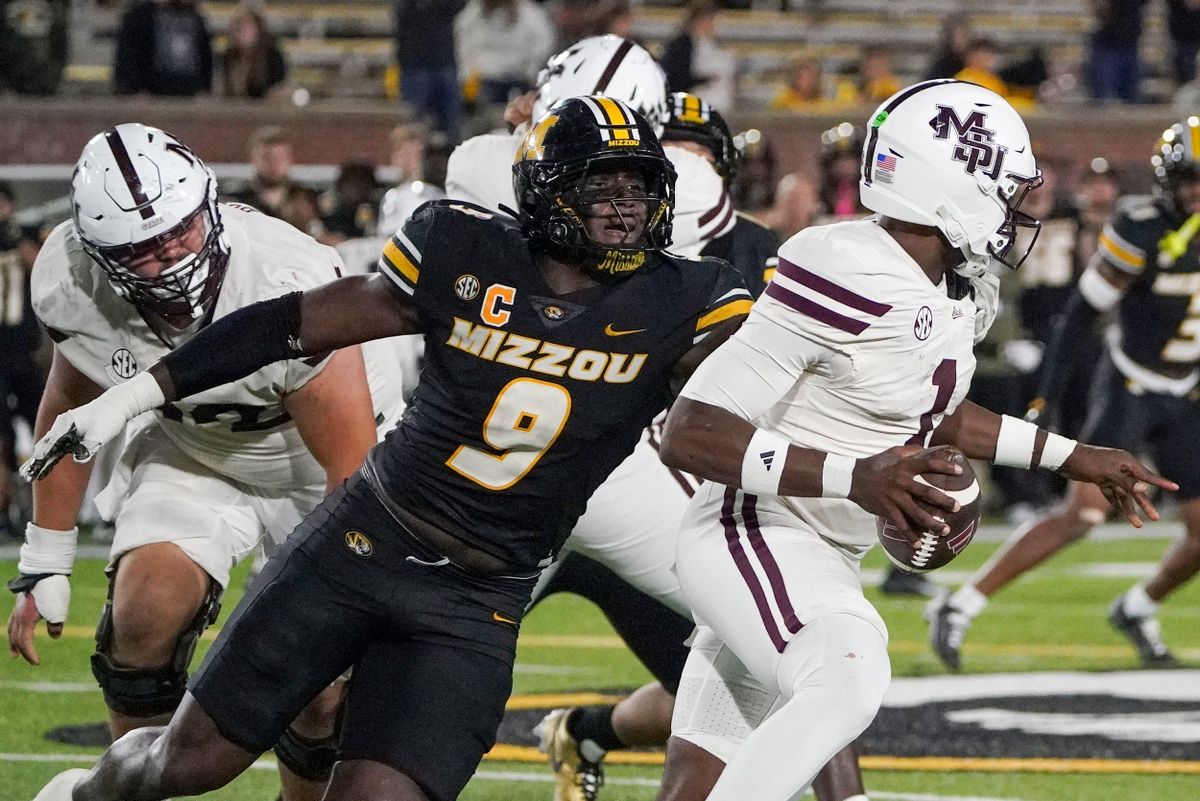
- (26) Zion Young, EDGE, Missouri - Checking off every measurable box, Young stands 6-6 with a muscular 262-pound frame and 33-inch arms, and he utilizes those physical tools exceptionally well. As a run defender, his length and physicality can overwhelm blockers, while he’s capable of threatening the edge of tackles as a rusher with the ability to transfer quickly into a bull rush or a hard slant inside to harass quarterbacks. If he can improve his success getting off of blocks when his initial rush is stymied and develop a few reliable counter moves, even with a modest athletic profile, his best football likely remains in front of him.
- (27) Christen Miller, DT, Georgia - The latest in a long line of Bulldogs defensive tackles with first round talent, Miller shines brightest as a one-gapping penetrator capable of finishing splash plays in the backfield and offering plus-lateral movement to make tackles along the line of scrimmage. While he has been susceptible to getting overwhelmed by double teams, he demonstrated improvement in that regard late in his college career and he has enough upper body power coupled with sound technique to be able to stack and shed as a two-gapper when called upon. Turning his athletic juice into more pass rushing production will be the key to unlocking his full potential, but he should be an early starting option for a team running even fronts with some positional flexibility.
- (28) Colton Hood, CB, Tennessee - An outstanding athlete with legit 4.4 speed, Hood rarely was beaten downfield in coverage at three different programs in three seasons, regularly hauled in jump balls, and improved significantly as a run defender during his collegiate journey, offering a well-rounded game that still has plenty of room for polish. That lack of stability and occasional issues with rigidness out of his breaks may have contributed to him not being selected in the first 32 picks, but he’s one of the youngest prospects in this class and his potential remains incredibly high in the right system, making him a likely early Day 2 target.
- (34) Emmanuel Pregnon, G, Oregon - While Pregnon isn’t the most athletic guard in this year’s class and struggles at times getting to the second level off along with getting beat by quick counters, he’s more agile than advertised in the zone blocking game and takes stellar angles to his targets, finishing blocks with authority and a nasty edge. Hand usage stands out as a major plus in his all-around game as a punishing run blocker and an unyielding pass protector, as he regularly delivers heavy blows with massive paws to opponents square in the chest and once he gets his mitts onto a target, they won’t be getting away from him as he stays locked on.
- (36) Brandon Cisse, CB, South Carolina - Lack of ball production with just two interceptions in three college seasons will be questioned and certainly had something to do with him not being a first round selection, but Cisse plays with the ferocity and attitude teams covet on the outside as a boundary cornerback. Even without flashy interception totals, he allowed just a 51% completion rate in coverage and consistently tackled well, signs he will be able to excel as a pro. Teams early in the second round seeking a quality outside corner who will cover and stick his head into the fight against the run should find great value with him.
- (37) Emmanuel McNeil-Warren, S, Toledo - A 6-3 mercenary for hire in the box, McNeil-Warren isn’t quite on par with current Seahawks star Nick Emmanwori athleticism-wise and has some rigidity with movements in coverage, but he offers similarly tantalizing versatility playing in the box or as a deep safety with rare size and physical tools to move around the formation as a chess piece. Along with having solid ball production for the Rockets (five picks, 11 pass breakups), he’s also a dangerous blitzing threat who matches up well against tight ends given his rare length and has the attitude to mix it up in the trenches that few other safeties possess.
- (38) D’Angelo Ponds, CB, Indiana - Listed at just 5-10, Ponds doesn’t have size working in his favor and that undoubtedly knocked him out of the first round discussion despite being an All-American talent for the Hoosiers, but no corner brings more dog to the fight in this class. Along with excellent ball tracking skills, he’s a highly instinctive player who reads quarterbacks like a book, possesses rare leaping ability to hang with much bigger receivers on contested throws, and brings his hard hat as a tackler. Measurables become less of a factor as the draft proceeds into Day 2 and it would be a surprise if he doesn’t hear his name called at some point in the second round.
- (39) Gabe Jacas, EDGE, Illinois - Offering plus size at 6-4, 260 pounds with 33-inch arms, Jacas doesn’t win with elaborate counter moves and he’s a bit rigid athletically, not offering the twitch of some of the EDGE prospects ahead of him on this list. But he constantly bullied the Big Ten’s best with impressive lower body power, jarring hands, and a relentless bull rush, tallying 11 sacks and 13.5 sacks as a senior, and he excels at punching the ball out of the hand of quarterbacks once he gets to them. He’s also a stout edge setter who executes well with his length at the point of attack to shed blocks and make plays, fitting the bill of a fringe first-round talent.
- (42) Avieon Terrell, CB, Clemson - A peanut punching demon, Terrell has some Byron Maxwell in his game forcing fumbles from careless receivers, and he’s been consistent generating pass breakups in coverage as well. His lack of long speed stands out as a potential concern against NFL talent, however, and running in the 4.5s in the 40-yard dash didn’t do anything to squelch those concerns. He may need to be in a more zone-heavy scheme to maximize his strengths as a pro, putting a cap on the number of teams that may be interested in him. Still, he should be in line to go in the first 15-20 picks on Day 2.
- (43) Chase Bisontis, G, Texas A&M - A rare athlete for the position with five-star recruit pedigree, Bisontis may be the best zone blocking prospect in this year’s draft class, blending heavy hands with fluid mobility and lateral quickness to effectively strike targets in space. Lack of length with 31 3/4-inch arms will occasionally create problems for him dealing with NFL power and being able to sustain blocks, particularly in the run game, but his physicality, toughness, and elite athletic traits should help mitigate the impact of that deficiency as a Day 1 starter with Pro Bowl and potentially All-Pro potential in the right scheme.
- (44) Lee Hunter, DT, Texas Tech - Testing-wise, Hunter didn’t do himself any favors in the pre-draft process with a poor combine workout, but teams leaning too heavily on those numbers will be missing out on a ferocious nose tackle with plenty of disruptive talent between the lines. While he won’t shoot into the backfield as a quick gap striker, he’s a real problem physically at the point of attack, as he regularly rag-dolled blockers off the snap and shed them to make tackles for loss in bunches. He’s also a feisty bull rusher who compensates for subpar athleticism with raw power and tenacity to shrink pockets, though he may not get a lot of opportunities to do that at the next level.
- (45) AJ Haulcy, S, LSU - Bringing a well-built 215-pound frame to the field, Haulcy has a vintage style, as he loves to dish out the punishment to receivers who dare trying to make a catch over the middle and though his fundamentals can slip away from him outside of the box in pursuit, he more than happily will throw his helmet into the ring to make big hits in the run game and can play some snaps up around the line of scrimmage. He has a knack for undercutting throws and excels at not only breaking up passes, but picking them off like a receiver. Average athletic traits may limit him to two-high usage, but he still has standout starter tools.
- (48) TJ Parker, EDGE, Clemson - A powerful, well-built edge rusher at 6-4, 263 pounds, Parker looked to be on the verge of being a top-10 pick after recording 11.0 sacks and 19.5 tackles for loss in 2024. His production in 2025 sank, which could be viewed as regression to the mean with a pass rushing pallet that lacks quality counters when the initial move doesn’t hit at the top of his rush. With that said, he has an excellent long arm move and he’s a smooth operating crashing inside on stunts while also being a reliable run defender who uses his hands well against blocks, having more than enough tools to become a quality starter in 4-3 or 3-4 schemes.
- (51) Keith Abney II, CB, Arizona State - Making significant improvements in three years in Tempe, Abney brings a blue collar attitude and plenty of quicks that could help him land playing time early on the boundary or in the slot, offering the type of versatility that few corners in this class can boast. He will have some adjustments to make defending NFL speed downfield and continued refinement working off press will be key to his development in the league, but for teams that want to add a physical presence to their secondary who has inside/outside flexibility, he will be a top target to come off the board in quick fashion in Day 2.
- (55) Treydan Stukes, CB/S, Arizona - Rebounding from a torn ACL with a phenomenal super senior season for the Wildcats, Stukes didn’t allow any touchdowns while picking off four passes and producing six pass breakups as a hybrid slot cornerback/safety, showcasing elite instincts and ball skills. Set to turn 25 as a rookie, he has a narrow lower body and a lengthy durability history to go with it, including a torn ACL in 2024, along with being an inconsistent tackler who at times relies on diving at ball carriers rather than wrapping up, but offers legit 4.3 wheels and the type of ball production that will entice teams in the need for a cover safety with slot flexibility.
- (57) Cashius Howell, EDGE, Texas A&M - Playing under 250 pounds for most of his college career, Howell’s run defense has been suspect at times with opposing blockers able to bully him while trying to set the edge. But surprisingly, he’s had success both with his hand in the dirt and standing up in wide-9 alignment, showcasing more potential scheme versatility than expected at his size. He’s a bendy, explosive upfield rusher with a dynamic spin move that can twist tackles into knots and while he will not be the perfect fit for every team, his immense pass rushing production and penetrating skills against the run should translate early at the next level.
- (58) Jalon Kilgore, S, South Carolina - Possessing good size at 200-plus pounds with 4.4 speed, Kilgore is versatile playmaker who has prior experience at both safety positions as well as playing in the slot, offering quality ball skills with eight picks in three years against SEC competition. Though he has been prone to miss an arm tackle attempt from time to time, he loves to mix it up against the run and has enough athletic juice to be able to handle smaller receivers out of the slot as well as playing single and two-high safety looks. Finding his position at the next level will be key, but he has plenty of systematic flexibility to fit in with most teams.
- (60) R Mason Thomas, EDGE, Oklahoma - Weighing barely a Big Mac above 240 pounds with 31-inch arms, Mason Thomas looks more like an off ball linebacker than an NFL edge with a lean, sawed-off frame, leaving limited room for further growth without compensating his best assets in the speed and quickness department. However, there are plenty of sub-245 pound rushers who have found success in the league, and he has a motor that runs non-stop. His experience dropping back into coverage to pair with his explosive athleticism as a dangerous one-on-one pass rushing threat should secure him a Day 2 selection, even if he’s not a three-down player early.
- (62) Julian Neal, CB, Arkansas - Turning into a viable NFL prospect with the Razorbacks after starting his career at Fresno State, Neal has elite size (6-2, 203) and consistently played the run well in college, which will improve his stock with plenty of teams. But average agility may make it essential for him to be in a zone-centric scheme early on, casting some system limitations in terms of potential suitors, with lots of growth needed technique-wise when manned up on faster wideouts. He has clear Day 2 traits, but players like Hood and Terrell falling out of the first round may push him into the third round in one of the deeper position groups in this class.
- (63) Derrick Moore, EDGE, Michigan - Measuring in at 6-3, 254 pounds, Moore has adequate size and athleticism to play defensive end with his hand in the dirt or outside linebacker in a two-point stance. His run defense has been inconsistent, as he doesn’t always have a quick read on when to shed blocks and rally to a ball carrier. But his pass rushing talents have been evident on a persistent basis the past two years, starting with a powerful bull rush that left many Big Ten tackles plowed into the pocket. He’s an excellent closer once he collapses on quarterbacks and has a nice bag of counters to work with, which should bode well for his future in the league.
- (65) Gennings Dunker, G, Iowa - A tackle for the Hawkeyes, Dunker’s average at best athletic profile will force him inside to guard at the next level and even with that adaption, his best fit may a system leaning more on gap schemes where he can rely on his power and feistiness as an unrelenting drive blocker. Still, his edgy temperament and propensity for driving opponents into the turf to finish blocks will endear him to teams running all types of offensive systems and he gets the most out of his ability in pass protection, making him a prime candidate to come off the board in the middle of Day 2 with early starting upside.
- (67) Keionte Scott, CB/S, Miami - Though under 200 pounds, Scott resembles a much bigger linebacker in the spirit of his play, as he relishes the chances to dish out some licks on running backs and craves the opportunity to blitz quarterbacks, excelling in both aspects of his game. He isn’t a ball hawk and has struggled when put in a position where he can’t play downhill to maximize his aggressive tendencies, which casts questions about his viability as a deep safety option. But he has enough quickness to perform his duties in coverage as a two-way slot and his pass rushing chops add another dimension that teams will covet.
- (68) Dani Dennis-Sutton, EDGE, Penn State - Dennis-Sutton has long been a ballyhooed prospect due to his tantalizing blend of size and athleticism, demonstrating the ability to dominate tackles with his length and power in spurts while producing 8.5 sacks each of the past two seasons. When he isn’t playing too upright, he also can be a force setting a firm edge and plays with more than enough physicality to hold up in that regard. But he has some limitations, as he can struggle with the leverage battle in the trenches and doesn’t always play to the speed/explosiveness of his athletic testing. Still, he should be bookmarked for Day 2 with three-down starter potential.
- (70) Charles Demmings, CB, Stephen F. Austin - One of the brightest stars at the FCS level with elite athletic traits, Demmings emerged as a dynamic force on the boundary, blanketing receivers to under a 45% completion rate. There will be growing pains covering NFL receivers and run defense in general will be a work in progress with his tackling proficiency being up and down for the Lumberjacks, but he showed he has immense potential in the right environment by holding his own at the Senior Bowl against FBS talent. Teams start to take swings on lower level prospects with tools in the middle rounds and the early third seems like his sweet spot.
- (72) Gracen Halton, DT, Oklahoma - On the smaller end of the spectrum at 293 pounds with sub-32-inch arms, Halton has size and length working against him as he comes into the pros, but he has elite athletic juice and explosiveness that will be a problem for interior blockers at the next level. Though he won’t be able to avoid occasionally getting knocked around in the run game due to lack of strength, his quickness should mitigate that in the right scheme where he’s allowed to threaten guards and tackles as a slippery one-gap merchant either at 3-tech or 5-tech alignments with passing down nose flexibility. In such an environment, he has the tools to be a nuisance for opponents with as much pass rushing upside as any interior defender in this class.
- (74) Genesis Smith, S, Arizona - Far more effective on the back end when he can bait signal callers into bad decisions and break on routes to make plays on the football rather than playing up in the box, where shoddy tackling has been his biggest detriment at the college level, Smith likely will be earmarked for the vast majority of his reps as a single or two-deep safety to allow him to roam center field as a magnet. But even if he doesn’t check off the versatility box quite like other top safeties in this class, his elite penchant for creating turnovers will appeal to many teams and should allow him to carve out a long career in the league.
- (75) Will Lee III, CB, Texas A&M - A 6-1 corner with plus-length and long strides, Lee checks off many of the measurable boxes and has excelled in both zone and man schemes for the Aggies against SEC competition, finding his way to get his hands on pass breakups in bunches. It may be tricky for him to deal with NFL speed without safety support, as he doesn’t have the juice to be able to recover if a receiver shoots past him on vertical routes, and tackling technique will have to be shored up to reach his ceiling as a potential starter. There’s plenty of tools to work with in the right system fit, however, and he could go in the late second to mid-third round.
- (78) Kamari Ramsey, S, USC - Ramsey has durability concerns coming into the league after missing multiple games in three seasons at the college level and his play can be borderline frustrating at times with missed tackles and inconsistent ball tracking in coverage continuing to crop up on his film. But he has shown the ability to play both safety spots as well as the nickel role and possesses enough size, athleticism, and football smarts to suggest he can do that in the NFL as well. With more seasoning and development under the right coaching staff to clean up his fixable issues, he has a chance to be a better pro player than college.
- (80) Davidson Igbinosun, CB, Ohio State - Racking up 18 penalties in the past two seasons, Igbinosun tends to get grabby at the top of routes to compensate for lack of elite change of direction and must clean up that part of his game to succeed in the NFL, where the yellow flags will fly relentlessly without technical refinement and more disciplined play in general. But he rarely gave up big plays on the back end for the Buckeyes and yielded just one touchdown in that span with plus-ball production and strong tackling efforts, having all the prerequisite skills to be a quality starting corner for a long time in the league as a second/third round prospect.
- (82) Bud Clark, S, TCU - Durability loomed as a major obstacle for Clark with the Horned Frogs, but once he got healthy, he created persistent havoc as a ball-hawking maestro with freelancing capabilities to undercut passing lanes for interceptions and pass breakups in bunches. His aggressiveness and assertiveness in coverage can occasionally get him in trouble against double moves and if he misreads a route, but his ball savvy wins far more times than not. His tackling improved significantly over his final two years at TCU, though a prospective team will have to be prepared for some whiffs from time to time from the slender defender.
- (83) Joshua Josephs, EDGE, Tennessee - Weighing in at just 242 pounds, Josephs can be bullied around a bit in the run game, though he does a fine job running down plays in pursuit and effort isn’t an issue in that aspect of his game. He didn’t produce near as many sacks and quarterback hits as the Volunteers would have liked the past few years, but he regularly turns up the heat pressure-wise on signal callers and has enough counter moves in his arsenal rushing the passer to believe that with more time in the weight room to add muscle to go with his length, he could become a quality three-down player in the league.
- (86) Malik Muhammad, CB, Texas - With a slender 6-0, 182-pound frame and a high cut proportion, Muhammad can struggle with bigger, stronger receivers on the outside and his tackling has been up and down throughout his college career, which could necessitate a slide to the slot in the NFL for some teams depending on scheme. With that said, some teams will still see value in him as a boundary defender who can handle NFL speed and he has all the athletic tools to be able to successfully make the transition inside and break up passes from two-way go situations, adding value as a Day 2 target who could go anywhere from the late second round into the third.
- (87) Domonique Orange, DT, Iowa State - Fitting the classic mold of early down enforcer who dominates against the run, the 322-pound “Big Orange” eats up blocks at the line of scrimmage and has surprising quickness and agility, which can make him tricky to execute reach blocks against and thus blow up zone runs before they even get started. He has nearly 34-inch arms and uses that length well with powerful initial pops, extension, and shedding of blockers, allowing him to excel as a two-gapper. He’ll mix in a quality swim and spin move to help split gaps, though those tools haven’t translated to much effectiveness as a pass rusher, which is his biggest flaw as a one-dimensional prospect.
- (89) Kaleb Proctor, DT, SE Louisiana State - Weighing just 292 pounds, Proctor lacks the girth and lower body anchor to play nose tackle at the next level and unless he adds some weight to his frame, his value on early downs will be limited in certain schemes. But that concern could become a non-factor because of his ridiculous first step and explosiveness attacking gaps to blow past blockers before they can get their hands on him, allowing him to be incredibly disruptive stymying the run and regularly harassing quarterbacks in the pocket. He will need to be given as many one-gap opportunities as possible to use his athletic gifts to test the edges of opposing blockers, particularly early on.
- (90) Tacario Davis, CB, Washington - Arguably the best size comp in this class to Riq Woolen with durability questions clouding his overall upside after missing quite a few games for the Huskies last season, Davis has rare length at 6-4 that allows him to close passing windows with ease and tested better than expected at the combine. While he surrendered a handful of big plays to speedy receivers at Arizona and Washington, he only gave up one touchdown in coverage his final two seasons. He’s also a willing, effective tackler who will pitch in against the run, posting an impressive 6% missed tackle rate in four collegiate seasons. As long as he can stay healthy, there’s starter talent in him as a mid-Day 2 candidate.
- (92) Beau Stephens, G, Iowa - A technician when it comes to working angles in the zone blocking game, Stephens aces at getting to a target and winning the position battle against opponents. In pass protection, he uses his hands well in conjunction with his footwork to keep defenders from getting past him, not panicking if he loses early and demonstrating a penchant for recovering to keep the quarterback clean. Projecting to the pros, length concerns remain significant with 31-inch arms, as more athletic NFL interior defenders will put that lack of reach to the ultimate test, but his savvy and fundamentals project him as a quality starter in the right scheme.
- (97) Jaishawn Barham, EDGE, Michigan - Formerly an off-ball linebacker for the Wolverines, Barham hasn’t had a ton of reps rushing off the edge and he won as a rusher primarily with athleticism at the college level, but his burst, hand usage, and motor shine as NFL-caliber traits to work with. At this stage of his development, he’s a chess piece who can shed blocks from both the inside as an off-ball defender or off tackle, but he’s largely a novice when it comes to technical aspects of the game. He has a long way to go learning how to set a firm edge and being a threat beyond his speed as a rusher, but his effort should inspire hope he grows quickly in the right setting.
- (99) Fernando Carmona Jr., G, Arkansas - A converted tackle, Carmona’s accuracy firing his hands at the point of attack leaves room to be desired, as he has a tendency for his hands to leak out wide, can be susceptible to power, and has had issues with holding penalties in the past. But he’s a springy mover whose background as a fleet-footed left tackle became a major asset in the zone run game for the Razorbacks, evidenced by his stellar 76.8 zone run blocking grade from Pro Football Focus, and that mobility shows up more times than not mirroring opponents in pass protection with nimble footwork as he allowed only one sack last season.
- (100) Wesley Williams, EDGE, Duke - Tenacity is the name of the game for Williams, who compensates for average at best athleticism with a relentless motor that never seems to run low on fumes and stellar technique aided by a boxy frame that allows him to regularly win the leverage fight. His sack production dipped substantially in his final year with the Blue Devils and he may not have enough juice to win quickly at the next level, but his Energizer bunny mentality should continue to create effort production for him that many other players don’t attain. A true blue collar fighter who could play some inside on passing downs, he has a great chance to out play his draft position.